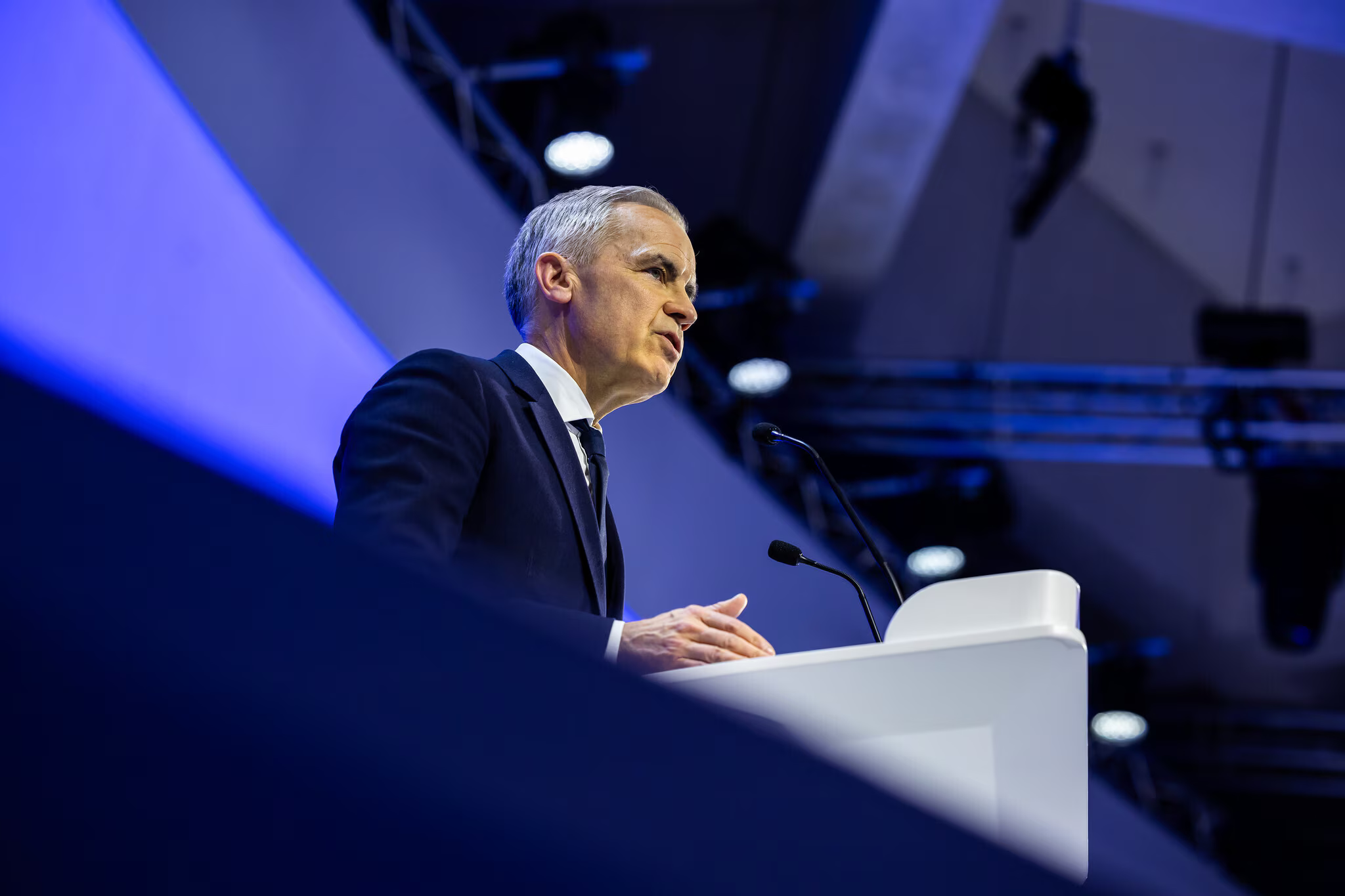
Mark Carney delivering his “Middle Powers” address at the World Economic Forum.
A surprising convergence of strategic thought between the Canadian Prime Minister and the Great Helmsman.
When Mark Carney took the podium at the World Economic Forum last week, the audience settled in for the usual bromides on sustainable finance and carbon pricing. Instead, the Canadian Prime Minister delivered a thunderous call for “middle powers” to unite against the caprice and bullying of superpowers. It was a speech that would have warmed the heart of a strategist from a very different era and climate: Mao Zedong.
To the untrained ear, Mr Carney’s doctrine sounds like standard multilateralism. But examine the geopolitical architecture he is proposing, and the ghost of the Chairman appears in the Swiss Alps. Fifty years ago, Mao’s strategic calculus broke the Cold War deadlock, indirectly precipitating the fall of the Soviet Union. Today, Mr Carney appears to be borrowing the Great Helmsman’s playbook.
The Theory of Three
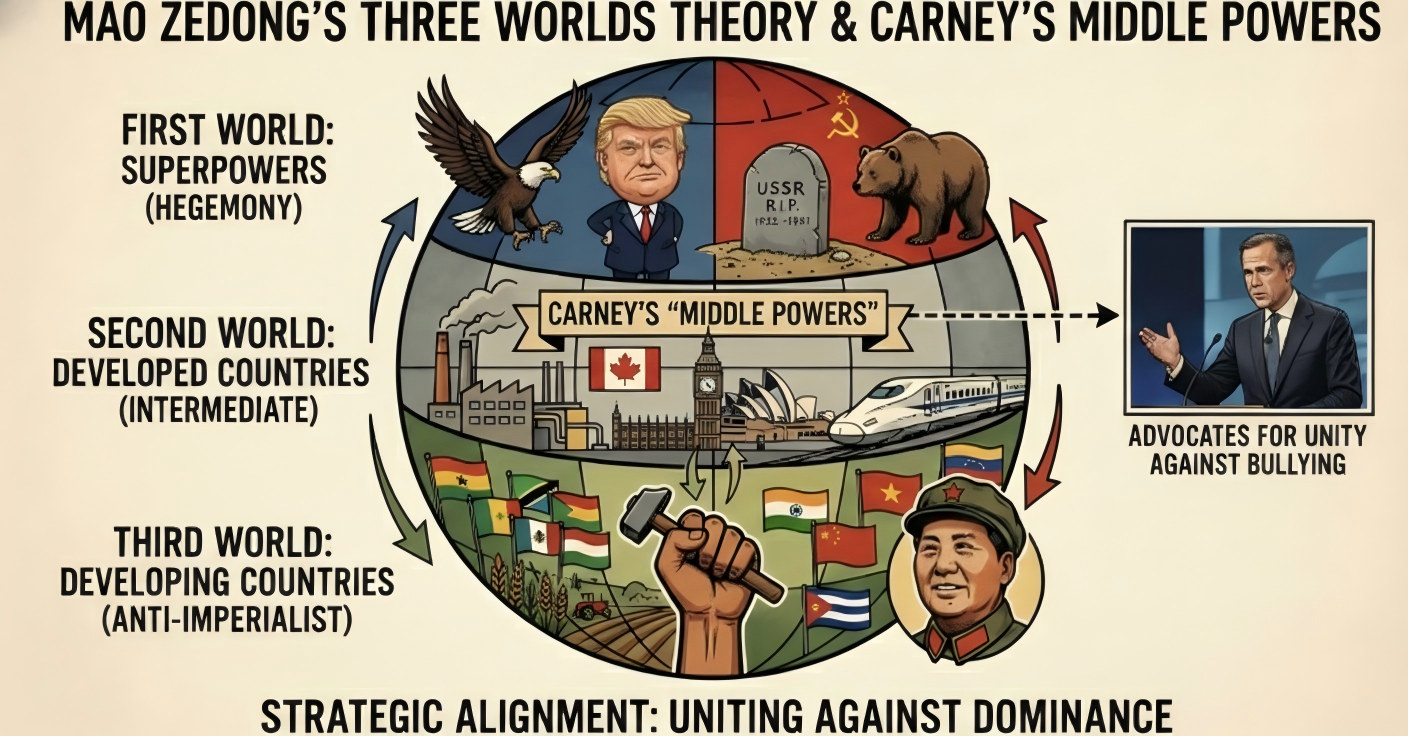
Strategic Alignment: Mao’s “Three Worlds” vs. Carney’s “Middle Powers”.
To understand the parallel, one must look back to the Cold War’s taxonomy. Since 1952, the world had accepted the French demographer Alfred Sauvy’s “Three Worlds” theory: the capitalist First World, the socialist Second World, and the non-aligned Third World. It was a static, binary struggle. But by the early 1970s, facing a hostile Soviet Union, Mao quietly redrew the map.
In Mao’s revised “Three Worlds Theory”—formally presented by Deng Xiaoping at the UN in 1974—ideology was secondary to power. The “First World” consisted solely of the two superpowers, the US and the USSR. They were, in Mao’s view, imperialist predators, inherently untrustworthy and driven by a lust for hegemony. The “Second World” comprised industrialised nations like Canada, Britain, and Japan—countries that, while wealthy, were bullied by the superpowers and were thus potential partners. The “Third World” included China and the developing nations of Asia, Africa, and Latin America.
Mao’s genius lay in the flexibility of this worldview. It allowed a communist China to tactically align with the imperialist United States to counter the immediate, existential threat of the Soviet Union. Yet, Mao never harboured illusions of a permanent alliance; superpowers, by his definition, were to be used, not trusted.
The Northern Pivot
Mr Carney finds himself in a strikingly similar predicament. He leads a vast, resource-rich nation living in the shadow of a superpower that was once “brotherly” but is increasingly viewed as predatory. For decades, Ottawa has watched its southern neighbour strangle Canadian innovation in the cradle—from the cancellation of the Avro Arrow interceptor to the slow death of Nortel Networks. In the Carney doctrine, the United States is the dangerous hegemon of the First World.
Consequently, Mr Carney’s pivot toward cooperation with China—ironically labeled Canada’s “biggest security threat”—is pure Maoist Realpolitik. Just as Mao allied with a capitalist foe to check a socialist brother, Carney is courting a systemic rival to balance a domineering ally.
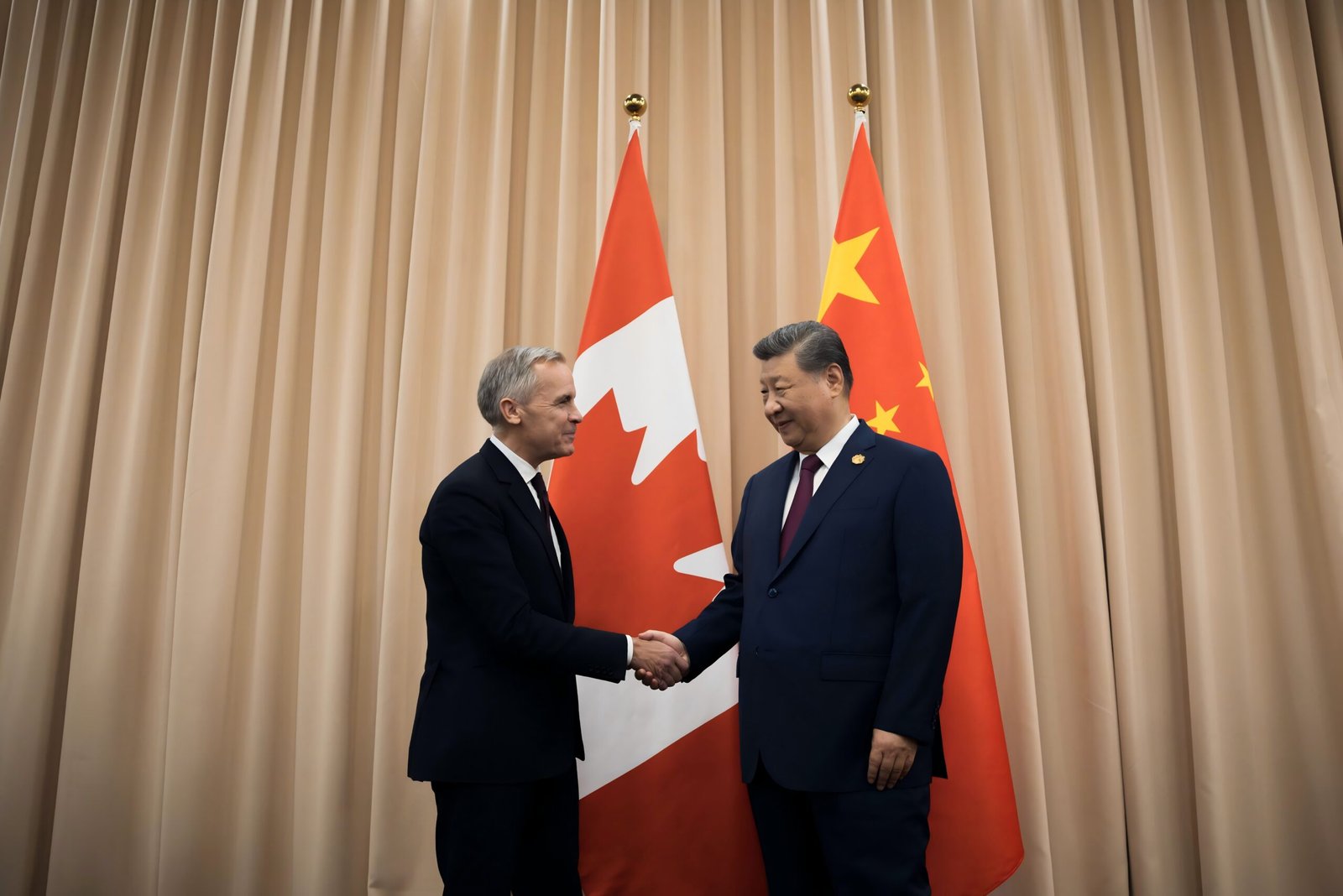
A new United Front? Carney meets Xi in Beijing.
The timing is conspicuous. Mr Carney’s Davos address followed a meeting in Beijing with President Xi Jinping. Mr Xi, a student of history, has faithfully preserved Mao’s strategic framework (along with the expansionist restraint practiced by Deng Xiaoping, Jiang Zemin, and Hu Jintao). If China (Third World) and Canada (Second World) agree that the superpower (First World) is the problem, the diplomatic logic for cooperation is robust.
The Price of Admission
However, if Mr Carney is serious about this new architecture, he would do well to study the receipt. Mao’s “Three Worlds” strategy was not merely a rhetorical construct; it was built on decades of transactional generosity.
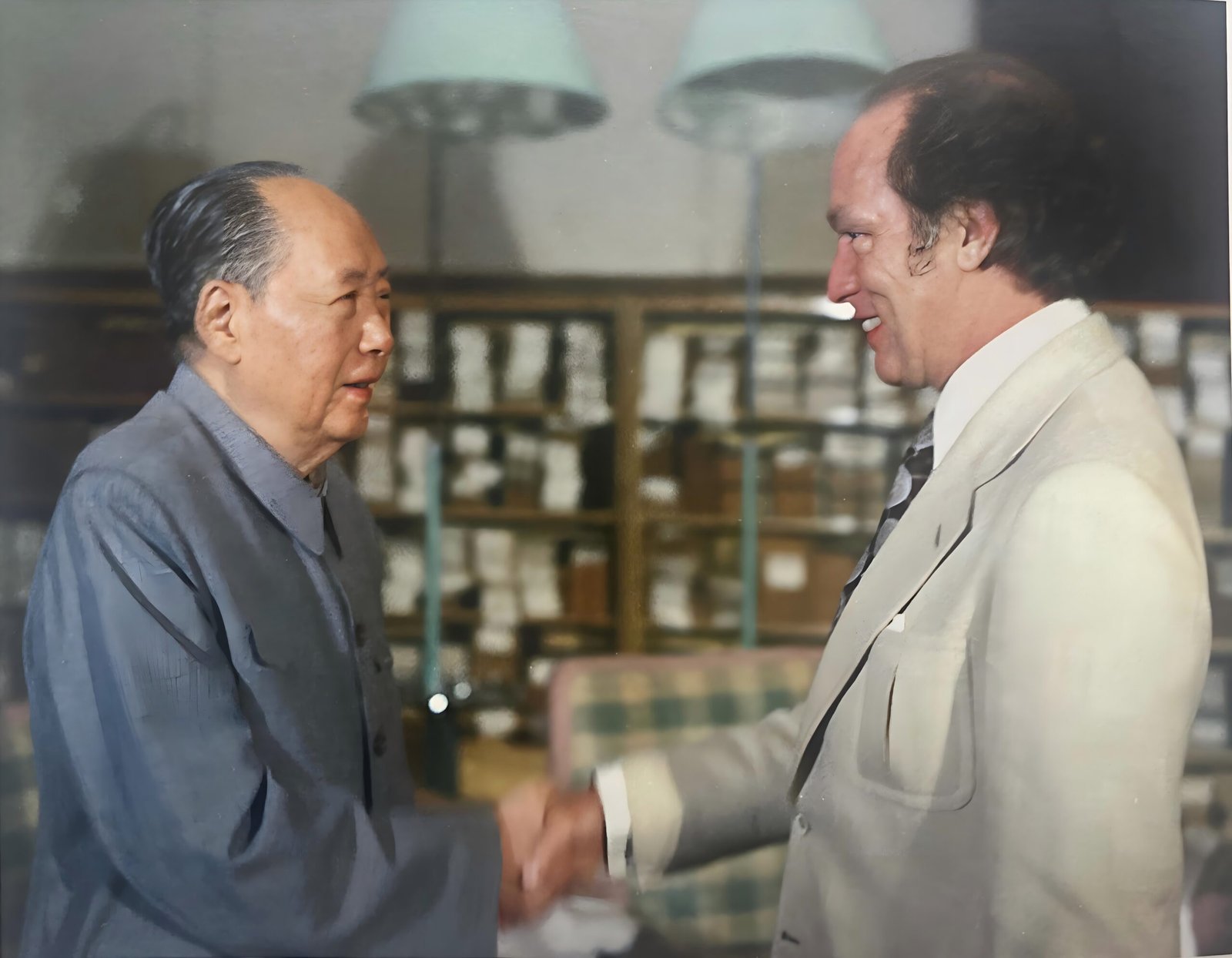
Historical precedent: Mao Zedong welcomes Pierre Trudeau, a leader of the “Second World”.
Consider the Tanzam Railway. In the 1970s, when China’s own economy was sputtering, Beijing poured hundreds of millions of dollars and sent thousands of engineers to build a railway linking Tanzania and Zambia. It was an exorbitant expense for a poor nation. Yet, for Mao, this was not charity; it was a down payment on legitimacy.
The dividend arrived on October 25th, 1971. Resolution 2758, which restored the People’s Republic of China’s lawful seat at the United Nations, was not merely a gift from the Nixon-Kissinger détente. It was the “African brothers,” as Mao later quipped, who “carried us into the United Nations.” That victory was the tripartite synthesis in motion: it required the massed votes of the Third World (bought with aid), the tactical neutrality of the Second World (the “benevolent” middle powers), and the strategic paralysis of the First World.
The lesson is stark. Building a coalition of the “middle” against the “mighty” is a noble ambition, but influence is rarely free. Mao paid for his coalition in steel and concrete. One wonders what currency the Canadian Prime Minister intends to use.
The Hegemon Who Wasn’t There
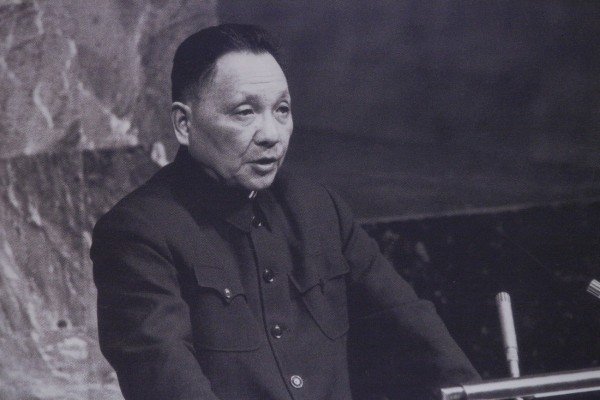
“China is not a superpower”: Deng Xiaoping addressing the UN General Assembly, 1974.
There is also a subtle but vital distinction in ambition. While Mr Carney seems eager to audition for the role of captain of the “Second World,” China’s leaders have spent half a century meticulously avoiding the title of “Third World” leader.
In his 1974 speech, Deng Xiaoping was emphatic. “China is not a superpower, nor will she ever seek to be one,” he declared. He even issued a poisoned pill for future leaders: if China ever acted like a superpower, the world should “expose it, oppose it and work together… to overthrow it.” This performative humility allowed Beijing to be the heavyweight in the room without carrying the baggage of the hegemon.
Mr Carney displays no such reticence. His Davos address was a job application. The Second World—that loose gaggle of democracies including Britain, Japan, and Australia—is a flock without a shepherd, and Mr Carney is implicitly offering Ottawa as the secretariat.
There is a rich irony here. The authoritarian leader (in the western view) of the largest nation on earth insists he is merely a humble participant, while the democratic leader of a middle-tier power is actively seeking the pulpit. If Mr Carney succeeds, he may find himself in the curious position of being a more overt bloc leader than Mao ever dared to be. One hopes he remembers the old revolutionary wisdom: the moment one puts on the crown, one becomes the target.