Halfway through 2026, the humanoid robot industry has posted a glittering report card, and a far messier reality underneath.

At a July World AI Conference briefing, MIIT deputy director Gan Xiaobin said full-year whole-unit output could top 100,000, up from about 20,000 in 2025, a fivefold jump any sector would envy. MIIT vice minister Ke Jixin called the surge a clear signal that humanoids are accelerating from exploration to scaled, standardised development. Yet at WAIC 2026, more than 200 whole-machine firms competed across bipeds, wheeled, industrial and consumer, from million-yuan to ten-thousand-yuan price points. The race has barely begun.
Dual oligopoly, but output is not deployment
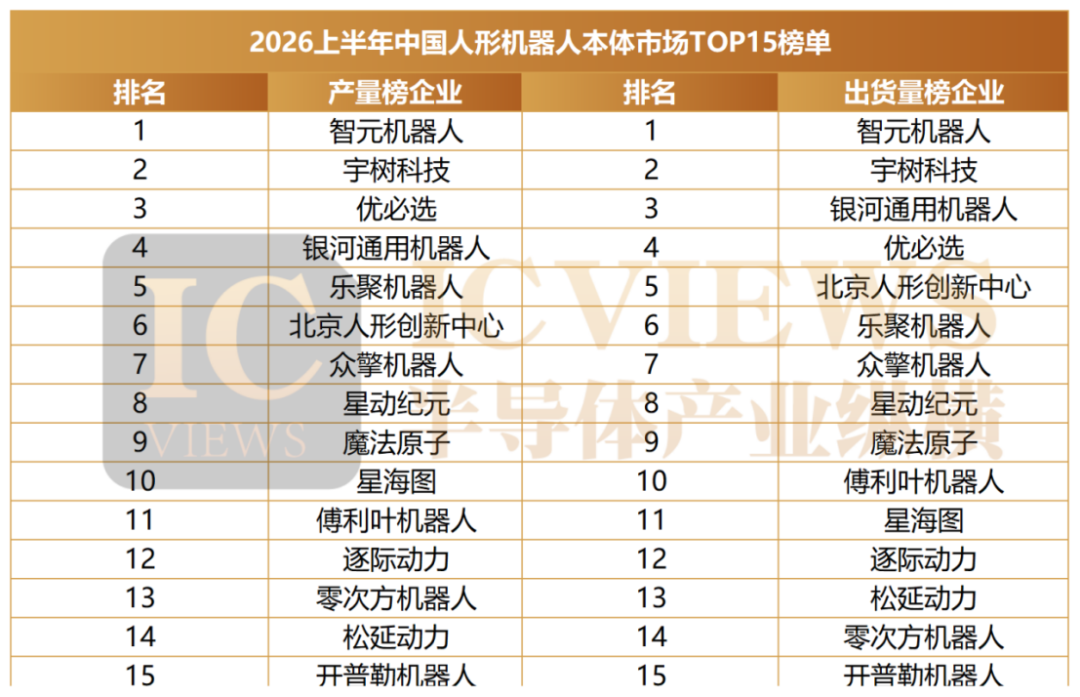
MIR DATABANK shows AgiBot and Unitree as the field’s two leaders. AgiBot rolled its 15,000th unit off the line in early June; Unitree hit about 11,000 in March and plans to lift annual capacity to 30,000, with 2026 shipments perhaps two to three times its 6,500-plus in 2025. But through the first three quarters of 2025 over 70 per cent of Unitree’s humanoid revenue came from research and education, industrial just 9 per cent. The machines are not yet “on the factory floor”; they sit in labs and classrooms. AgiBot partner Yao Maoqing calls mass production “the core foundation for embodied intelligence to leave the lab”, yet the gap between units built and units working remains the industry’s central contradiction.
UBTECH, third in output, slipped to fourth in shipments, a sign of inventory or slow delivery. Its U1 consumer humanoid passed 13,361 orders at 169,800 yuan for the Pro, but as a consumer product those orders are not counted in industry output, a stark split between hot consumer demand and cool industrial reality.

Five firms, five states of survival
At WAIC the field splits wide. The national humanoid innovation centre runs stable deployments in guiding, inspection and sorting, planning 5,000 units with wheeled models over 400,000 yuan and bipeds over 600,000; tellingly it ships far more wheeled than biped because wheeled is cheaper, steadier, longer-lasting in industry. Matrix Manufacturing bets on high-end bipeds, its MATRIX-3 at 1.70 metres and 65 kilograms with 27-degree-of-freedom hands, four-hour runtime, 580,000 yuan, about 1,000 orders, still in adaptation. Banxing offers ODM skeleton delivery at 208,000 yuan. Zhongjian’s ZERO is still a prototype. Magic Atom went vertical with a traffic-patrol robot already on duty in Wuxi.
Biped, wheeled or dog?
Is “human-shaped” even necessary? Biped advocates cite environmental compatibility: stairs, corridors and benches were built to the human scale. Pragmatists counter that quadrupeds are stabler and lower to the ground, and that in industry an AGV base with an arm already works. In 2025 quadrupeds shipped over 44,000 units; the first to “go to work” en masse this year were quadrupeds and wheeled dual-arm robots. A practitioner’s blunt take: for bipeds to stand in industry they must first solve endurance and reliability, and neither answer is good yet.
Capital pivots to brains
In the first half of 2026 embodied-AI funding hit 104.1 billion yuan, nearly double all of 2025. But over half flowed to “brain” firms; body makers got under 20 per cent. VLA models took 42 per cent of funds, world models 27 per cent, data infrastructure 20 per cent. The bottleneck is no longer hardware but the intelligence to understand the world. Global compliant robot data stands at only 500,000 hours, a gap above 99 per cent of the 10-million-hour level needed, and most humanoids still rely on remote control or preset routines.
Battery is the other hard wall. A 70-kilogram humanoid burns 200 to 300 watts just standing; real endurance is one to three hours. Energy density follows physics and will not leap soon.
The cull has begun
In February 2026 China released its first humanoid and embodied-intelligence standards system. MIIT and SASAC launched a real-scene training push. Yet more than 680 whole-machine firms now exist and over 99 per cent are still spectating. Insiders expect a violent shakeout in three years. As one put it, everyone is still showing moves; real skill shows in combat. A robot that cannot work will be cleared from the market.
Editor’s note: This is an adapted translation of the original OFweek report. It has been trimmed and restructured for readability for an international business audience.