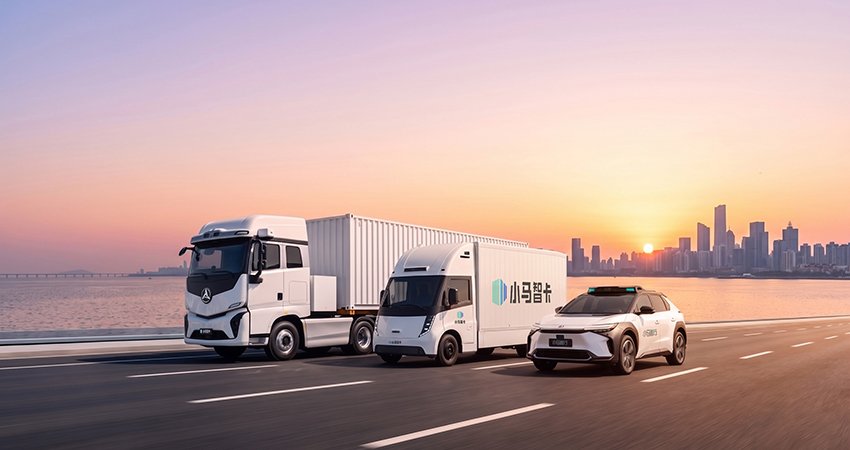
Pony.ai and Uber said on 19 August they will deepen their strategic partnership and deploy more than 2,000 Pony.ai Robotaxis across five European cities, one of the largest Robotaxi deployment plans in the region. Pony.ai’s total overseas deployment target now exceeds 4,000 vehicles.
The expansion builds on Pony.ai and Uber’s existing commercial operation in Zagreb, Croatia, and will extend the service to five European cities including Zagreb. Riders will be able to summon a Pony.ai Robotaxi directly inside the Uber app.
From one city to five: a co-built fleet
Pony.ai and Uber have settled on a “co-built fleet” model that pairs a technology provider with a mobility platform. Rather than building everything in house, the two sides divide the work: Pony.ai contributes its Level 4 virtual driver, its proven user experience and its operating playbook. Uber contributes user reach, ride-hailing, payments, customer service and a mixed-capacity network. and local partners chosen by both sides handle day-to-day fleet management.
This split avoids duplicated infrastructure. Pony.ai does not have to stand up a ride-hailing platform and a full local operations team in every overseas city, and Uber does not have to develop its own Level 4 system. Who funds the vehicles and who owns the assets can be arranged flexibly city by city.
Zagreb already validated the single-city version of this model. In May, Pony.ai, Uber and Croatian firm Verne launched a commercial Robotaxi service there. The next test is whether the same model adapts to different roads, regulations and operating environments, moving from one city to a regional footprint.
Why Uber is doubling down
Uber’s core need is simple: Robotaxi capacity that can serve complex old-town centres, keep accepting rides during rainy rush hours, and cost little enough to run at scale. Pony.ai has crossed fromtechnology testing to commercial operation.
It now runs driverless commercial Robotaxi services in Beijing, Shanghai, Guangzhou and Shenzhen with a fleet of 1,975 vehicles, and has logged more than 100 million kilometres of autonomous road testing, including over 40 million kilometres fully driverless. Its experience in China’s first-tier cities meets Uber’s high bar for Europe.
A dual-engine strategy
Pony.ai’s seventh-generation Robotaxi is already profitable per vehicle in Guangzhou and Shenzhen, proof that the unit economics close. Cost is the other lever: founder and CEO James Peng has said Pony.ai’s vehicle cost is roughly a quarter to a fifth of Waymo’s, a gap built from R&D, supply chain and engineering. Lower vehicle cost lets local partners deploy more units for the same money.
As the European fleet grows, Pony.ai expects recurring income from technology licensing and a share of passenger fares, not just project fees. That is the heart of its “China plus overseas” dual engine: China validates the product and drives down cost. overseas scales the fleet and grows revenue, then feeds operating lessons from new roads and rules back into the product.
Pony.ai already holds autonomous-driving test or operation licences in the Middle East, Singapore, South Korea, Luxembourg and Croatia, and has set a 2026 goal of entering more than 20 cities worldwide with a fleet above 3,500 vehicles.
The takeaway
The next phase of the Robotaxi contest is about who can actually organise technology, vehicles, orders, capital and ground operations together. Uber’s continued backing is turning Pony.ai’s European co-built fleet into a closed loop. If the 2,000 new vehicles, and the broader 4,000-vehicle plan, convert into real running fleets, what gets validated is not just one company’s overseas path, but a Robotaxi commercial model born in China and built to be copied worldwide.
Editor’s note: This is an adapted translation of the original CheDongXi report. It has been trimmed and restructured for readability for an international business audience.