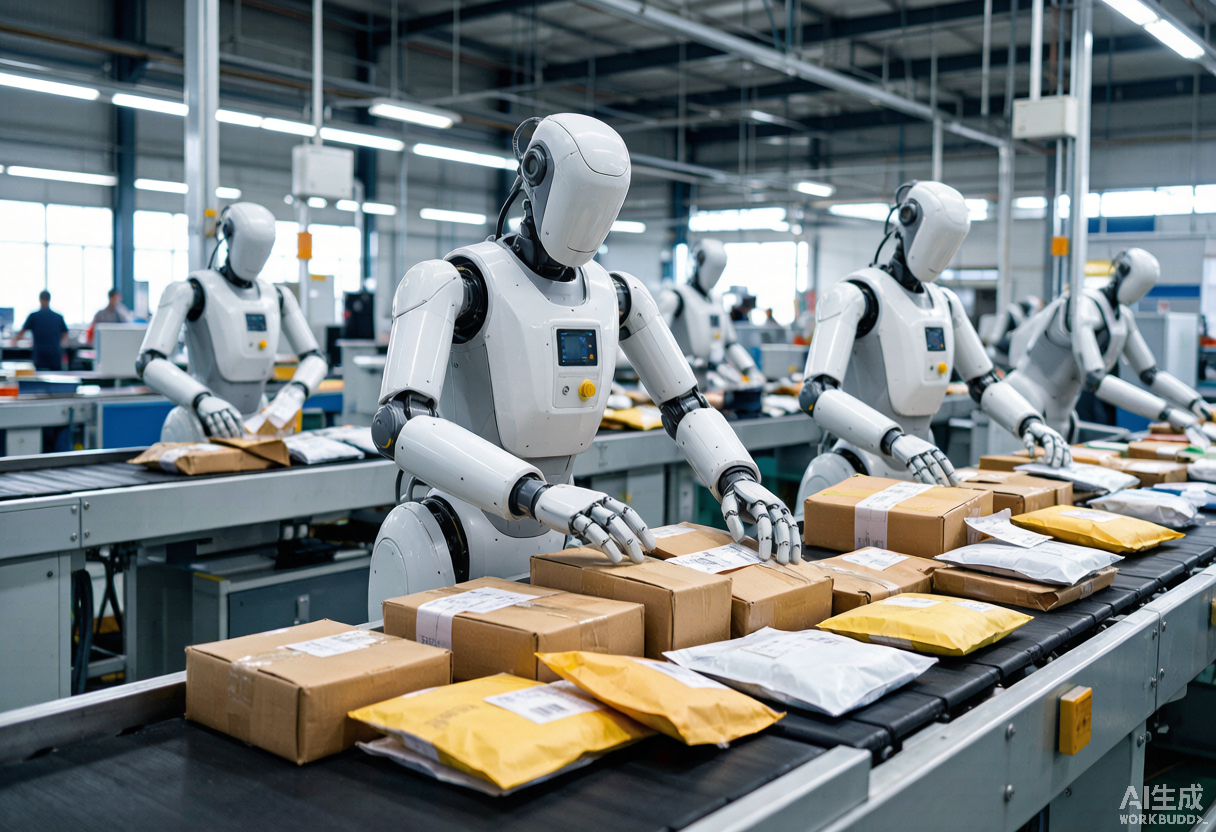
A short video posted by a Chinese foreign ministry spokesperson on overseas social platforms turned a homegrown humanoid sorting robot into an unexpected hit. On 12 August, a Shenzhen Evening News reporter visited the Shenzhen land-mail processing centre to see what the machine can actually do.
A humanoid that handles a messy sorting line
On a busy conveyor, five humanoid robots stand at their stations with dexterous five-fingered hands, grabbing, flipping and dropping parcels so the shipping labels face up. A monitor watches each unit through three high-definition views, including a head camera and two wrist cameras, to confirm every parcel is flipped and placed correctly.
The H007 sorting robot was developed in house by WoNeng Embodied (Shenzhen) Co, a Longhua district tech firm, after eight months of on-site iteration at the postal line. Getting there was not smooth. The team started basic R&D last year and moved onto a real postal line early this year, where the robot managed only a few dozen parcels an hour and could not cope with the live environment. An around-the-clock on-site push, capturing data daily and tuning algorithms overnight, broke the bottleneck after four to five intense months.
“We trained it like an infant, hand by hand, to practise grabbing, placing, flipping and reading labels,” said Hong Huacong, the company’s executive director and a computer engineer.
The numbers
The H007 now sorts steadily at 1,200 parcels an hour with accuracy above 95 per cent. Its human-like multi-degree-of-freedom frame carries 24 active joints in its nimble hands, so it can pick a normal parcel with one hand or lift a large item with both. It is small and light, and drops into an existing station without reworking the layout.
From lab to line
WoNeng Embodied settled in Longhua in April, incubated by core research teams from Tsinghua University and the University of Electronic Science and Technology of China together with a group that has worked in logistics for two decades. It focuses on the “logistics robot plus embodied intelligence” track, and has built a large proprietary logistics database plus its own model, giving the robot multi-dimensional perception and autonomous decision making so it can handle worn labels and odd-shaped parcels.
Longhua offered what the firm wanted: a special computing-power subsidy that lowers model-iteration cost, a mature local supply chain for motors and automation gear so parts can be tested and restocked fast, and a deep pool of IT and automation talent. The company now has more than 100 robots in service at postal sites and logistics yards nationwide, over 50 of them in Guangdong, and its 2026 output target is in the thousands.
Editor’s note: This is an adapted translation of the original Shenzhen News report. It has been trimmed and restructured for readability for an international business audience.