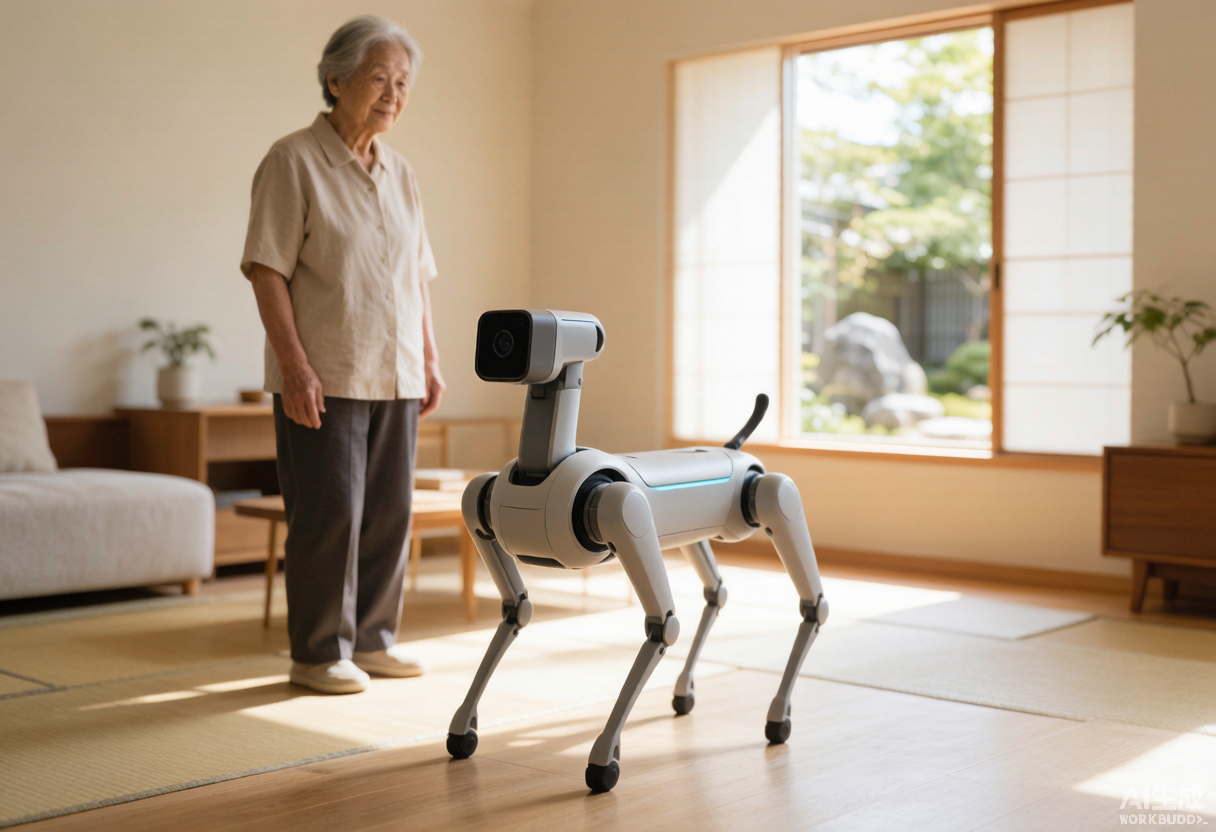
Chinese consumer-embodied-intelligence firm Vbot said its global strategy has begun, with Japan as the first overseas market. Under a strategic agreement, Japanese robot-solutions firm Future Robotics has bought in Vbot’s flagship quadruped development platform, the Datou EDU edition, and will build local applications around elder-care companionship and village public services.
Over three years the two sides plan a full Japan rollout, with scaled elder-care deployment first and an initial order worth RMB 1 billion. The tie-up targets the core pain of ageing societies.
Why Japan
Japan’s ageing is the deepest in the world. Its over-65 population has reached 36.2 million, 29.4 per cent of the total, with one in six people above 75. Falling rural population and labour shortage have spawned huge demand for smart elder-care and service robots, making Japan the most mature, hungriest market for robot eldercare. Future Robotics, founded in August 2015 by core members of Waseda University’s robot lab, the team that built one of the world’s first humanoid research groups, brings demand analysis, development and delivery across five tracks including super-ageing adaptation, human-robot manufacturing and disaster recovery.
Vbot’s strength
Vbot, China’s first consumer-embodied firm, was founded in December 2024 by Yu Yinan, former Horizon Robotics autonomous-driving product president and a Baidu senior scientist. It fuses body, spatial and agent intelligence into multi-form products for outdoor and indoor scenes. It has raised four rounds above RMB 700 million from top backers including Vision Capital, Bertelsmann, Baidu Ventures and Hillhouse. Its first consumer robot dog, the Vbot, launched in late 2025 as the world’s first remote-free smart dog. In March it set a three-year, 1 million-unit sales goal with JD.com. the Vbot began delivery in May with 500 units produced and over 1,500 users expected.
The Datou EDU edition
The Datou EDU edition, launched in July 2026 at RMB 39,988, targets commercial service, robot labs, enterprise R&D and enthusiasts. It carries 128 TOPS on-device compute, a depth binocular camera and 16-line lidar, and opens ROS 2 with five development interfaces so users build on top of it. Vbot calls the robot-dog-plus-arm its signature capability sample, having linked the dog’s compute to a arm for mobile manipulation.
The bigger picture
China’s Ministry of Industry and Information Technology says first-half 2026 saw over 400 humanoid models, more than half the global total, and Chinese quadrupeds near 70 per cent of global shipment share. IDC puts 2024 global quadruped sales above USD 180 million and about 20,000 units, 72.1 per cent consumer. Notably, the US Federal Communications Commission recently moved to bar imports of Chinese humanoids and quadrupeds. That trade wall, Vbot argues, only confirms Chinese embodied products have reached the world’s front rank, and the overseas wave will only intensify.
Editor’s note: This is an adapted translation of the original OFweek report. It has been trimmed and restructured for readability for an international business audience.