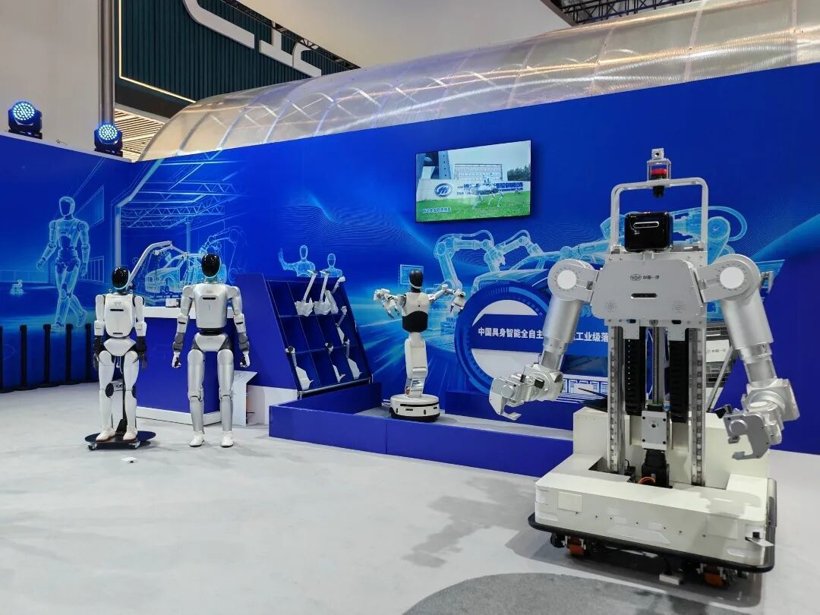
During the 2026 World Robot Conference, FAW Die Technology (Changchun) showcased a wheel-arm robot, a full-size bipedal humanoid, a small bipedal service humanoid, a heavy-load robot and joint modules, presenting what it called “China’s fully autonomous embodied-intelligence automotive manufacturing scenario.”
FAW is building an embodied-intelligence development platform around a “one brain, diverse bodies” product architecture, modularising perception, decision, planning, control and execution. It reuses the auto industry’s accumulated strengths in perception and spatial intelligence, compute-communications and electrical architectures, energy and thermal management, materials and product engineering, and verification manufacturing and quality systems, forming a shared technology base for robot-grade reliability, automotive-grade quality and scaled delivery.
The FAW wheel-arm robot is an in-house industrial humanoid that fuses a self-developed VLA manipulation model and whole-body motion control. It can perceive the environment, understand tasks, plan paths and operate autonomously, handling parts recognition, flexible grasping, transport, loading, bolt fastening and precise positioning on automotive lines. It has already been validated in real production and test scenarios, including windshield-fluid picking and delivery and rear-suspension bolt tightening in the final-assembly shop, and welding-part loading in the welding shop.
The full-size bipedal humanoid was developed end to end, from industrial design and mechanical structure to core hardware and control. It stands 1.73 metres tall with 41 degrees of freedom, using a “brain plus cerebellum” architecture: the brain handles voice interaction, environment understanding and task planning through a large language model and agents, while the cerebellum lifts standing, walking and whole-body coordination through imitation learning, reinforcement learning and whole-body control.
The smaller bipedal service humanoid stands about 1.5 metres and can walk stably, move omnidirectionally and turn, aimed at venue guiding, reception, tech showcases, brand service and human-robot interaction, probing scaled use in commercial service.
The heavy-load robot targets industrial heavy transport and precision assembly, using a four-steer-wheel mobile base, SLAM navigation, a multimodal sensing system and dual seven-degree-of-freedom arms for autonomous positioning, path planning, dynamic avoidance and dual-arm coordination. Its single arm carries a rated load of 25 kg with eight hours of battery life, and it has completed design simulation and entered prototype validation.
FAW is also developing, trial-building and validating a range of joint modules, having finished tests on temperature rise, precision, noise and long-duration load fatigue, providing the core-component backbone for stable, efficient and dexterous motion.
Editor’s note: This is an adapted translation of the original Gasgoo report. It has been trimmed and restructured for readability for an international business audience.