At the 2026 World Robot Conference, Schaeffler Embodied Intelligence Robotics (Taicang) showed up for the first time, centring its display on the core parts and subsystems that make a humanoid move.
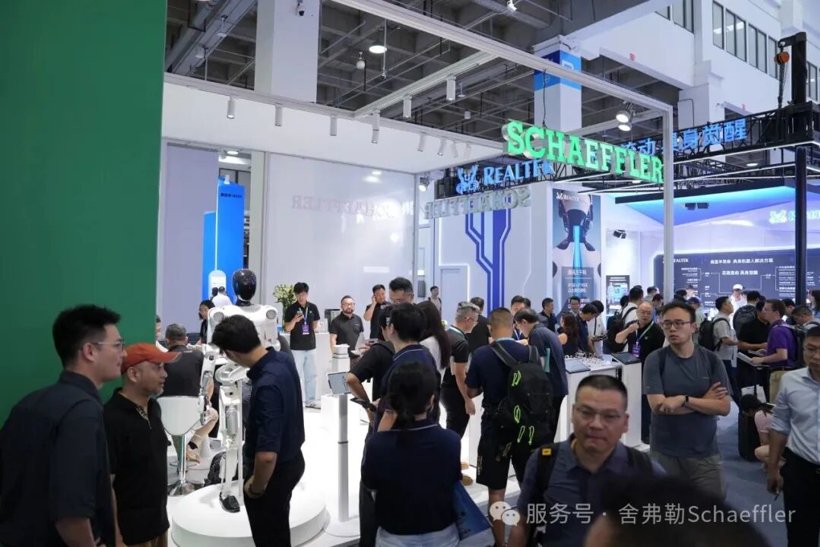
Schaeffler is leaning on decades of automotive and industrial drive know-how. The lineup spans robot high-performance computers, a 48V low-voltage power controller (LVPC), tendon-driven dexterous hands and actuators, electric lift columns, tension and torque sensors, planetary reducers, high-precision reverse planetary roller screws, robot bearings, encoders, and frameless torque motors.
Two parts drew attention. A lightweight integrated harmonic-reducer joint module, built for extreme compactness, drops into a humanoid’s shoulder, elbow, or wrist to raise system integration. In rotary joints, a module with an integrated planetary-gear reducer builds the bearing straight into the rotor, cutting installation space by about 20 per cent and shaving up to 500 grams.
Schaeffler frames its model as a trio: frontier R&D plus a digital factory plus accumulated data assets, linking digital twins, 5G, and large AI models into a closed loop from research to production. It offers two cooperation shapes, as a systems and components supplier, and as a user deploying humanoids in its own factories for manufacturing data and landing support.
The commercial signal: Schaeffler’s embodied unit has already won a production order from a local humanoid customer and will start series output of the relevant parts this year. A German tier-one supplier is now competing for shelf space inside Chinese humanoids.
Editor’s note: This is an adapted translation of the original Gasgoo report. It has been trimmed and restructured for readability for an international business audience.