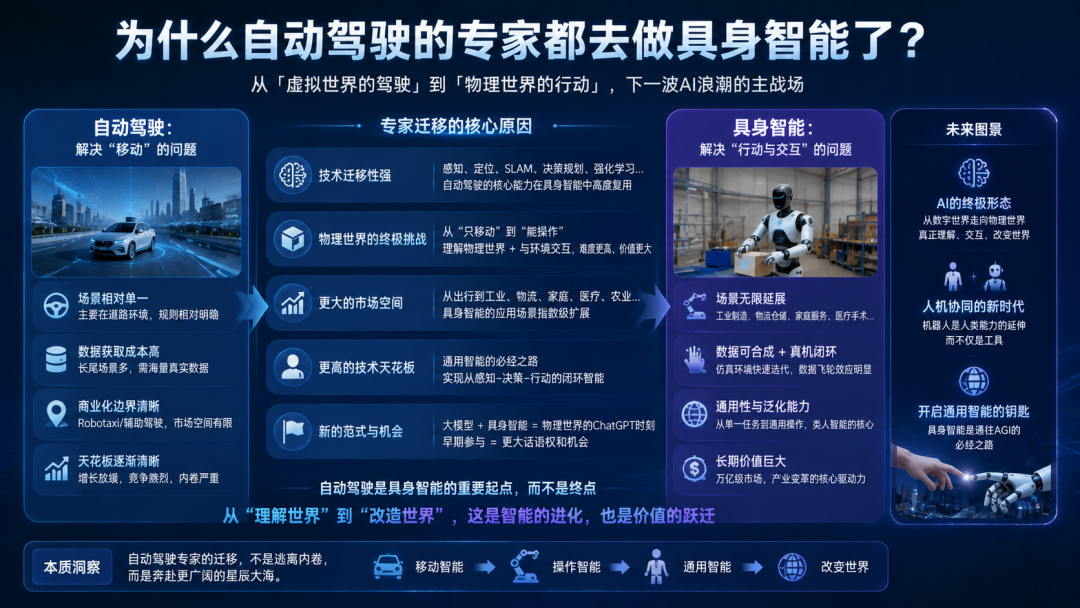
A quiet migration is reshaping Chinese robotics. By one tally, nearly 40 core autonomous-driving executives and technical leads have moved into embodied AI.
The names leaving
Li Auto alone lost eight senior people in half a year, most to robotics. Former autonomous-driving president Lang Xianpeng founded Kunlun Robotics, raising three rounds in 90 days to a valuation above 1 billion dollars. Former CTO Wang Kai and driving head Jia Peng started Zhijian Dynamics with five rounds in eight months. Horizon bled harder: at least 14 core staff left, 13 into embodied AI. Chen Yilun, ex-Huawei car BU autonomous-driving CTO, and Li Zhenyu, ex-Baidu intelligent-driving president, co-founded Tashi Zhihang with a 120 million dollar angel round, a domestic record. Momenta’s production head Gao Jiyang founded Xinghai, and ex-XPeng chief scientist Guo Yandong built AI2Robots. WeRide’s COO, XPeng’s VP, and Cainiao’s research lead all jumped. Horizon’s own alumni spun Vita, Dingdang, and Jijia.
Pushed and pulled
Two forces move at once. The push is the car price war: from 2024 to 2025, per-vehicle margin fell from double digits to 3 to 4 per cent, turning autonomous-driving units from moat to cost centre, with budgets halved. The pull is the triple convergence of large models giving robots a general brain, world models giving prediction, and Tesla proving a data loop moves from FSD to Optimus, plus capital pouring in hundreds of billions of yuan.
The people are the same kind: they understand the physical world, closed-loop control, and the data flywheel. The car industry spent a decade raising a workforce validated by millions of vehicles. The price war was the fuse; the real gift was a ready-made team.
Experience transfers, but not cleanly
The architectures rhyme. VLA models, world models, end-to-end large models, and data loops all travel. But the car is a constrained world: fixed roads, clear rules, one task. The robot faces an open world of screwing, sorting, and handling where one model will not fit all. Some robotics CEOs now prefer pure robotics hires, and cross-industry candidates get fewer interviews. Engineering, mass production, and data loops are hard currency; mechanics, force control, and compliance still cost tuition.
A state research centre sees China’s embodied-AI industry at 400 billion yuan by 2030 and above 1 trillion by 2035. The AV refugees are not a downgrade. They bring first-half experience to a second half that will likely take as long as cars did. But they will speed the commercial clock.
More images
Editor’s note: This is an adapted translation of the original OFweek report. It has been trimmed and restructured for readability for an international business audience.