A new round of consolidation among China’s state-owned carmakers has actually started. On 14 September, GAC Group said it had signed a letter of intent with FAW Car Co to buy part of a joint-venture vehicle company held by FAW through a share issue, alongside a supporting fundraising.
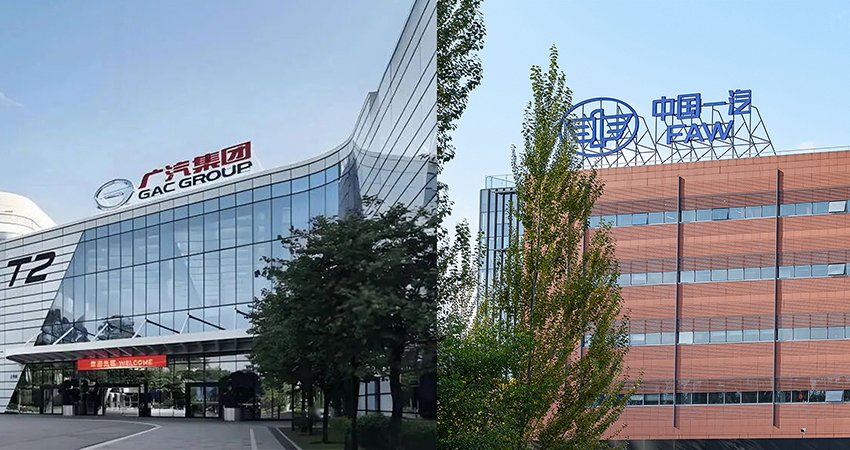
In effect, FAW will take a stake in GAC by injecting assets and become GAC’s second-largest shareholder. The transaction is expected to count as a major asset restructuring and a related-party deal, though it will not change GAC’s actual controller and does not amount to a backdoor listing. GAC’s A-shares were suspended from trading on 14 September for up to ten trading days.
Neither side has said which joint-venture vehicle company is involved, how much equity is being bought, what the target is worth, or how much of GAC FAW will ultimately hold. The strongest clue is that both FAW and GAC run Toyota joint ventures, so the undecided target is most likely a Toyota entity.
FAW is a central SOE overseen directly by SASAC, while GAC sits under Guangzhou’s municipal state capital. The two sold more than five million vehicles combined in 2025, and until now each ran its own brands, research, manufacturing and supply-chain systems. FAW will not just become a GAC shareholder, it will place existing vehicle assets into the deal, making the transaction a landmark for this round of state-car consolidation.
The big open question is which assets FAW is putting in. FAW’s joint-venture vehicle business centres on FAW-Volkswagen and FAW Toyota, in which FAW Car holds 60 per cent and 50 per cent respectively. FAW-Volkswagen spans five production bases in Changchun, Chengdu, Foshan, Qingdao and Tianjin. FAW Toyota, headquartered in Tianjin, runs three bases in Tianjin, Changchun and Chengdu with four vehicle plants and two engine plants, plus research, logistics and sales arms.
Policy landed three days earlier. At a 11 September MIIT briefing on intelligent connected new-energy vehicles, Shao Ji, deputy director of the NDRC’s industrial development department, said the government would support large corporate groups in reform, push mergers and acquisitions through market and legal channels, and back leading firms consolidating research and production to cut duplicated competition. GAC’s trading halt came three days later.
GAC’s own trajectory explains the timing. Its annual sales fell from 2.505 million in 2023 to 1.7215 million in 2025, a drop of more than 780,000 units in two years. The weakness came mainly from the joint ventures. GAC Toyota and GAC Honda had long been its steadiest source of volume and profit, but as NEV penetration rose, Japanese brands lost share in China and the old profit engine stalled. GAC posted its first annual loss since listing in 2025, with a net loss attributable to shareholders of RMB 8.784 billion.
In the first half of 2026, GAC sold 773,100 vehicles, up 2.35 per cent, with own-brand sales of 346,000, up 35.69 per cent. Volume steadied but profit has not returned, with a first-half net loss of RMB 4.467 billion. The old business is falling fast, the new one is still climbing, and the cost of keeping a full technology system alive has not shrunk. That is GAC’s reality.
FAW has needs of its own. It sold 3.302 million vehicles in 2025, still a domestic leader, but more than 2.3 million came from joint ventures. Its own brands keep growing yet still need more scale and faster product cadence in the NEV passenger market. GAC holds part of what FAW lacks: Aion has already run production and sales at the hundreds of thousands level, and GAC has invested for years in pure-electric platforms, batteries, electric drive and NEV supply chains. Its main research and manufacturing bases sit in Guangzhou and the Pearl River Delta, close to China’s most mature consumer electronics, chip and smart-hardware supply chains, assets that matter more as cars become intelligent.
FAW brings larger vehicle scale and mature manufacturing, procurement and supply systems. Once the capital tie is in place, cooperation no longer has to stop at a strategic agreement.
Plenty of large state-owned car groups remain. At central-SOE level there are FAW, Dongfeng and Changan, and at local level SAIC, BAIC and GAC. Many own their brands, research institutes, NEV platforms, battery and drive projects, plus intelligent-driving and smart-cockpit teams. On the private side, BYD, Geely and Chery are using larger volume to spread research and manufacturing costs, while Xiaomi and Yinwang keep raising the bar on intelligent investment. If state carmakers keep building separate platforms, teams and supply chains, the duplicated spending will stretch resources and weaken products. FAW and GAC have taken the first step. How the market reshapes from here is still open.
Editor’s note: This is an adapted translation of the original Chedongxi report. It has been trimmed and restructured for readability for an international business audience.