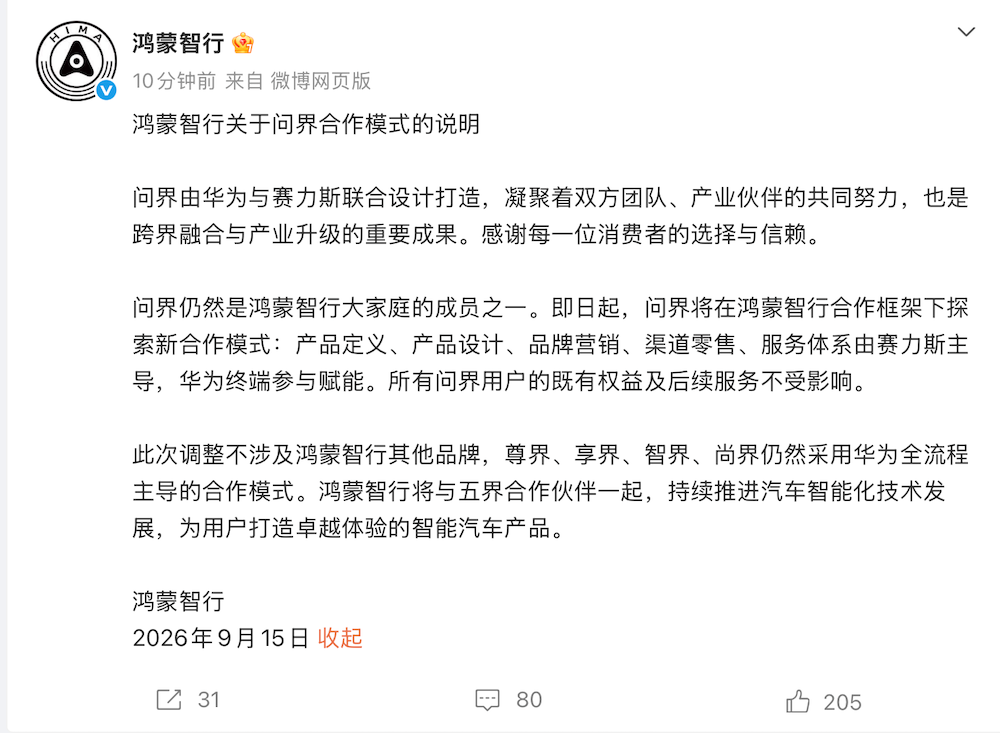
Harmony Intelligent Mobility Alliance (HIMA) and Seres have responded to a change in how the AITO brand is run. Product definition, product design, brand marketing, channel retail and after-sales service will be led by Seres, with Huawei’s consumer unit contributing enablement.
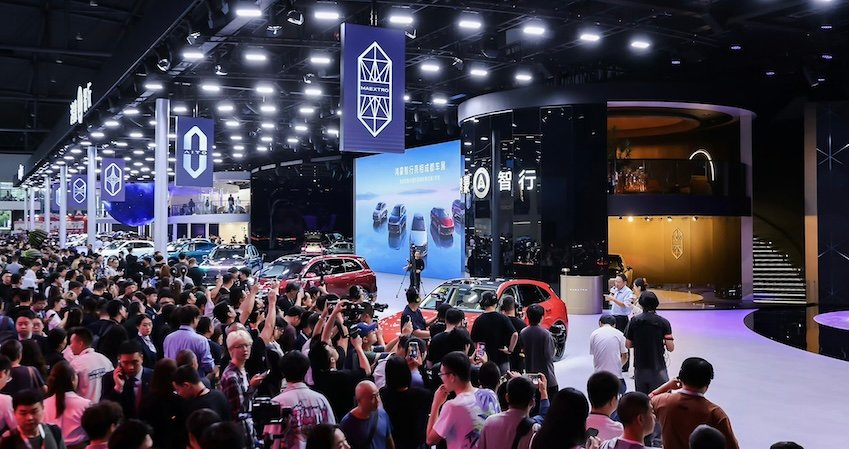
AITO remains part of HIMA, and existing owner rights and future service are unaffected. HIMA stressed that the change does not extend to its other brands: Maextro, Stelato, Luxeed and Shangjie will keep the model in which Huawei leads the full process. Chinese media had reported the same week that Huawei would switch to a lighter asset model with Seres, which would lead AITO’s products, marketing, sales and service, letting HIMA concentrate resources on its remaining brands.
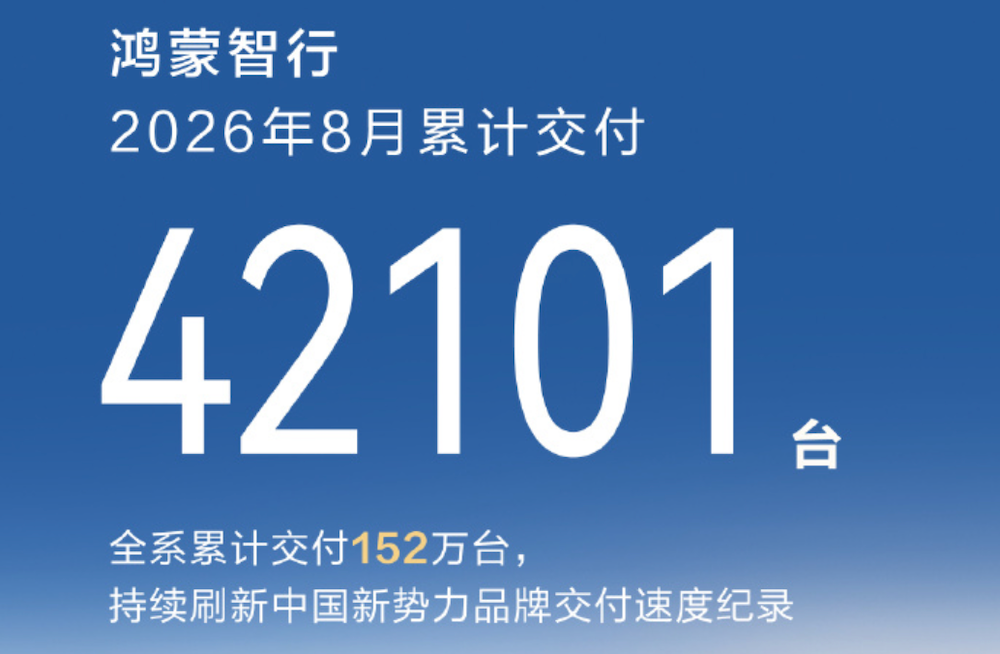
Three conditions made the handover possible. First is volume. HIMA delivered 42,100 vehicles in August, while Seres sold 24,200 new-energy vehicles that month, of which Seres Auto delivered 20,700, putting AITO at roughly 49 per cent of HIMA volume. A brand with close to half the alliance’s sales no longer needs to lean on the group story to be noticed.
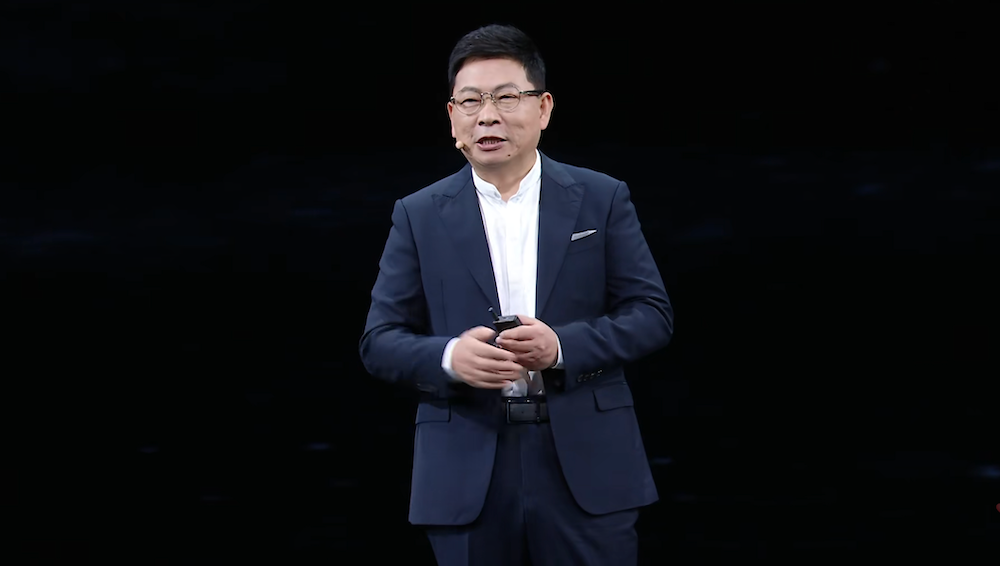
Second is brand equity. When the new AITO M9 launched on 27 May 2026, Yu Chengdong, Huawei executive director and chairman of its device BG, set out four “number ones” covering price, reputation, residual value and safety. AITO took the top average transaction price among new-energy challenger brands, the top net promoter score, the top residual value among Chinese plug-in hybrids and the top combined C-NCAP score. That recognition underpins Seres taking the wheel.
Third is technology. Seres bought certainty by taking a stake in Yinwang. In August 2024 it agreed to buy 10 per cent of Shenzhen Yinwang Intelligent Technology for RMB 11.5 billion, paid in full by September 2025. Huawei’s then rotating chairman Xu Zhijun said at the signing that Huawei and Yinwang would give AITO more predictable, manageable and sustainable technology and supply guarantees. As a Yinwang shareholder, Seres is bound to Huawei’s core technology, so even after the handover AITO’s supply of HarmonyOS cockpit and Qiankun intelligent driving will not be downgraded or interrupted.
For HIMA, letting go of AITO is resource reallocation rather than a forced concession. Its model, defined as Huawei leading the full process with full-stack technology and lifecycle management, consumes enormous resources across every brand. AITO is now established on volume and brand, while Luxeed, Stelato, Maextro and Shangjie are still in a growth phase needing investment. With limited resources, moving support from a mature brand to brands that need it most is the obvious trade.
Product separation also opens room. To avoid internal overlap, HIMA set clear lanes from the start: AITO holds family SUVs, Luxeed targets young sporty cars and SUVs, Stelato takes luxury business and rugged off-road, Maextro pushes above the million-yuan ultra-luxury market, and Shangjie serves younger trend buyers. For years every AITO model was an SUV, with no sedans or MPVs. With Huawei handing back control, that limit loosens. Seres said in an August 2026 investor record that its priority is to run each product well for the long term rather than launch cars frequently, and that it will move into sedans, MPVs and other competitive segments in step while defending its high-end SUV share.
The tie-up dates to January 2019, when Seres, then under the Sokon group, signed a broad cooperation deal with Huawei at Huawei’s Shenzhen headquarters covering industrial internet, ICT infrastructure and the intelligence and connectivity of new-energy vehicles. Huawei had not yet created its intelligent automotive solutions unit, so the work stayed exploratory. From 2021 the two moved into deep integration: a memorandum in March, a deepened agreement at the Shanghai auto show in April where the first Seres Huawei Smart Selection SF5 went on sale through both channels, and the launch of the AITO brand on 2 December 2021, followed by the M5 at Huawei’s winter flagship event on 23 December.
The AITO M7 followed in July 2022, the month Sokon renamed itself Seres Group. In February 2023 the two signed a deeper joint-business agreement, and in November 2023 Huawei’s Smart Selection model became the HIMA technology alliance with Seres as its first partner. In July 2024 Seres agreed to buy 919 AITO-related trademarks and 44 design patents from Huawei and affiliates for RMB 2.5 billion, bringing brand assets home. In August 2024 came the Yinwang investment, and in March 2025 the equity change completed, making Seres one of Yinwang’s three shareholders. On 29 September 2025 Seres said it had paid the full RMB 11.5 billion for its 10 per cent stake.
On 13 January 2026 the millionth AITO vehicle rolled off the line at Seres’ super factory, reaching one million units in 46 months and making AITO the first Chinese challenger brand to hit a million in production and sales. AITO delivered more than 420,000 vehicles in 2025, about 70 per cent of HIMA’s full-year 589,000.
The financials reversed with the partnership. Group revenue went from RMB 35.842 billion in 2023, with a net loss of RMB 2.45 billion, to RMB 145.176 billion in 2024 and net profit of RMB 5.946 billion, the first profitable full year, then a record RMB 165.054 billion in 2025 with profit of RMB 5.957 billion. Gross margin rose from 26.15 per cent in 2024 to 29.14 per cent in 2025. In the first half of 2026, hit by model changes and lower volume, revenue was RMB 57.493 billion with a net loss of RMB 1.717 billion.
The sales model shifted too. AITO’s network began as two types: experience centres in shopping malls run mainly by Huawei, and user centres built by Seres, a split that let stores spread fast. By the end of 2022 AITO was in more than 1,000 Huawei stores, up to 61.78 per cent of its roughly 1,214 outlets. In July 2023 the two set up a joint AITO sales and service working group to close the loop on marketing, sales, delivery, service and channels. In August 2024 Seres said it would build its own flagship stores, a step to strengthen its brand and cut reliance on Huawei’s channel, and from the second half of 2024 it pushed luxury dealers from Mercedes-Benz, BMW and Audi to switch networks. Its own user centres grew quickly, reaching 380 outlets across 218 cities by the end of 2025 and more than 390 by April 2026. Seres has said it does not fund the building or operation of other brands’ stores, making its channel spend brand-specific rather than shared across HIMA’s five brands.
Editor’s note: This is an adapted translation of the original Chedongxi report. It has been trimmed and restructured for readability for an international business audience.