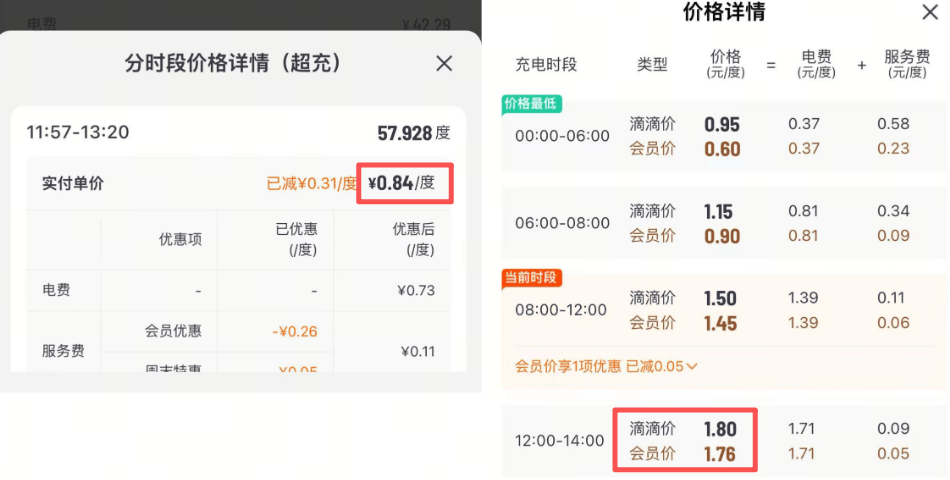
The high priced electricity once found only on motorway service areas is quietly taking over city charging stations. A Shanghai resident who uses Didi Charging told a reporter that a membership rate he paid at 0.84 yuan per kWh climbed to 1.76 yuan per kWh in the same time slot, nearly double. He added that not every hour doubled, but the stations he uses most rose 50 per cent or more across the board.
Public charging prices split into two parts, the electricity itself and the service fee, and the rise needs both explained. On the electricity side, a market reform changed the maths. In December 2025 the National Development and Reform Commission and the National Energy Administration issued the Basic Rules for the Medium and Long Term Electricity Market, effective 1 March this year, which cancels fixed time of use pricing and fixed peak valley windows for large direct market participants such as major charging operators and grid affiliated firms. Industrial and commercial electricity is now fully marketised in real time.
Real time floating behaves like a bidding trend. Before, a busy station’s peak price was locked inside a fixed band no matter the queue. Market pricing breaks that ceiling: when the grid is tight, terminal prices can exceed the old peak. The flip side opens too. When the load is low and regional power is plentiful, real time prices can dip below the old valley, and the cheap window shifts. One user noted the old 10 pm to 6 am bargain now starts after midnight.
A State Grid dispatcher explained that peak valley frames were never a simple meter reading but a dynamic split based on real time supply and demand and net load. Within one administrative zone the grid’s sale price is uniform, so different peak windows across nearby stations come from operators reading their own business scenes. A mall basement peaks at 8 to 11 and 18 to 21, matching opening and commute crowds. An open air site peaks at 12 to 14 and again at 14 to 15, catching office lunch breaks and ride hailing rest stops. Same grid, different curves.
On the service fee, the National Business Daily reported core district rates moving from 0.2 to 0.3 yuan per kWh to 0.4 to 0.6. That rise is the market healing. Before 2020, charging service fees were government guided. Once EVs scaled, the cap lifted and competition set prices. Late in 2020 Evergrande’s Star Charge ran a free service fee subsidy that kicked off a price war and crushed operator margins. One Star Charge calculation put the upfront build of a standard 20 space, 1,200 kW station at 1 million yuan, so cheap power alone could not pay it back.
The pattern now is price guided load and load answering price. When wind power is abundant and the grid is light, drivers are nudged to charge, and when the evening peak or net load climbs fast, they are nudged to avoid it. The operators have stopped racing to the bottom and started pricing for survival.
Editor’s note: This is an adapted translation of the original Sohu report. It has been trimmed and restructured for readability for an international business audience. The full original (in Chinese) is at https://www.sohu.com/a/1084575673_355019.