Exoskeleton robots have moved from rehabilitation wards and factory floors into Chinese shopping malls, and provincial governments have started paying part of the bill.
Since June, several provinces have adjusted the local categories covered by consumer goods trade-in subsidies. Shandong, Chongqing, Beijing, Xi’an and Jiangsu have added exoskeleton robots to the list. Shanghai and Xi’an offer the most, up to RMB 2,000 per unit. Jiangsu and Beijing apply a straight 15 per cent of the final price, with caps of RMB 1,500.
Two kinds of buyer, only one of them served
Consumer demand comes from two groups, and they want different things.
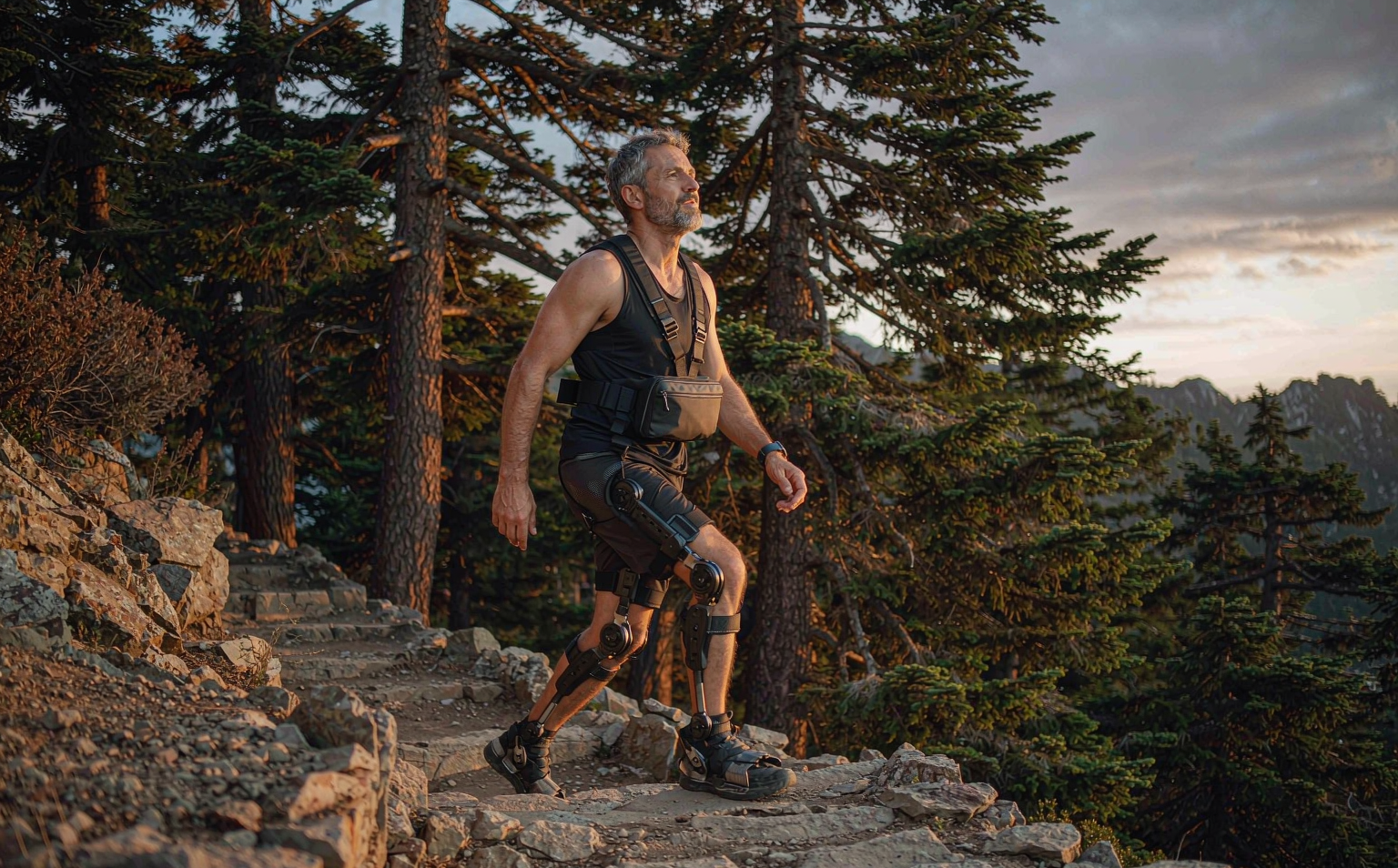
The first is outdoor sports. Hiking, long-distance trekking, cycling and load-bearing photography all load the knee and tire the muscle, which is a problem an exoskeleton can relieve immediately. Aoshark has named general outdoor users as its first target, and Toread’s second-generation device claims to offset 30 kilograms of load while collecting real gait data from scenic-site rentals.
The second group is older users, the market most often cited as the prize and the hardest to serve. Their core requirement is not falling over. Most consumer products on sale are designed around saving effort, and their effectiveness depends heavily on how well the user already walks.
The consumer track is where the policy bites
Policy attention has moved to safety. In March the Standardisation Administration issued several recommended national standard plans, two of which bear directly on consumer products.
The first covers human-machine interaction safety risk assessment for exoskeleton robots, applied across the full lifecycle of non-medical devices, and sets thresholds for fall prevention, false triggering and emergency stop. The second is a safety technical specification for wearable hip-joint exoskeletons, not limited to medical use. Both are still in drafting.
Note what those standards do. They do not specify how strong a product is. They specify how safe it is. That is the correct order for a category about to be sold to people in their seventies.
Who is selling what
The market splits into three tracks. Hospital rehabilitation is led by Fourier, Chengtian and Maibu, where medical device registration creates an entry barrier and generates most of the industry’s revenue. Industrial application is led by Aoshark, Chengtian and Maibao, focused on assisting workers in manufacturing and logistics. Consumer products come from Chengtian, Kenqing and Jike, aimed at tourism rental and home care for older people.
The most telling signal on the supply side is Haier. The appliance maker opened the world’s first exoskeleton experience store in Shanghai in March, the first retail presence the consumer category has had. Its range splits by user: W1 for older buyers, W2 for outdoor use, and W3 in full carbon fibre at under 1.8 kilograms, using a non-Newtonian fluid layer to damp shock around the hip. About a dozen stores are now open.
Scenic sites have taken on the market education role. Dozens of mountain and Great Wall sites rent exoskeletons by the hour, with entry prices as low as a few dozen yuan, which has put a large number of ordinary visitors into a device for the first time.
Fit is the unsolved problem
Unlike other wearables, an exoskeleton depends on individual fitting. Different wearing positions and fitting accuracy change the experience materially. Kenqing sells by height and waist measurement, Chengtian offers some models sized by height, and Jike differentiates by series, with the differences mostly functional.
Research from AVC Revo finds that the problems reported by older users cluster around comfort and adaptation rather than capability, which is the same gap the safety standards are being written to close.
Editor’s note: This is an adapted translation of the original OFweek report. It has been trimmed and restructured for readability for an international business audience. The full original (in Chinese) is at https://robot.ofweek.com/2026-11/ART-8321203-8420-30710450.html.