Lens Technology disclosed in an investor relations record on 1 November that its Kunshan base has reached output of 100 humanoid robots per day, with capacity still being added as self-developed equipment arrives.
The company plans to reserve more than 10,000 units of monthly capacity for each of two customer product series, designated Q and T.
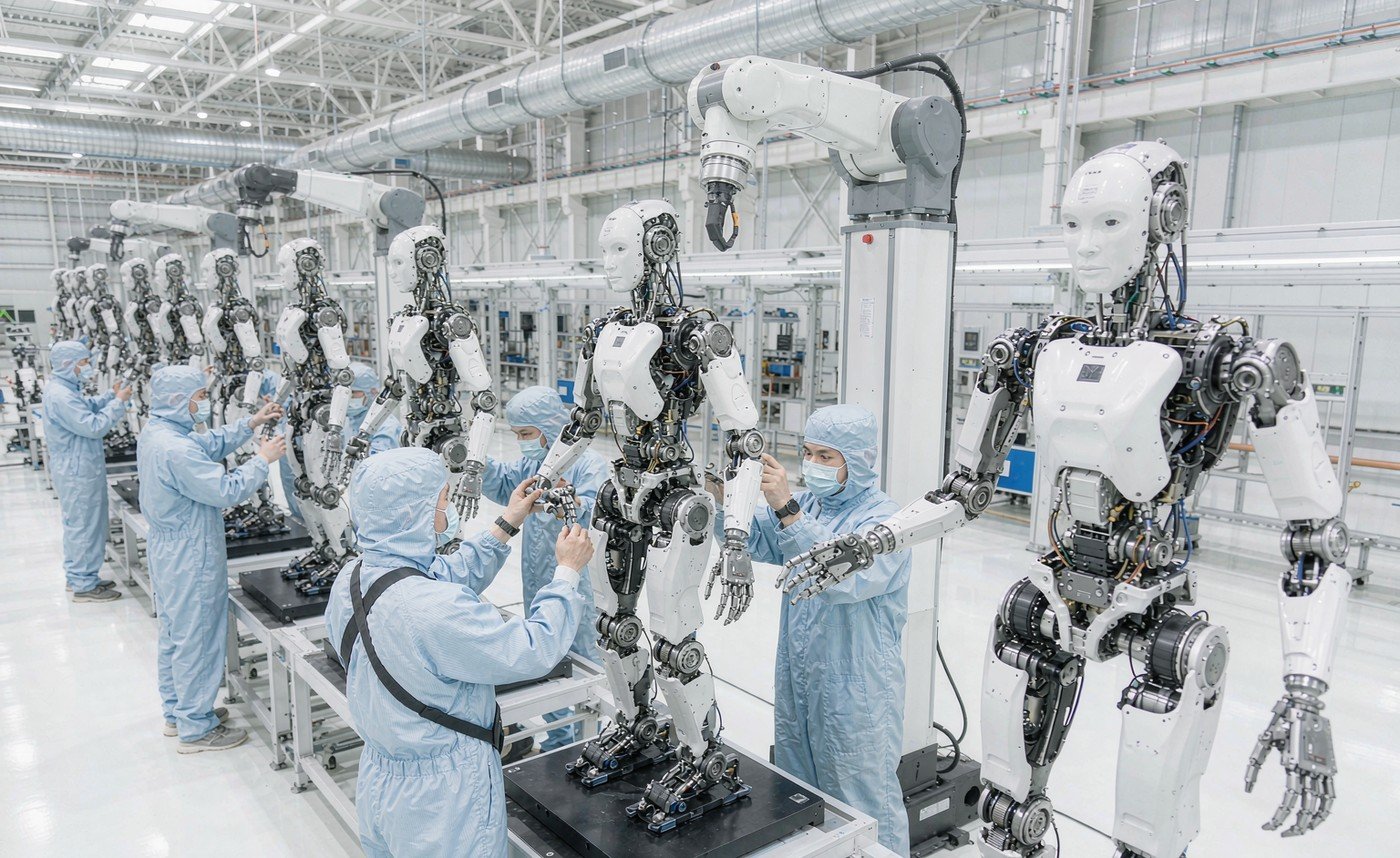
Eleven weeks from empty floor to daily output
The schedule is the story. Preparation began in late August. The first unit came off the line in late September. Output climbed to a hundred a day over the following weeks.
Lens is not new to this. It established an intelligent robotics subsidiary in 2016, seven years before the current funding wave. From 2024 it has worked closely with AgiBot, and the two completed what the company describes as the world’s first thousand-unit production delivery.
Its involvement goes past assembly. Lens has contributed to the development, assembly and testing of AgiBot’s joint modules, DCU controller and OmniPicker gripper, and is co-developing head curved display modules, dexterous hand modules and high-strength joint modules with customers.
From OEM to ODM, and the margins in between
The stated direction is a move from contract manufacturing toward co-design and manufacturing, a shift from OEM to ODM. Pure assembly earns a thin margin. Component content plus joint design captures a far larger share of each robot’s bill of materials.
The company also holds more than one million square metres of industrial, residential, education and medical park space, and has accumulated over 10,000 hours of self-collected robot data. That makes its sites a training ground for both body and control policy, and it argues that a fully automated line where robots build robots could land first on its own floor.
What the numbers say
In the first nine months of 2026, Lens posted a 10.74 per cent decline in revenue and a 50.06 per cent decline in net profit. Smartphones and computers still account for 77.54 per cent of revenue, with robotics and other new business below 10 per cent.
The Kunshan line is genuine capital expenditure, and the ODM transition requires a research team funded out of current earnings. New business is supporting valuation and expectation rather than profit.
Lens is one of roughly 30 Chinese automotive parts companies that have set up robotics subsidiaries or entered dexterous hand production since 2025, alongside Bosch, Valeo, Joyson and Tuopu. The common asset is not robot expertise. It is precision machining, supplier management and the ability to hold a tolerance at volume, which is exactly what a humanoid programme needs once it leaves the prototype stage.
Editor’s note: This is an adapted translation of the original OFweek report. It has been trimmed and restructured for readability for an international business audience. The full original (in Chinese) is at https://robot.ofweek.com/2026-11/ART-898890-8420-30710093.html.