Every scale-up in artificial intelligence so far has depended on somebody else having already digitised the raw material. Language models inherited three decades of web pages and source code. Autonomous driving inherited a fleet already on the road, with shadow-mode collection turning ordinary journeys into training signal.
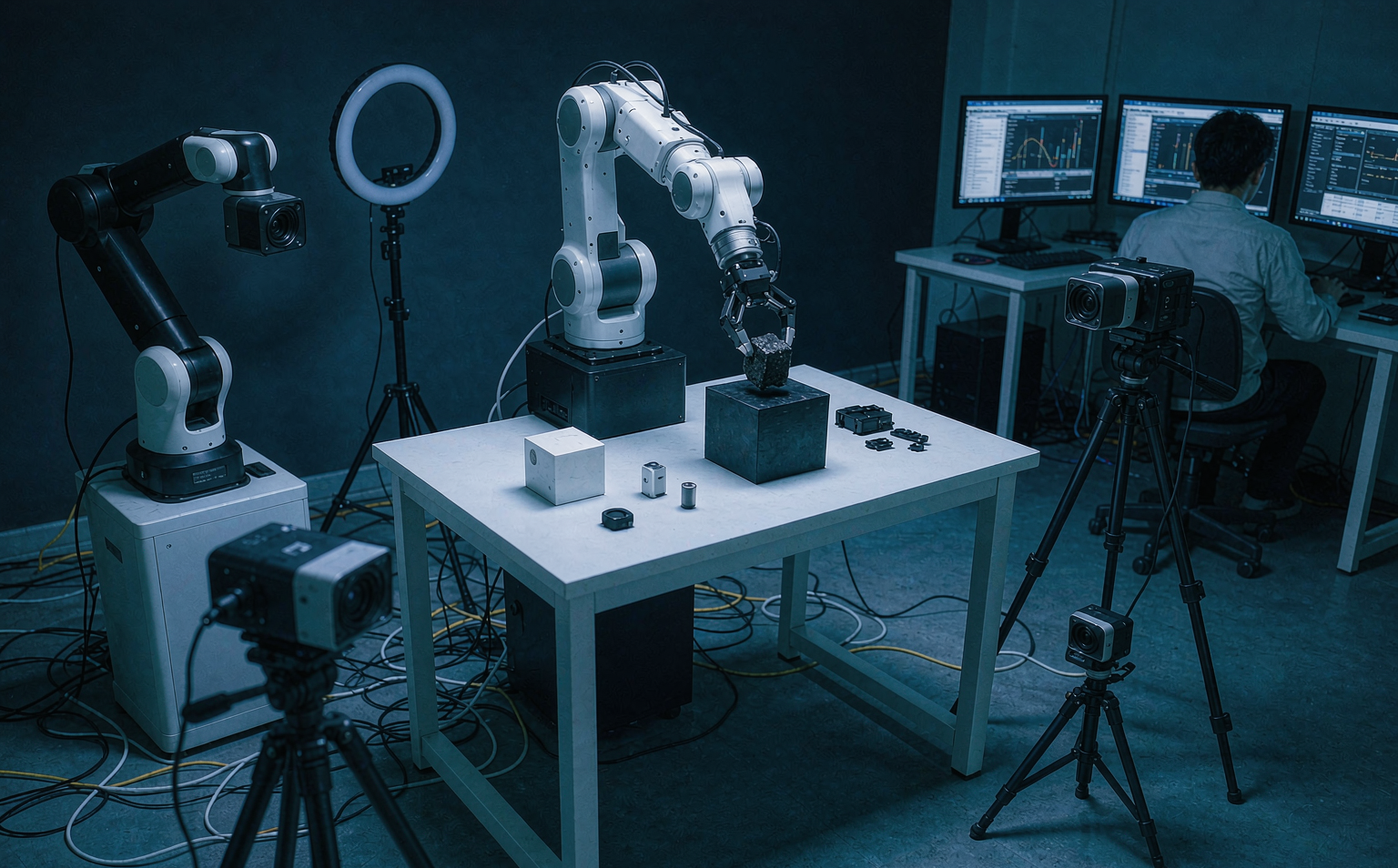
Embodied intelligence inherited nothing. After two years of effort, the industry’s cumulative stock of usable real-robot and first-person footage amounts to a few million hours, which is not enough for the training runs that frontier robot models now require.
On 30 October, a spatial intelligence company called InSpatio opened a facility in Hangzhou it describes as China’s first embodied simulation data centre, with a target of one million hours of simulated training data per month and a per-unit cost around one tenth of conventional teleoperated collection.
What a usable hour of robot data contains
A training sample worth having needs three things at once: a three-dimensional observation of the scene, the physical contact feedback produced by acting in it, and an executable action sequence. The record has to capture what the robot saw, how it interacted with an object, and what changed afterwards.
Two routes exist. Collect in the physical world with hardware and wearable rigs, or generate in the digital world with modelling and physics simulation. Both have hit throughput ceilings, for different reasons.
The ceiling on physical collection
Teleoperation remains the main source of manipulation data, and it is slow in a way that does not improve with effort. An operator running a robot for an hour, after accounting for rig setup, fault handling and task resets, produces under thirty minutes of usable trajectory. More data means more robots and more operators, which is a linear cost curve with a floor made of salaries and real estate.
First-person wearable capture removed some of the hardware cost but inherited different limits. Changing the environment, to test different clutter, lighting or surface material, means sending people back to move props and re-shoot. Many real sites do not permit modification at all: a trading supermarket, an active workshop, a pharmacy. Training teams that find a failure mode often cannot return to the place that produced it. Hazard zones, production lines, secured facilities and private homes are simply closed.
The ceiling on simulation
Simulation should solve this, and does not, because the bottleneck moves upstream into scene construction. A physics engine provides the dynamics. Somebody still has to build the room, model the objects, bind the joints, set collision bounds and enter friction coefficients. A 3D artist building one interactive room from scratch takes days to weeks.
Delegating that to a generative model is the current fashion and is not yet production-grade. Using Blender through a model still runs a loop of parameter adjustment, render, comparison against reference, and further adjustment, at tens of minutes per object and hours per scene. Multi-pass inference multiplies the cost, and procedurally stitched scenes carry an obvious synthetic look. Worse for training, geometry and spatial scale drift between viewpoints unless real measurement constrains the generation, which widens the gap between simulation and reality rather than closing it.
Three production lines
InSpatio’s answer is to treat physical space as raw material and run it through a factory. Its Topos engine converts a real location into an editable digital scene in three stages.
Capture first. A portable scanner covers more than a hundred square metres in fifteen minutes. Where entry is not permitted, multi-angle video and photographs taken by on-site staff substitute, or native 3D generation fills in.
Then decomposition. The system identifies manipulable objects, cups, medicine boxes, drawers, door handles, and separates them from the background, which solves the adhesion problem that plagues ordinary 3D scans. Occluded surfaces, object undersides and the holes left when an object is removed are completed using a generative 3D model so the result is a closed mesh. Physical calibration follows: collision bounds, mass and friction values, and rotational or sliding joints for doors and drawers, so the object can enter a physics engine directly.
Conversion of a scanned home, supermarket, restaurant or warehouse completes within hours, after which the scene is reusable indefinitely and can be varied by parameter rather than by moving furniture.
Parallelism replaces scheduling
Once a space is an editable master, the two hardest problems in real-world collection disappear. Environmental variation becomes a parameter. And instead of one robot collecting one trajectory at a time, a small number of real demonstrations seed many parallel simulation channels that plan and execute simultaneously, with the physics engine computing grasp, push and place outcomes and discarding failed attempts such as interpenetration or slippage.
Output is a batch of samples carrying depth, pose, contact force and action semantics. Throughput then depends on scene reuse and cloud capacity rather than on how many operators can be hired.
Two quality controls are stated. Scene counting uses whole premises as the unit, so a room relit or re-shot counts as a variant rather than a new scene, which prevents the numbers inflating without coverage. Delivery is graded by layer: spatial geometry, physical interaction, and closed-loop task evaluation.
There is also a feedback loop into evaluation. When a customer’s model fails repeatedly on transparent cups, reflective surfaces or dense stacking, the failure type can be used to generate matching hard cases directly, and regression tests run in the same environment.
The strategic point is not that simulation beats reality. It is that embodied AI has been trying to reach language-model scale without a language-model-scale supply of its raw material. Building the factory is the precondition, and the first company to run one on a production schedule sets the terms.
Editor’s note: This is an adapted translation of the original Zhidx report. It has been trimmed and restructured for readability for an international business audience. The full original (in Chinese) is at https://www.zhidx.com/p/606540.html.