On a stage at the 33rd Barron’s investment conference, Elon Musk put dates on something that had been a slide for three years. SpaceX will launch the first batch of Starmind space AI computers, designed jointly with Nvidia, in the third quarter of 2027, scale up meaningfully in 2028 and begin mass expansion in 2029. Previous outside forecasts had the first launch in the fourth quarter of 2027 or later.
The supporting paperwork has moved too. SpaceX has applied to the US Federal Communications Commission for more than one million Starmind orbital slots. Its Bastrop, Texas factory is laid out for batch production of thousands of AI satellites. A Federal Aviation Administration licensing reform sets a target of more than 1,000 launches and re-entries a year by 2030.
Chinese A-share investors moved before the engineering did. Space compute concept stocks hit limit-up across the board. Xiangming Intelligent rose the full 20 per cent. Fanyuan Weitou added 15.41 per cent. Xinsi Communication, Xice Testing and Jingwei Hengrun each gained more than 10 per cent.
Why the servers went to orbit
The proximate cause is not physics. It is permitting. After the US midterms, with Democrats controlling Congress, states moved to tighten approvals for terrestrial data centres. The incoming Texas governor called for a pause on new data centre approvals pending regulation. Reporting suggests the freeze has already touched SpaceX’s own Memphis project.
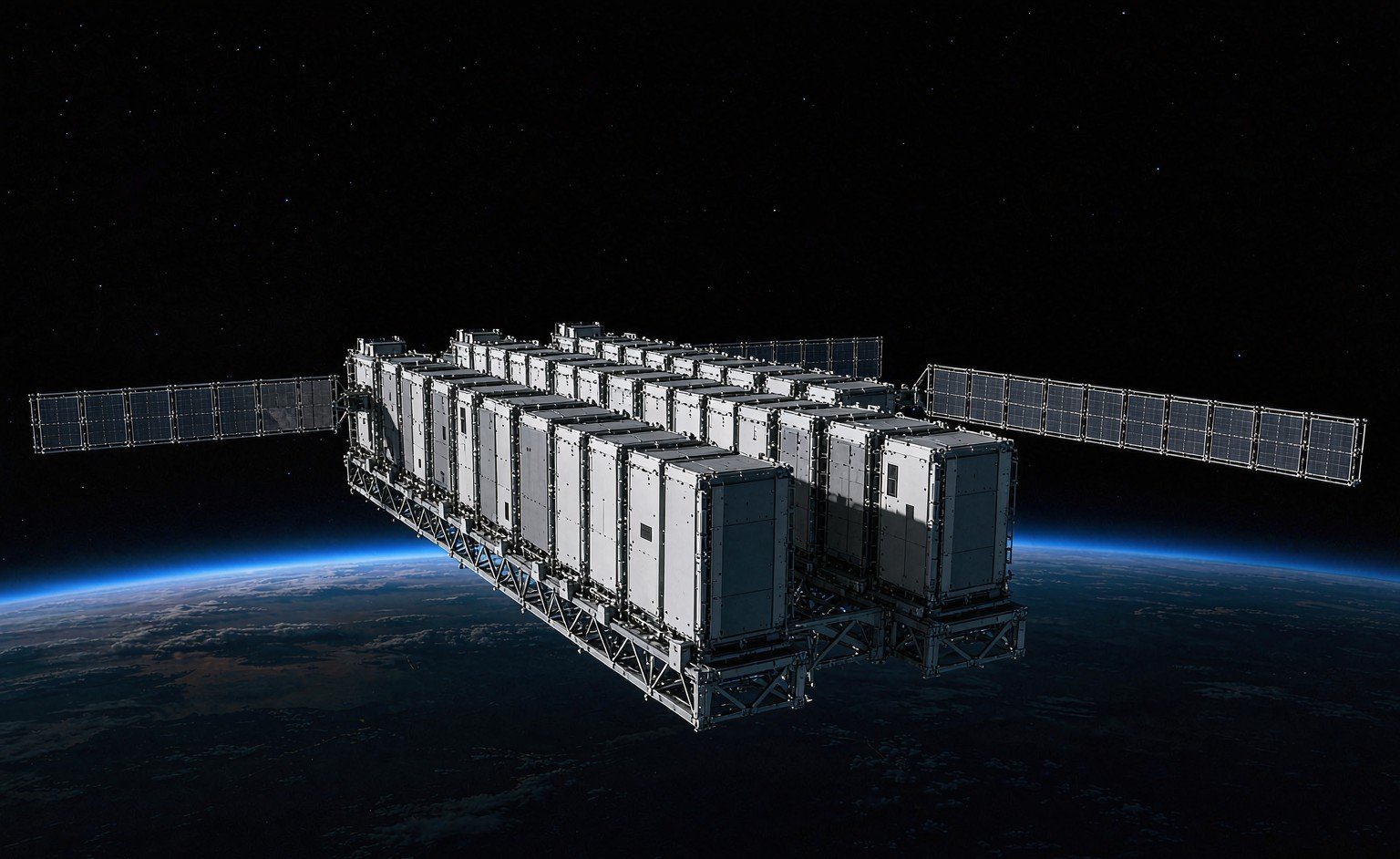
Even without politics, ground construction is constrained by power shortages, multi-year approval cycles, community opposition and a shortage of skilled trades. Orbit bypasses land, grid and environmental review in one move. Bernstein estimates that orbital data centres could cut total cost by 25 per cent or more against terrestrial facilities. A dawn-dusk orbit gets near-continuous sunlight, generating 6 to 10 times more power per unit area than the same panel on the ground, and radiative cooling in vacuum uses no water.
The engineers are less romantic. Morgan Stanley puts full cost parity at 2031, with satellites depreciating over about five years and early Starship flights deploying only single-digit megawatts. Ordinary GPUs suffer soft error rates up to 10 times terrestrial levels in orbit. Google measured HBM anomalies at cumulative radiation of 2 kilorads. Radiation-hardened HBM and GPUs are still the binding constraint. Launch cost sits near USD 658 per kilogram against an economic threshold of USD 200 to 500.
Institutions nevertheless put the space compute market at USD 135 billion by 2030, growing at a compound 130 per cent.
Flight 15 is the near-term catalyst
SpaceX plans its 15th Starship test flight on the 13th, and for the first time will try to catch both booster B22 and ship S42 with the tower arms. Catching the upper stage is the milestone that turns a partly reusable rocket into a fully reusable one. JPMorgan called ship capture the key step on the road to full reusability in an October 21 note and raised its target. Morgan Stanley has a USD 300 target and argues the AI business is valued at less than 10 times sales inside it.
The arithmetic is the whole argument. Falcon 9 puts mass in orbit at roughly USD 5,000 per kilogram with an expendable upper stage. Starship targets USD 20 to 40 per kilogram. If ship recovery works, the cost of building orbital real estate falls by another order of magnitude, which is the precondition for Starmind at scale. SpaceX expects weekly launches in the first half of 2027 and twice weekly by the end of that year. JPMorgan models launches rising from single digits in 2026 to about 5,000 in 2031, supporting 75 gigawatts of orbital compute.
China is on the same ladder
The competitive dimension is usually left out of the American bull case. China’s Long March 10B recently completed the world’s first controlled first-stage recovery using a net capture system, and Zhuque-3 achieved an orbital-class land recovery. Chinese progress on reuse is part of why Washington loosened commercial launch licensing.
For Chinese listed companies the trade is more prosaic. Launch capacity, satellite payloads, inter-satellite lasers, space photovoltaics and thermal structures are the five named links. Jiadu Technology holds a stake in Yusan Xinghe, which is planning a Pazhou space intelligent computing centre. Western allies of the trade point out that SpaceX’s compute satellites use Nvidia’s Vera Rubin NVL72 exclusively, which pulls PCB and backplane suppliers along with it.
The honest reading is that orbit is a patch on the terrestrial grid, not a replacement for it. The grid is not getting easier to permit, and that is the entire thesis.
Editor’s note: This is an adapted translation of the original 36Kr report. It has been trimmed and restructured for readability for an international business audience. The full original (in Chinese) is at https://36kr.com/p/4062369499239299.