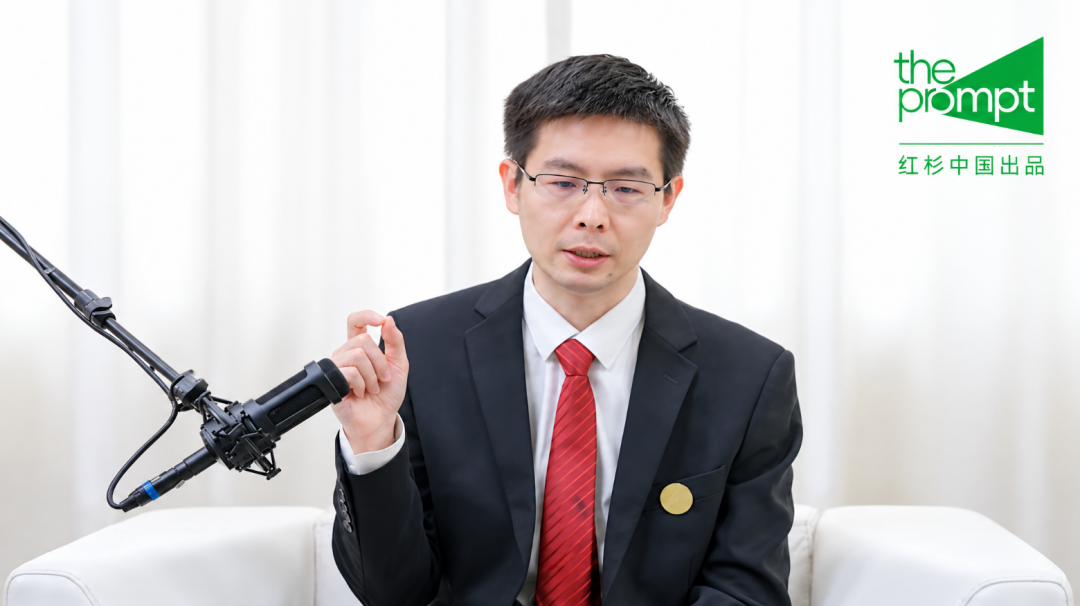
Since October, Wang Xingxing has been on more stages than most celebrated figures in Chinese technology. The industry fair in Shanghai, the World Internet Conference, the Import Expo, the World Zhejiang Entrepreneurs Conference. Short clips of his talks and candid shots of him in transit have filled Xiaohongshu and WeChat Channels.
At each stop he has repeated one claim. Embodied AI is a few millimetres away from its GPT moment, and 2027 is very likely to be the inflection point for the robotics industry.
His definition is precise. In 80 per cent of unfamiliar environments, taking natural language instructions and completing 80 per cent of tasks unaided. By his account, the leading embodied models are now infinitely close to that line.
Where the millimetres are
The bottleneck Wang describes is the small, stubborn gap between a model and the physical world. A large model can produce a plan that reads as coherent. Put it in front of a gripper that has to make contact with an object at the right pressure and angle and it stops being useful. That is why robots still cannot reliably finish work on instruction.
He thinks the gap closes within one to two years, and says teams in China and abroad are already working on it.
Others in the industry hear the same words and do not read optimism. Millimetre-level tactile sensing and generalisation across environments are engineering problems of a different class from model capability. Even a better model leaves hardware problems that can only be solved through mass real-machine trial and error, and that does not compress into a two-year schedule.
The tone changed with the valuation
People who have watched Wang for years notice the shift. At the 2024 World Robot Conference he poured cold water on the room, saying large language models had no connection to the physical world and were effectively living in a dream. On stage he talked about components and reliability, and asked the audience for patience with problems that do not yield quickly.
Then came the Spring Festival Gala appearance and the blockbuster listing. Unitree became a name beyond the industry, and Wang began talking about GPT moments, about having underestimated how fast AI would arrive, about an optimistic future.
Whether those predictions land is a separate question. The change in register is harder to separate from the capital market that now prices his company.
Bodies and brains did not merge smoothly
The gap Wang points at has existed since before the model boom. Model companies trained text and multimodal systems in the digital world. Robot companies ground away at dynamics and whole-machine stability. Different goals, different scorecards, and two unrelated funding logics, one keyed to benchmarks and the other to supply chains and motion capability.
RT-2 broke that boundary in 2023 by demonstrating the vision-language-action pattern. Model teams wanted bodies so they could collect physical interaction data and close the simulation-to-reality gap. Robot teams did not want to be reduced to sheet metal, and feared being squeezed by an upstream model supplier. Everyone announced full-stack self-development, with Tesla’s Optimus as the reference case.
The arithmetic killed most of those plans. Compute costs, a talent shortage, and the mismatch between model iteration speed and hardware debugging cycles were too much. Chinese body makers including Unitree, AgiBot, Fourier and Leju kept shipping humanoid prototypes while looking for model partners.
In August, at the STAR Market IPO roadshow, Wang confirmed that Unitree and DeepSeek had signed a strategic cooperation memorandum covering artificial general intelligence, high-performance general robots and large models. Unitree keeps the body and the lightweight motion-control cerebellum. The general model comes from DeepSeek.
Outside observers treat that division as close to optimal. An investor who follows the sector, speaking on condition of anonymity, is less sure the dividend is easy to collect. People assume that bolting a good model onto a good body produces generalisation automatically. In practice the adaptation cost is high and continuous, paid in real-machine data and alignment work. Whether model companies will open their underlying weights, and whether body makers will hand over their most valuable scenario data without reservation, are unresolved questions on both sides.
The money left before the millimetres closed
Technology needs time. Capital does not have it.
According to IT Juzi, domestic embodied AI funding fell to 33 deals worth RMB 10.105 billion in October. In June, the peak, it was 55 deals worth RMB 30.892 billion. Deal count has almost halved.
The failures are no longer hypothetical. Yinghe Robotics and Shenlan Robotics have entered bankruptcy proceedings. CloudMinds has been mired in layoffs, unpaid wages and supply chain disputes. Wujing Dynamics raised money, announced intent orders, and folded within months with close to RMB 8 million in unpaid wages. Even Yixing Robotics, backed by Li Xingxing, son of Geely chairman Li Shufu, could not close a commercial loop and disbanded its team.
Silicon Valley is going through the same wash. K-Scale Labs, one of the better-known open-source humanoid startups, ran out of cash after a failed round, and its founder wrote a public letter dissolving the team. It died in the gap between a working prototype and a product.
Investors have rewritten their questions. Where is the stable paying scenario, outside a lab demo. When does unit cost fall into a commercial band. How many of the orders are repeat orders. A demo and a story no longer clear the bar.
That is the context in which a founder turns up at four conferences in six weeks. The last few millimetres is a real technical proposition, and it names the actual engineering blockage. It is also, in a market where financing has tightened, a way for the most credible voice in the sector to keep expectations positive. Without a continuous positive expectation, the ammunition stops arriving.
The split inside the industry is no longer about who can build a full stack fastest. It is about who survives long enough to be there when the millimetres close.
Editor’s note: This is an adapted translation of the original Sohu Tech report. It has been trimmed and restructured for readability for an international business audience. The full original (in Chinese) is at https://www.sohu.com/a/1100626806_115565.