The old glowing Apple logo was a trick of the light. MacBooks used LCD panels, and behind every LCD sits a full-bleed backlight. All Apple had to do was cut an apple-shaped hole in the lid’s metal shell and let the panel’s own light leak through the shape. No separate light source, no extra power budget, no component to fail.
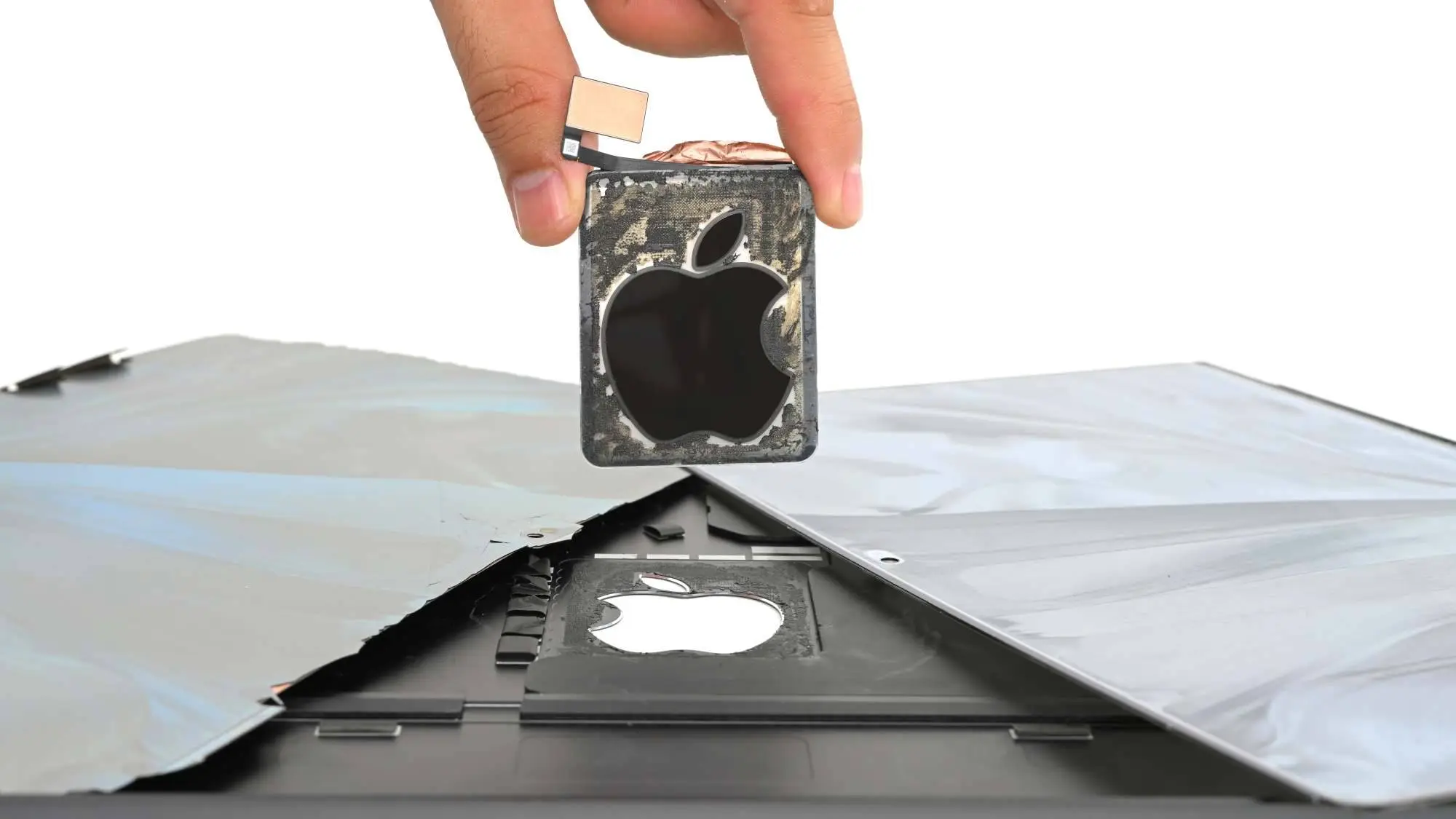
Tandem OLED removed the trick. Each pixel emits its own light, so there is nothing behind the panel to borrow. Apple had to build a lighting assembly instead, and iFixit found it during a teardown of the new 14-inch MacBook Pro: a strip carrying four LEDs, buried in the foam padding behind the display.
How four diodes replaced a backlight
The light from those four diodes hits a white reflective layer at the bottom of the cavity and spreads, then passes through a translucent diffuser film. Switched off, the logo looks much like the current MacBook Pro, a mirror-finish apple. Switched on, white light transmits softly through the coating and the brightness adjusts with ambient light.
Getting to that answer cost iFixit the panel. Separating the glass from the electroluminescent layer underneath tore the two apart, destroying a working display and its touch layer in the process. Apple’s own service documentation, published alongside the launch, lists no separate part for the glowing logo. If it fails, the whole display assembly including the lid gets replaced.
The mould changed, and the scales moved
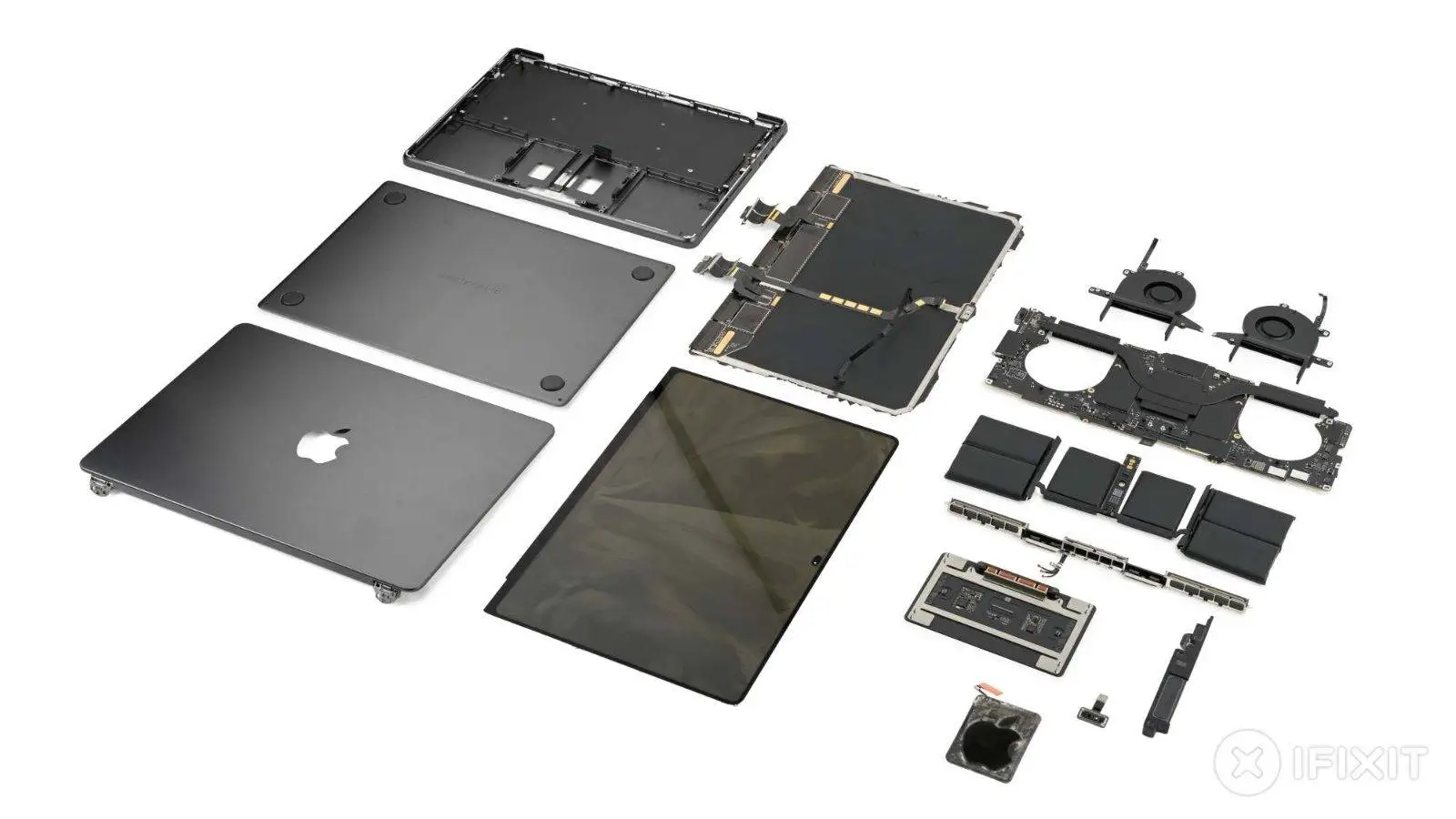
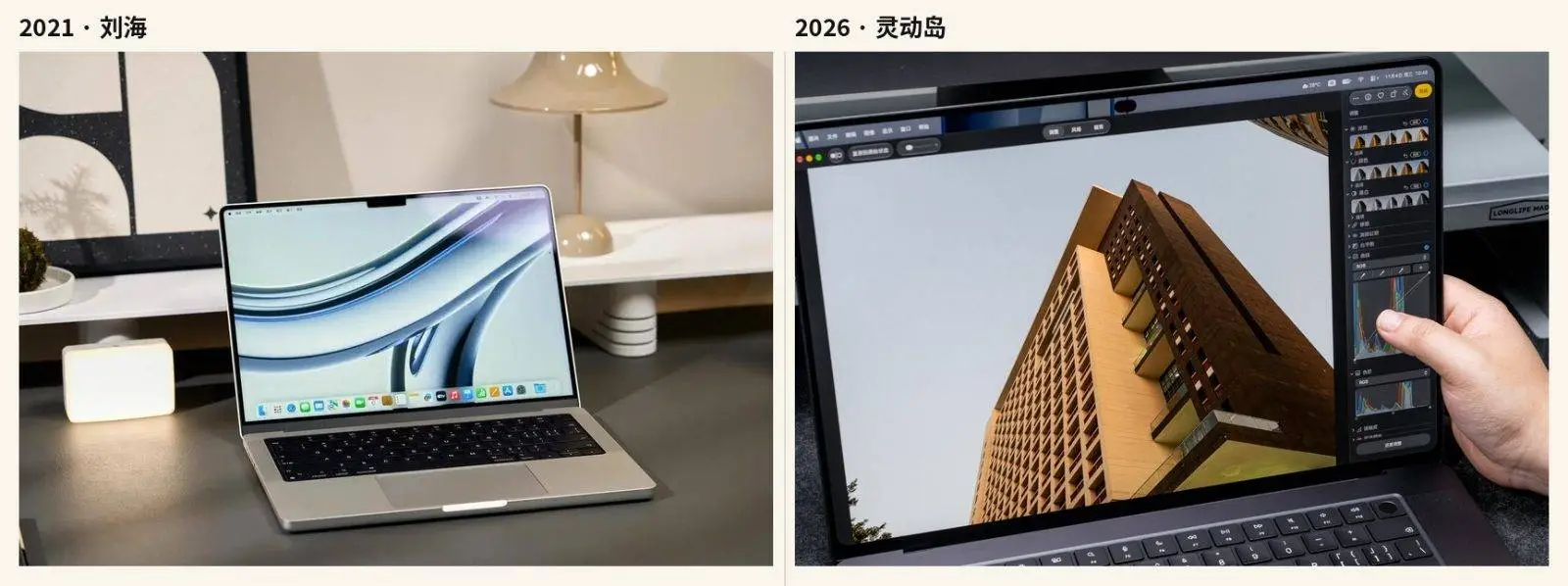
This is the first real mould change since the 2021 redesign, and the first MacBook to carry the island cutout. The 14-inch machine is now about 1.38 kilograms, roughly 220 grams lighter than the model it replaces. The 16-inch drops from 2.14 to 1.82 kilograms, a 320-gram cut.
Where the mass went is more interesting than the total. OLED saved 101 grams. The lower chassis saved another 92. The bottom cover alone lost 44 grams through internal milling, and the screws holding it went from eight to four. The 72.6Wh battery barely changed at 276 grams against 278. The speakers actually gained 10 grams to protect the acoustic chamber. Apple took aluminium out of the structure almost gram by gram.
Two boards, swapped
Touch changes the mechanical problem. A screen that is pushed with a finger needs to sit still, and Apple could have solved that by tightening the hinge. That would have cost the one-handed lid lift the line is known for. Apple’s industrial design vice president Molly Anderson has said the company redesigned the display housing and hinge to do both, and human interface design vice president Steve Lemay has framed touch as a way to make swiping, pinching and dragging files easier, with keyboard and trackpad still the primary input.
iFixit ran a parts-pairing test that matters more than the teardown photos. It took two identically configured 14-inch units and swapped their logic boards. On boot, macOS Repair Assistant recognised the battery and the display, and Touch ID accepted a new fingerprint enrolment. The touch layer worked with no calibration at all, and True Tone and brightness control survived intact.
That is a measured retreat from the pairing regime that once disabled True Tone for a replaced screen and killed biometric authentication after a home button or mainboard swap. Apple opened a self-service repair programme in 2022, later allowed used genuine parts, and has been handing back software calibration rights in small increments since. This is another increment, and it raises an obvious question for the modification scene in Shenzhen: whether an older, non-touch MacBook body could be made to accept a touch panel.
The score is still five out of ten
iFixit rated the machine 5 out of 10 for repairability, up from 4 for the previous generation. That is an improvement, not a compliment. The Thunderbolt ports sit on their own small boards and the fan is a separate module, but both are trapped under the mainboard. Clearing dust from a fan or replacing a worn port means lifting the entire board out of the chassis.
HDMI, the SDXC reader, the unified memory and the SSD remain soldered or integrated with no path to replacement or upgrade.
A five-year gap between moulds produced a laptop that is meaningfully lighter, genuinely easier to open, and still closed at the two places owners most want to change. The direction of travel on repair is finally forward. The pace is one point per generation.
Editor’s note: This is an adapted translation of the original Sohu Tech report. It has been trimmed and restructured for readability for an international business audience. The full original (in Chinese) is at https://www.sohu.com/a/1100513711_413981.