Wangyuan Technology sells machines that clean swimming pools. On 30 October it cleared an overseas listing filing with the China Securities Regulatory Commission, and the numbers behind the business are now on the record.
Revenue reached RMB 812 million in 2025 with net profit above RMB 100 million, up from RMB 378 million in 2023. Unit sales rose from 371,000 to 501,000 over the same period, and own-brand products accounted for RMB 678 million, or 83.5 per cent of revenue.
A machine spotted over dinner
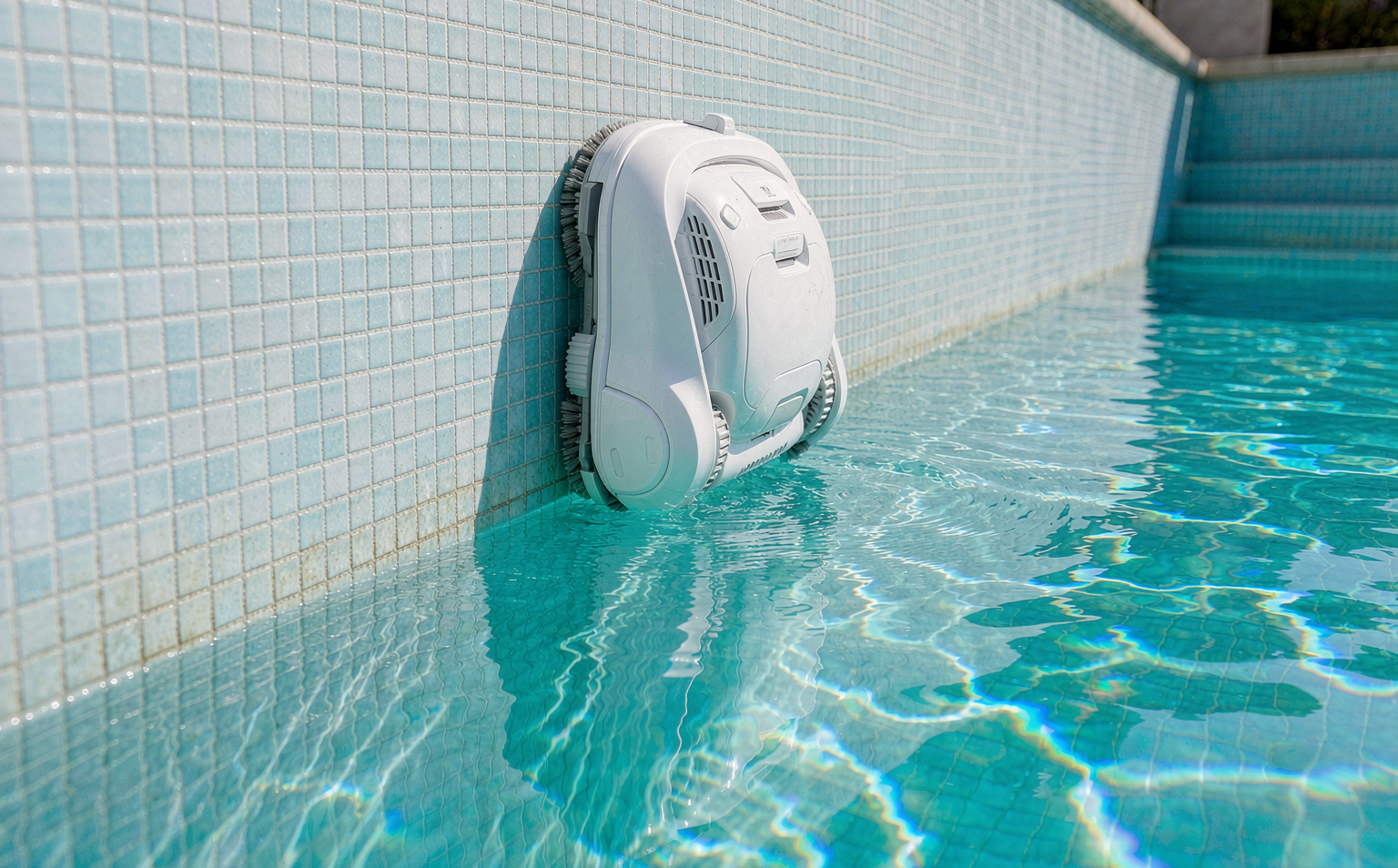
Fu Guilan saw her first pool cleaning robot more than twenty years ago at a French friend’s house. She was close to fifty, had studied French, had worked at a marine technology institute under the State Oceanic Administration and had already run a trading company. She decided the small machine crawling along the pool wall contained a business.
She founded Wangyuan in Tianjin in 2005 with her son Yu Qian. A year later the first products reached Castorama, a French chain, sold well for a few months, and then came back. The underwater motor seals had failed and water had got inside. By her own account the venture consumed several million renminbi of savings and two mortgaged apartments, and the company was still losing money in 2007 and 2008.
The turn came around 2009, when she noticed a segment the incumbents had left alone. Foreign machines served large luxury pools and cost thousands of dollars. Plenty of European and American households instead owned cheap above-ground pools and would not spend that much on cleaning equipment. Wangyuan built smaller, lighter and cheaper machines, then added cordless models to remove the cable.
The company moved from contract manufacturing for foreign brands to selling under its own labels, WYBOT and Winny Pool Cleaner. Fu, now 70, remains chair and general manager. Her son is vice chair and technical director, her spouse sits on the board, and the two of them control 87.8 per cent of the shares.
Third in the world, first in China
By 2024 self-manufactured shipments put Wangyuan third globally and first in China. In cordless products it holds 19.7 per cent of the global market, the largest single share.
The wider market is no longer growing in a straight line. IDC counted about 1.533 million pool robot units shipped worldwide in the second quarter of 2026, down 6.3 per cent year on year, in what should be the peak season. Channels in Europe and North America are still working through inventory, buyers are in a replacement cycle rather than a first-purchase cycle, and price competition has sharpened. Cordless machines now account for 61.6 per cent of in-ground pool cleaner shipments, which means the feature that once differentiated a product has become the entry ticket.
Margins are thinner than the category suggests. Chinese manufacturers describe average gross margins of 50 to 55 per cent, but several firms run net margins in the single digits because marketing absorbs the rest. Israel’s Maytronics, long the category leader, reported a net loss of about ILS 222 million for 2025. Among cordless shippers, the top five worldwide in 2024 were all Chinese and took 51.4 per cent combined.
The tariff arithmetic
Wangyuan earns 93.1 per cent of its revenue outside China, with North America and Europe together at 85.1 per cent. From May 2025 its products entering the United States have carried an additional 30 per cent duty, and tariff and logistics costs reached RMB 60.08 million in 2025, roughly a fifth of cost of sales.
The prospectus carries an estimate of what a wider application of the rate would do. If close to half of US-bound products were dutied at the new level, the incremental cost could exceed RMB 45 million, more than 40 per cent of 2025 net profit. The company lists flexible pricing, procurement changes and overseas contract manufacturing as responses. Each of those either passes cost to a consumer with alternatives or moves production out of the network that made the machine cheap.
Thirty-seven renminbi out of every hundred
The more binding constraint sits in distribution. Around half of 2025 revenue came through Amazon, gross margin was 62.9 per cent and net margin 12.4 per cent. Sales and marketing spending rose from RMB 97.2 million in 2023 to RMB 303 million in 2025, which works out at about RMB 37 of every RMB 100 collected going back out the door to find the next buyer.
Inventory tells the same story from the other side. Stock rose from RMB 120 million in 2023 to RMB 282 million in 2025, up 135 per cent, and inventory days lengthened from 248 to 293. Pool owners buy in spring and summer, so manufacturers produce and ship months ahead, and unsold stock ties up cash in a warehouse on another continent.
Legal exposure runs alongside. Zodiac, a pool equipment incumbent, brought a US Section 337 investigation and patent suits in several jurisdictions. The 337 case ended in 2023. Actions in California and France remain open, with the French claim at about EUR 2.5 million.
Where the next margin comes from
The shakeout is already visible below the leaders. Suzhou-based Zhicheng Dongli, which sells SMOROBOT cleaners into the same markets and took a RMB 25 million investment from an Ecovacs subsidiary in 2024 for about 8.62 per cent, entered bankruptcy review proceedings in September 2026 and says it is pursuing pre-restructuring.
The premium end is the escape route being tested. Beatbot, whose AquaSense 2 Ultra lists above USD 3,000 before promotions, integrates surface, wall, floor and waterline cleaning into one machine and raised more than RMB 1 billion in September 2025 led by Meituan Longzhu. Aiper, the consumer brand of Yuanding Intelligent, went the other way and pushed into specialist pool retail, reaching more than 1,000 French stores.
Both routes end at the same gate. A pool robot that reliably returns to its dock, empties itself and does not break earns a premium. One that stacks features earns a longer service queue and a thinner margin.
Wangyuan spent two decades proving a Chinese company can sell robots into European and American households. The listing will test something narrower: whether that business can grow without buying every extra unit of revenue through ever more expensive traffic.
Editor’s note: This is an adapted translation of the original OFweek report. It has been trimmed and restructured for readability for an international business audience. The full original (in Chinese) is at https://robot.ofweek.com/2026-11/ART-8321204-12003-30710405.html.