Japan has just spent USD 12 billion to make sure a chemical stays Japanese. The asset is a photoresist maker. The buyer is a chemical company and a state bank. The seller is the state fund that took the same company private four years ago.
The trade
Mitsui Chemicals and the Development Bank of Japan will acquire 100 per cent of JSR from the Innovation Network Corporation of Japan (JIC) for JPY 1.84 trillion. It is the largest chemicals acquisition in Japanese history by value.
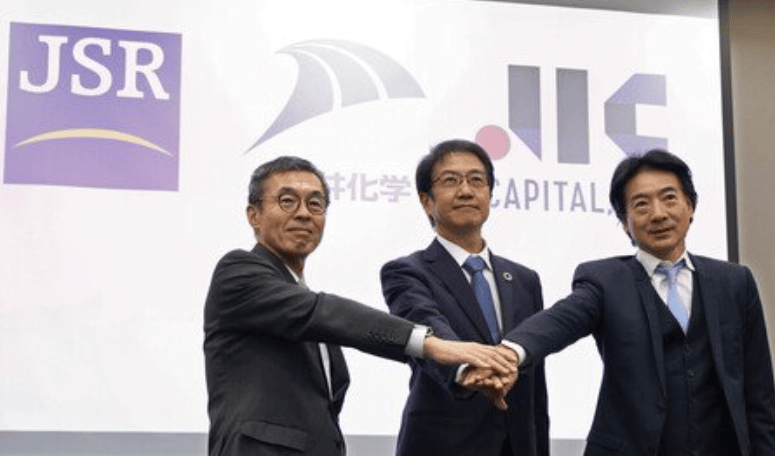
JSR is the second largest photoresist supplier in the world with a 19 per cent share, and its materials sit inside the supply chains of TSMC, Samsung and Intel. It listed in Tokyo in 1970 and carried a market value of around JPY 900 billion before it was taken off the exchange.
Why the state moved first
In 2022 Merck approached JSR with a bid. Merck had already bought AZ Electronic Materials in 2014 and Versum in 2019, assembling one of the broadest semiconductor chemicals portfolios in the industry. What it lacked was resist, particularly for extreme ultraviolet lithography. JSR was the obvious gap to fill.
JIC intervened instead. The fund bought JSR and delisted it, and the company stayed inside the Japanese system. Four years later the same fund sells at JPY 1.39 trillion, against JPY 900 billion paid, a 54 per cent gain and roughly 24 per cent annualised.
The numbers behind the moat
Photoresist is a small business. Volumes are measured in tonnes, margins are thinner than in logic or memory, and the payback on a new resist platform is measured in years rather than quarters. Every one of Japan’s five major suppliers, JSR, Tokyo Ohka Kogyo, Shin-Etsu Chemical, Sumitomo Chemical and Fujifilm, is domestic.
That concentration is the point. Resist is a consumable that decides whether a wafer prints or scrapes, and it is where Japan’s leverage over advanced nodes actually lives. Ownership of the second largest supplier is not a portfolio position. It is an export control instrument that happens to pay a dividend.
The mechanism, not the deal
What Tokyo built is a relay. Public capital takes the earliest and slowest risk, the part of the curve where a private buyer would want a discount. Once the technology clears its hardest stretch, the asset passes to industrial capital that can run it commercially, and the state exits with a return.
European and American competition policy has spent a decade arguing about whether this kind of thing is fair. Japan stopped arguing in 2022 and started buying. The result is that the country now owns the choke point for the next lithography generation as well, including high numerical aperture EUV, without having to win a single leading edge logic node.
The lesson for anyone building a domestic materials industry is uncomfortable. Merck saw a good business. Tokyo saw the last line of a national strategy, and paid for it with money that did not need a quarterly return.
Editor’s note: This is an adapted translation of the original Sohu Tech report. It has been trimmed and restructured for readability for an international business audience. The full original (in Chinese) is at https://www.sohu.com/a/1100583791_120505449.