Honda’s first half looked nothing like the headlines coming out of its Chinese joint ventures, and the gap between the two is the most useful number in the global car business this month.
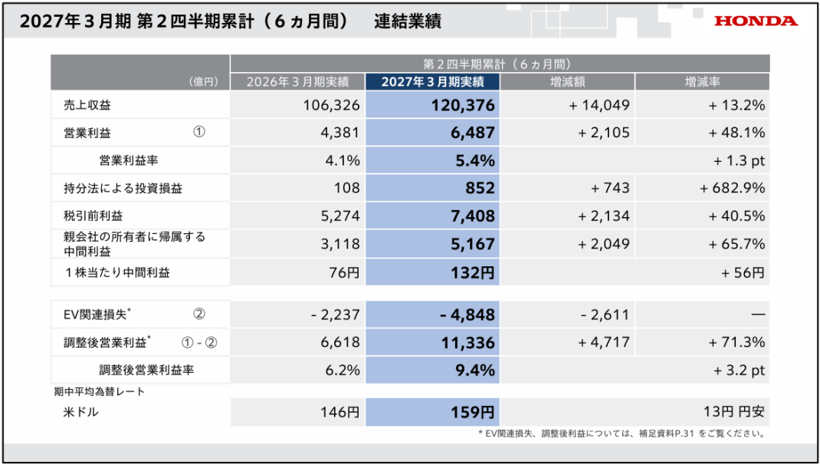
For the six months to 30 September, Honda reported revenue of JPY 12.04 trillion, up 13.2 per cent, and net profit attributable to owners of JPY 516.76 billion, up 65.7 per cent. That half-year profit alone exceeded the company’s full-year guidance of JPY 400 billion. US tariff adjustments and yen movement did much of the work.
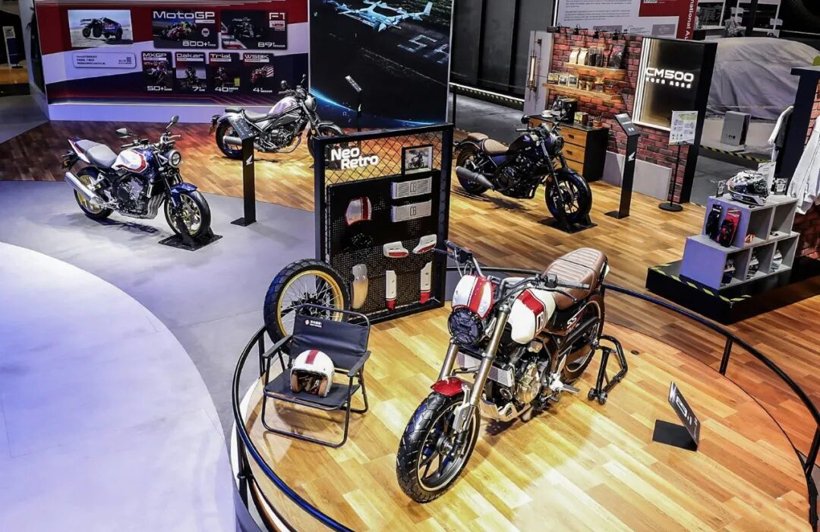
Motorcycles carry the group
The two-wheeler division produced first-quarter operating profit of JPY 233.9 billion at a 20.5 per cent margin, on global half-year sales of 11.9 million units, up 10.6 per cent, with India and Brazil contributing heavily.
Cars were weaker. Global car sales fell 6.6 per cent to 1.569 million units, with China the drag. North America sold 897,000 units in the half on strong demand for compact cars, efficient vehicles and hybrids.
Honda has responded to policy shifts market by market rather than defending a single global electric timeline. It cancelled development of three North American battery-electric models as US incentives were withdrawn and demand cooled, and it has written a separate China strategy on the premise that Chinese buyers will not accept a foreign-designed electric car unchanged.
USD 3 billion into Ohio
Honda is building a new plant in Ohio with investment of about USD 3 billion, roughly JPY 470 billion, scheduled to start production within 2029. It is aimed at rising hybrid demand and configured to handle electric models flexibly. North American capacity rises from 1.67 million to 1.91 million units by 2029, which holds the base even if the US tariff rate on Japanese cars, cut from 27.5 to 15 per cent, moves again.
The company has also cut its full-year car sales target from 3.39 million to 3.16 million units. All 230,000 units of that reduction come from China.
The China parts decision
Nikkei Automotive reported that Honda has adopted a policy of widening its use of China-standard components, moving away from its traditional in-house supplier relationships toward parts with proven Chinese market performance and lower prices.
Honda says it is not cutting purchases from Japanese suppliers and that competitiveness, not nationality, decides sourcing. The practical consequence is still structural. If Honda adopts platforms developed with Chinese partners, nomination authority can shift toward the Chinese side, and Honda’s traditional supplier family loses ground.
The comparison is not flattering. Toyota began local development with the bZ3X from March 2025. Nissan’s N7, N6, NX7 and NX8 all came through that route. Honda is arriving late to a decision its competitors made two years ago.
The pressure is visible at the bottom of the range. BYD’s Dolphin is now competing directly with Honda’s own N-Box in Japan’s kei segment. Honda’s next-generation Avancier will debut overseas rather than in China, on the company’s reading that hybrid demand is stronger outside.
Honda can afford to be patient because its balance sheet is not Chinese. It cannot afford to be absent, because the technology and cost base that will define the next decade of cars is being set there. China can do without Honda. The reverse is a harder sentence to finish.
Editor’s note: This is an adapted translation of the original Gasgoo report. It has been trimmed and restructured for readability for an international business audience. The full original (in Chinese) is at https://auto.gasgoo.com/news/202611/13I70477858C109.shtml.