Bethel’s first motor project has entered production, supplying its WCBS brake-by-wire system. With in-house valve bodies, solenoid valves and controllers already in place, the move adds motor manufacturing to the company’s command of core electronic chassis components.
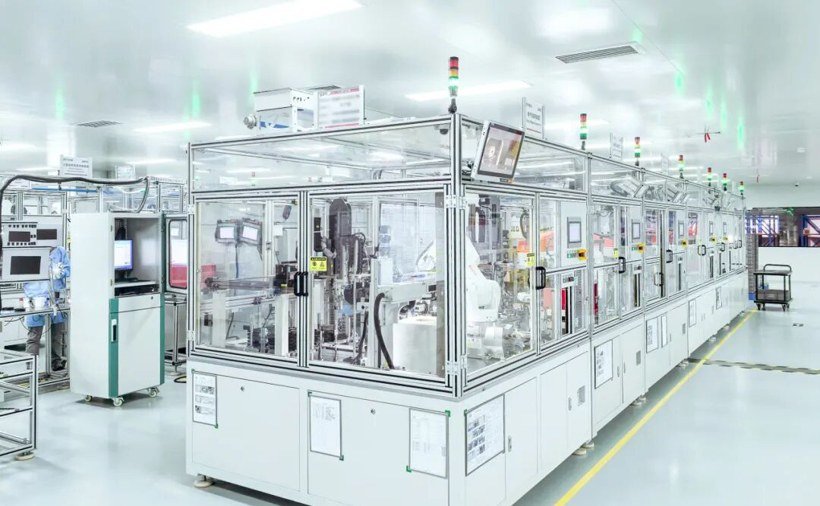
For the brake-by-wire application, Bethel developed its own magnetic circuit and winding technology. Raising slot fill and magnetic density increases power density, delivering 700 watts of peak power in a compact size to support rapid pressure build-up.
Higher slot fill and magnetic density also make electromagnetic noise harder to control, so the design was tuned to balance output with smooth operation. A low-inertia rotor improves response to control commands, and an integrated RPS position sensor enables pedal feel simulation and closed-loop control of braking energy recovery within the WCBS system.
The company said the project took just three months from line installation to formal production.
From here, Bethel’s motors will extend across WCBS, EMB, EPS and suspension systems, giving it a fuller base for integrated brake, steering and suspension control. Its first EMB project reached mass production in March and has shipped 60,000 units to date, with three further volume projects under way.
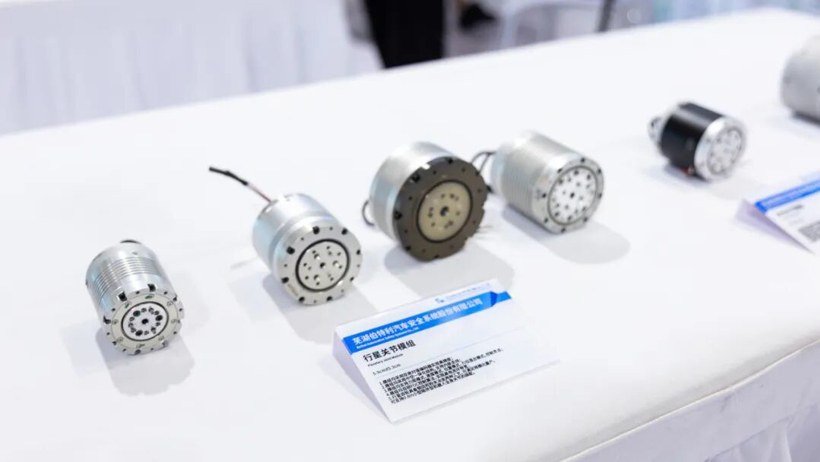
Alongside vehicle systems, Bethel is developing frameless torque motors and direct-drive motors for humanoid robot joints, and has laid out precision transmission parts including ball screws, micro roller screws and planetary roller screws. It first showed its joint modules publicly at the 2026 World Manufacturing Convention.
For different parts of the humanoid body, Bethel offers planetary, harmonic and cycloidal joint modules. The planetary unit uses dual absolute encoders and a hollow integrated structure, supporting torque, speed, position and mixed force-position control for small companion robots. The harmonic unit targets upper limbs with precision and response tuned in. The cycloidal unit is built for high-load lower limbs and trunks.
Editor’s note: This is an adapted translation of the original Gasgoo report. It has been trimmed and restructured for readability for an international business audience. The full original (in Chinese) is at https://auto.gasgoo.com/news/202611/19I70478461C103.shtml.