Frost & Sullivan recently published a white paper on the global quadruped and wheel-legged robot industry. Measured by revenue, three Chinese companies, Unitree, Juewei Technology and DeepRobotics, entered the global first tier alongside Boston Dynamics of the United States and ANYbotics of Switzerland. The older phrase about Hangzhou’s four little dogs, which named Unitree, Juewei, DeepRobotics and Wuba, is giving way to a wider Chinese four as domestic firms form a block at the top of the market.
Unitree built a manufacturing business
Unitree is a general-purpose robotics company working across humanoids, quadrupeds, components and embodied models. It was the first in the world to sell high-performance quadrupeds publicly and to land them in industry, with Go2, B2 and A2 among its live models. In 2023 its quadruped business generated RMB 119 million, or 75.78 per cent of core revenue. The next two years took that to RMB 231 million and RMB 698 million, but by 2025 humanoid revenue had reached RMB 868 million and overtaken the dogs.
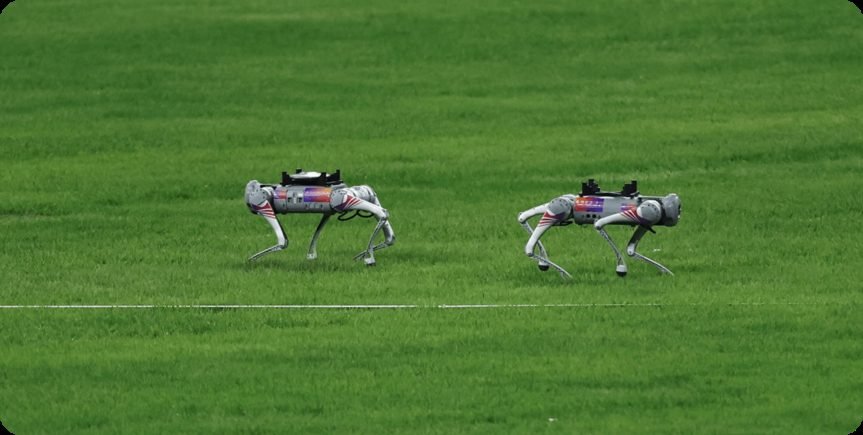
Scale defines the route. GGII data shows Unitree held 69.75 per cent of global quadruped sales as early as 2023. By 2025 cumulative shipments exceeded 33,000 units and the average selling price had fallen from RMB 38,300 in 2023 to RMB 30,300, reflecting both product mix and deliberate cost reduction. Unitree built a standard product, expanded coverage through online, offline, direct and distribution channels, and turned scale and iteration into commercial efficiency. Growth came from supply.
Juewei took the dangerous jobs
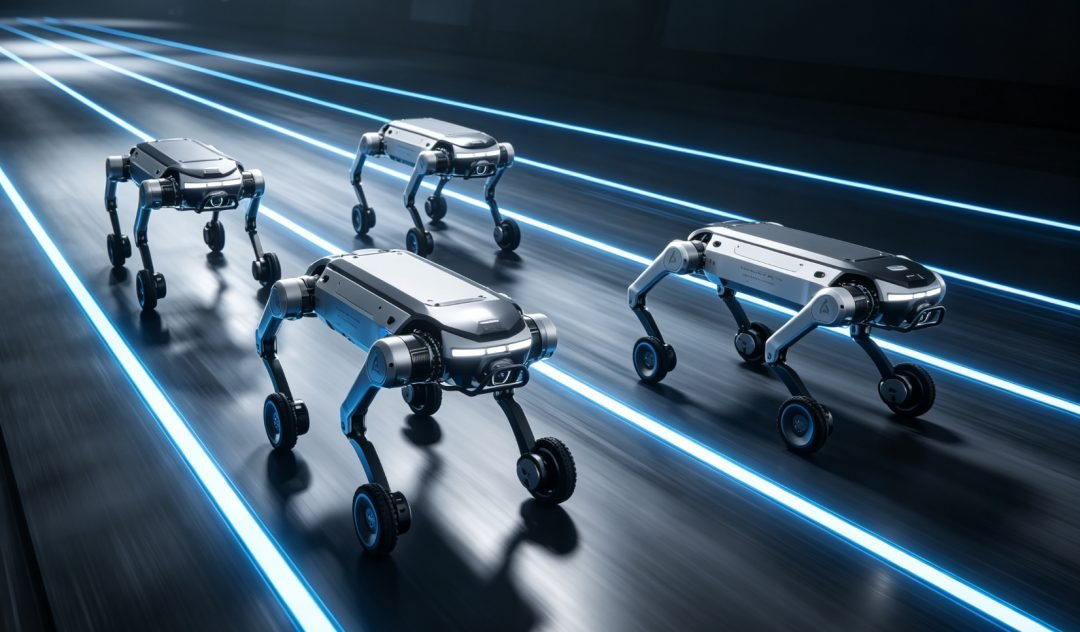
If Unitree makes standard products, Hangzhou-based Juewei chose the hardest special-purpose route. Mines, petrochemical plants, aluminium smelters and firefighting all contain high-risk, repetitive and long-duration tasks unsuitable for people. Juewei’s stated goal is an all-terrain autonomous mobile intelligences that reduces human exposure in dangerous zones. Its MOVENEW P3S industrial base carries 16 in-house MICPOW 106 high-density flat-wire joints, and the company is the only maker applying flat-wire motors to an embodied body. It also offers a liquid-cooled P3S LC, the first liquid-cooling system on an embodied machine.
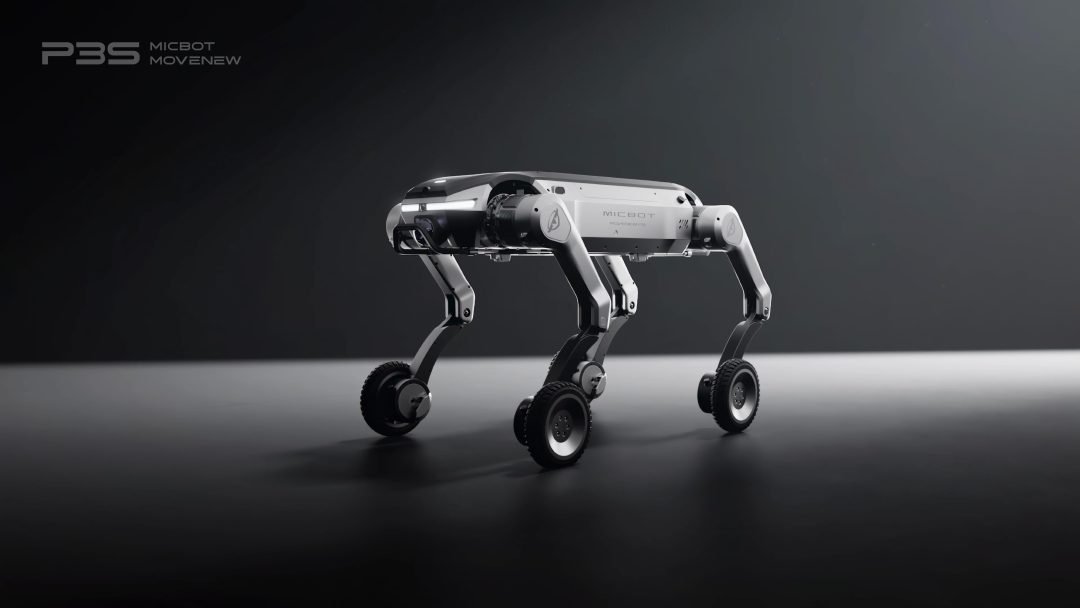
In continuous walking and stair climbing the P3S carries about 100kg, rises to 300kg under heavy load, and reaches a 400kg dynamic and 600kg static limit as a transport carrier, the highest load figure in the industry. Juewei has extended from components into bodies, task software and platforms, using the MicVLC industrial brain with MICBOT-HUB and MICBOT-MOVE for device management, scheduling and control. The company is trying to become real productivity at the most dangerous industrial sites rather than a demonstration machine.
DeepRobotics patrols, Weilan moves in
DeepRobotics, founded in 2017, picked the lighter route. Since 2019 it has worked with units under State Grid and China Southern Power Grid to make quadruped and wheel-legged machines a new path for power inspection. Its solution entered the tunnel corridor project of Singapore’s SP Group in 2024, with a second phase delivered the following year. It serves power inspection, emergency firefighting and police security with products such as the Jueying X30 and Lynx M20. The job is not heavy lifting but frequent, routine patrol, a tool that can hold a post for long periods.
The fourth seat is contested. Weilan Technology is a strong candidate as the only one of the four treating the home as the main battlefield. When it settled in Nanjing’s Jiangbei new area in 2019, few backed the idea. Peers crowded into business customers, the consumer supply chain was unformed and imported chips put machines beyond household budgets. Weilan chose to keep the track and change the brain, developing an A3 heterogeneous computing cluster with six domestic chips to bring voice and scene recognition inside the cost line. Baby Alpha series sales passed 25,000 units, some models priced below RMB 10,000, reaching 295 cities. The company entered the 2025 Forbes China AI 50 and holds more than a hundred invention patents. What it sells is closeness: how well the machine fits into a family.
Put the four together and they are running on four different tracks. Unitree industrialised the dog. Juewei sent it into the heaviest dangerous work. DeepRobotics made it a routine inspection worker. Weilan brought it into the living room. The shared lesson is that China’s robotics industry has learned to avoid homogenous infighting and to compete through differentiation instead. An installed base is one measure. Knowing which problem a machine is built to solve is another.
Editor’s note: This is an adapted translation of the original OFweek report. It has been trimmed and restructured for readability for an international business audience. The full original (in Chinese) is at https://robot.m.ofweek.com/2026-11/ART-8321204-8420-30712924.html.