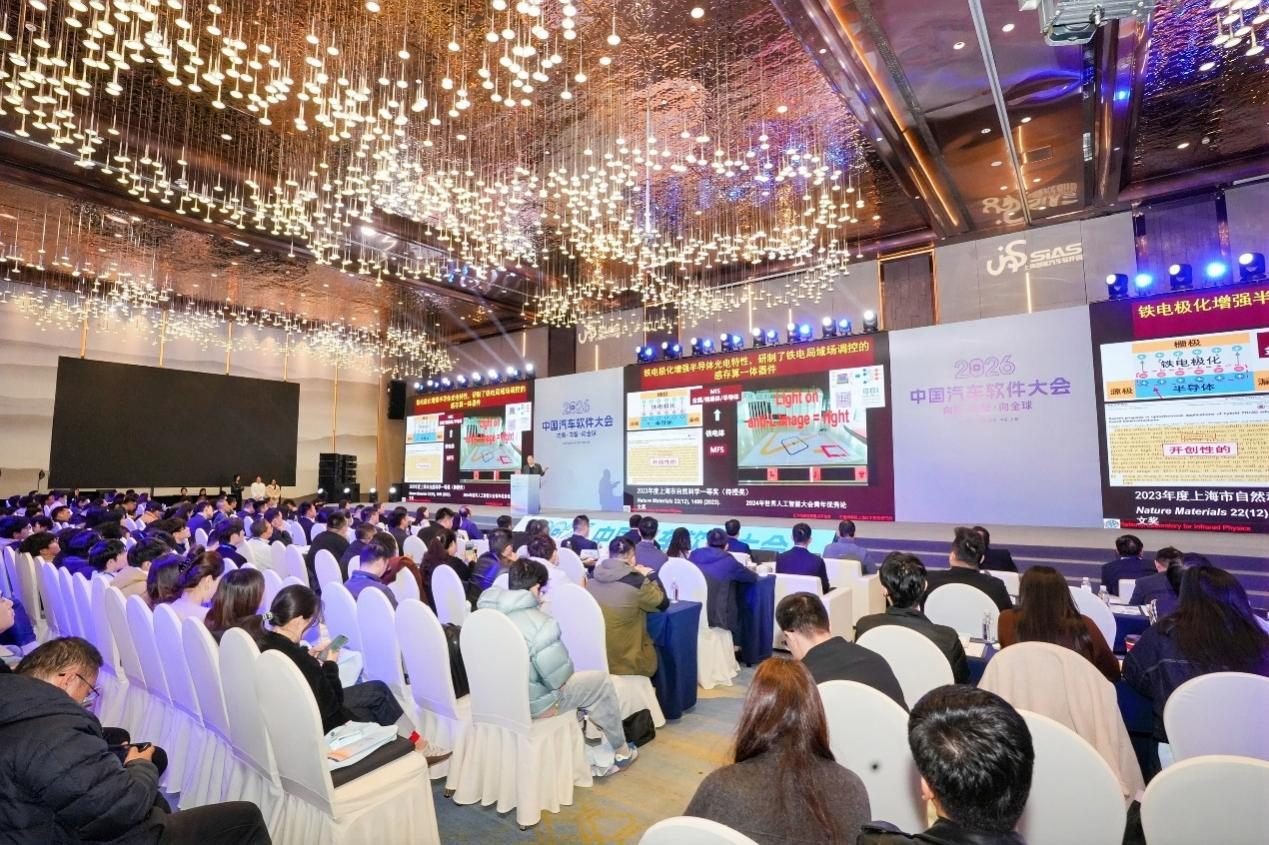
The 2026 China Automotive Software Conference opened in Jiading, Shanghai, on 19 and 20 November under the theme of newness, intelligence and global reach. Hosted by the China Association of Automobile Manufacturers and Shanghai International Automobile City, the programme ran one closed session, one main forum, four themed forums and a series of releases focused on chip-software coordination, base software and operating systems, embodied intelligence in autos, trusted data flows and cockpit interaction.
From scale advantage to system advantage
2026 marks the start of the 15th Five-Year Plan and a transition for China’s auto industry from scale and market strength towards technological-system and ecosystem strength. A representative of the Ministry of Industry and Information Technology said automotive software spans vehicle operating systems, applications and cloud services across the full life cycle of research, production and operation, and called for innovation led by application, standards that guarantee safety and trust, and open cooperation on ecosystem growth.
A Shanghai official framed the shift more directly. Global competition is moving from whole-vehicle performance to software and ecosystems, with software-defined vehicles, data-driven design and AI reshaping the travel experience. The city promised to complete vehicle-grade software engineering tools, tie into its plan for a high-level autonomous-driving pilot zone and help Chinese firms join international standard setting.
CAAM secretary-general Fu Bingfeng reported that from January to October China produced and sold more than 14.4 million new-energy vehicles, over 54 per cent of the total, with exports becoming a major growth driver. L2 combined driver assistance had passed 70 per cent penetration in passenger cars. He called for stronger standards, deeper AI use to raise efficiency and safety, and greater international coordination on basic software.
Data, insurance and the embodied turn
The conference hosted several releases. A new International Automobile City software park site of 40,000 square metres came into use with a national 10-gigabit optical network and a high-performance computing centre to support driver-assistance algorithms, vehicle-grade software and chip-software integration, with the first tenants signing on stage. A strategic letter of intent between Tongji University’s School of Mechanical Engineering and Robotics and Shanghai International Automobile City aims to move robotics research out of laboratories and into production lines, linking university work in robotics and embodied intelligence to the city’s industrial scenarios.
A joint centre involving the Shanghai Meteorological Service, Jiading district and the automobile city published a solution that combines vehicle, weather and insurance data to identify high-risk vehicles and improve rescue response. A white paper on trusted driving data for advanced-automation insurance, led by CAAM with Pacific Insurance, Dongfeng, Changan, GAC and others, focuses on L4 systems and cross-institution data collaboration. The first batch of automotive intelligent agents also connected to a trusted data space built by CAAM and Zhonglian Technology, allowing agents to call on data under controlled and traceable conditions.
Four afternoon forums covered chip-software integration, embodied intelligence in the auto industry, trusted data circulation and cockpit experience. Speakers from Dongfeng, SAIC, Huawei, Neusoft Reach and others discussed high-safety AI operating systems, AI-driven vehicle architecture, phone-car connectivity and data-driven insurance. Now that hardware scale is largely settled, the contest is over the software and data layer built on top of it.
Editor’s note: This is an adapted translation of the original Gasgoo report. It has been trimmed and restructured for readability for an international business audience. The full original (in Chinese) is at https://www.gasgoo.com/apps/e060bad9eca91db7f01403fc7120041f/robot/news/70478677-%E5%90%91%E6%96%B0-%E5%90%91%E6%99%BA-%E5%90%91%E5%85%A8%E7%90%83/.