In Race for AI Supremacy, Capital Floods Robotics While Nvidia Navigates Sanctions
MONDAY, JANUARY 26, 2026
SHANGHAI / BEIJING
Nvidia CEO Jensen Huang Visits Shanghai Amid US Export Control Tensions
Nvidia’s chief executive makes a low-profile visit to the company’s Shanghai office, signaling a continued commitment to the Chinese market despite tightening US sanctions.
SHANGHAI — The founder and CEO of Nvidia, Jensen Huang, arrived in Shanghai today for an unpublicized inspection of the company’s local operations, marking his first visit to the mainland in over a year. The visit comes at a delicate geopolitical juncture, as Washington continues to tighten export controls on advanced AI semiconductors. Industry insiders speculate that Huang’s presence is intended to reassure domestic staff and partners about Nvidia’s long-term strategy in China, specifically regarding the distribution of compliant chips like the H20 series.
Analysts suggest this move highlights the indispensability of the Chinese market, which still contributes significantly to Nvidia’s global revenue despite regulatory headwinds. “Huang’s visit is a pragmatic diplomatic mission,” notes a Shanghai-based semiconductor analyst. “He is walking a tightrope between complying with the US Commerce Department and maintaining relationships with key Chinese clients like Alibaba and Tencent, who are increasingly eyeing domestic alternatives.” The visit is expected to include closed-door meetings with key cloud computing stakeholders, though no official public itinerary has been released.
Shanghai Unicorn StepFun Secures $718m in Series B+ Funding
Generative AI startup StepFun raises a massive financing round to accelerate the development of its multimodal large language models.
SHANGHAI — Shanghai-based artificial intelligence unicorn StepFun has successfully closed a Series B+ funding round, raising over $718 million (5.2 billion RMB) from a consortium of state-backed and private investors. This latest capital injection values the company as one of China’s most valuable AI startups, intensifying the domestic race to rival OpenAI’s GPT-4. StepFun, known for its Step-2 large language model (LLM), plans to use the funds to expand its computing infrastructure and recruit top-tier talent in algorithm research.
The sheer size of the deal underscores the continued appetite of Chinese capital for foundational model companies, even as the market begins to consolidate. “This funding secures StepFun’s seat at the high table of China’s ‘Model Wars’,” says a venture capital partner involved in the deal. The company has stated its intention to focus on “scaling laws” for multimodal capabilities, aiming to improve reasoning in complex industrial scenarios. This move puts increased pressure on competitors like Moonshot AI and MiniMax to demonstrate commercial viability in 2026.
DeepSeek Releases Open-Source ‘v4’ Model, Claiming Efficiency Breakthrough
Hangzhou-based lab DeepSeek unveils its v4 model, boasting superior coding and reasoning performance at a fraction of the inference cost of US rivals.
HANGZHOU — DeepSeek, an AI research lab rapidly gaining global notoriety, has today released the open weights for its DeepSeek-v4 model, a massive Mixture-of-Experts (MoE) architecture that purportedly outperforms GPT-4.5 on key coding benchmarks. The release has sent shockwaves through the developer community due to its “Manifold-Constrained Hyper-Connections” (mHC) architecture, which drastically reduces computational overhead. Early benchmarks suggest the model achieves near-parity with frontier Western models while running on consumer-grade hardware, a strategic play to capture the open-source ecosystem.
The release challenges the proprietary business models of Western giants by offering state-of-the-art reasoning capabilities for free. “DeepSeek is effectively commoditizing intelligence,” observes a Beijing-based AI researcher. The v4 model also introduces a “silent reasoning” module that performs chain-of-thought processing without generating token costs, a feature likely to appeal to enterprise users optimizing for budget. This development highlights China’s growing prowess in algorithmic efficiency as a counter-strategy to hardware restrictions.
AsiaInfo and ABB Robotics Launch ‘Embodied Intelligence’ Lab in Beijing
A strategic partnership between a leading software provider and a global robotics giant aims to bridge the gap between industrial automation and generative AI.
BEIJING — Software heavyweight AsiaInfo Technologies and Swiss-Swedish multinational ABB Robotics have formally inaugurated a joint “Embodied Intelligence Laboratory” in Beijing. The facility, unveiled by AsiaInfo Chairman Tian Suning and ABB Robotics China President Han Chen, will focus on integrating large AI models with industrial robot control systems. The collaboration seeks to create “physical AI” solutions that allow robots to adapt autonomously to unstructured manufacturing environments, moving beyond rigid pre-programmed tasks.
This partnership represents a critical convergence of IT (Information Technology) and OT (Operational Technology) within China’s manufacturing sector. “The lab will serve as a testbed for the next generation of smart factories,” stated Dr. Ouyang Ye, AsiaInfo’s CTO. With Alibaba Cloud joining as a technology partner, the initiative aims to deploy these intelligent systems across the automotive and electronics supply chains. The move aligns with Beijing’s broader “New Productive Forces” policy, which prioritizes the upgrading of traditional industries through advanced digital technologies.
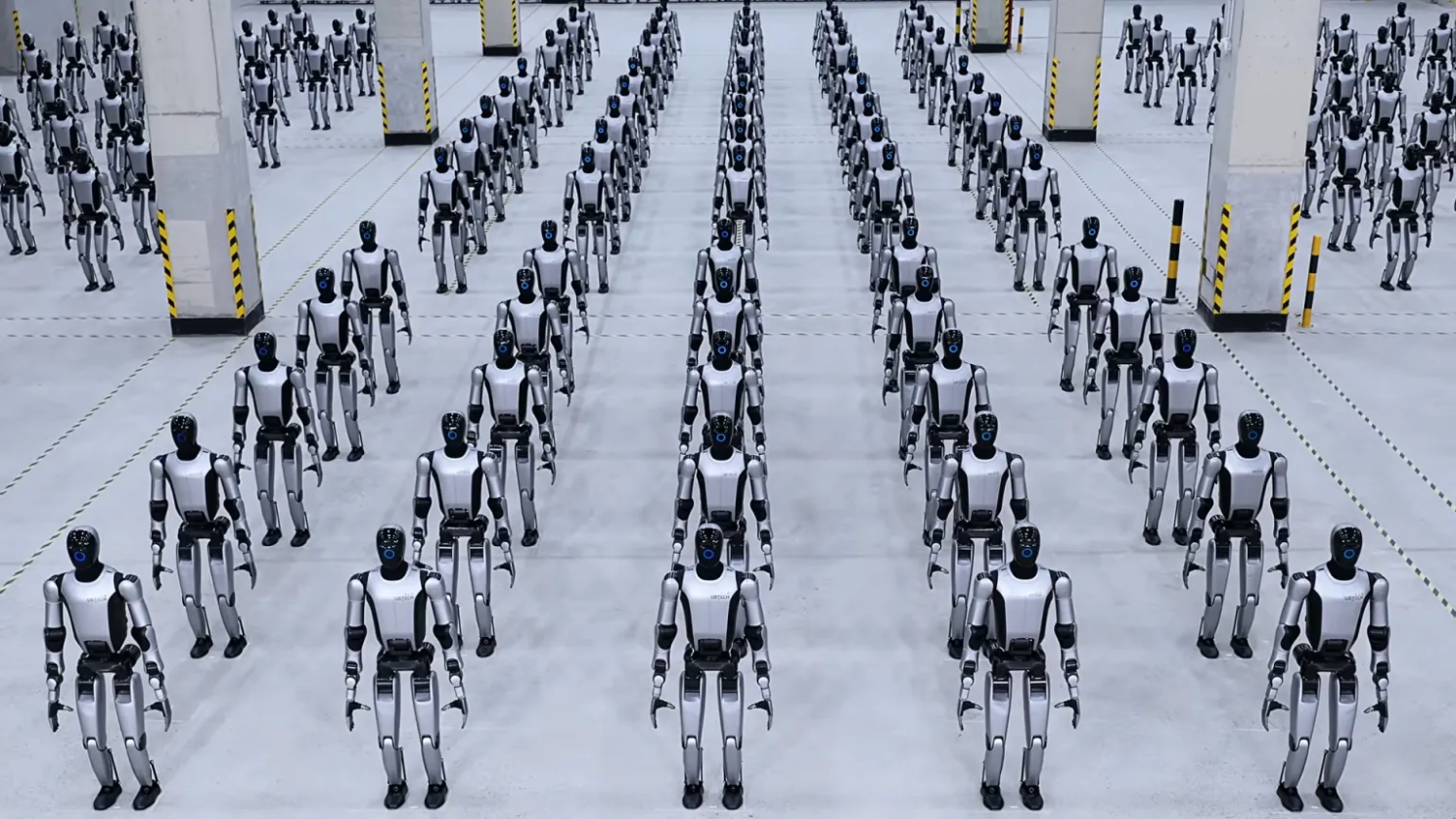
Unitree Robotics Reports Record 2025 Shipments, Targets Mass Production
Hangzhou’s Unitree reveals it shipped over 5,000 humanoid robots last year and outlines ambitious plans for automated mass production lines in 2026.
HANGZHOU — Unitree Robotics, often described as China’s answer to Boston Dynamics, has disclosed that it shipped more than 5,500 humanoid robots in 2025, a figure that eclipses many international competitors. In a statement released to quell market rumors, the company confirmed that its manufacturing lines have successfully produced over 6,500 units to date, validating its supply chain stability. The announcement comes as the company prepares to deploy its robots in more complex commercial scenarios beyond research and education.
The disclosure signals that China’s humanoid robot industry is transitioning from prototype exhibitions to commercial reality. “Unitree is proving that scaling complex robotics is a manufacturing problem, one that China is uniquely positioned to solve,” argues a Shenzhen-based hardware analyst. With the impending release of its G2 model, Unitree is aggressively targeting the factory logistics market, placing it in direct competition with Tesla’s Optimus. The company’s ability to lower unit costs through local supply chains remains its primary competitive moat.
Ministry of Industry Steps Up ‘AI+Manufacturing’ Integration Plan
Beijing issues a new directive to accelerate the deployment of general-purpose AI models across 1,000 industrial scenarios by 2027.
BEIJING — The Ministry of Industry and Information Technology (MIIT) has released a comprehensive work plan today detailing the “deep integration” of artificial intelligence with the manufacturing sector. The policy document mandates the creation of 100 high-quality industrial datasets and the launch of 1,000 “high-level industrial intelligent agents” within the next year. It explicitly calls for the application of three to five general-purpose large models in factory settings, signaling a state-directed push to move AI from consumer chatbots to the factory floor.
This directive provides the regulatory framework for China’s industrial upgrading strategy, emphasizing “secure and reliable” supply chains for key AI technologies. “The government is clearly steering capital and R&D towards the real economy,” notes a policy expert at the Chinese Academy of Social Sciences. The plan also highlights the need for international cooperation, albeit with a focus on establishing a “globally leading open-source ecosystem” led by Chinese standards. This state support is expected to benefit industrial AI providers like Inspur and Hikvision.
Agibot Unveils Compact ‘Backpack’ Humanoid for Education Sector
Shanghai startup Agibot releases a smaller, more affordable humanoid robot designed to lower the barrier to entry for embodied AI research.
SHANGHAI — Agibot, a rising star in the embodied AI space founded by former Huawei “Genius Youth” recruit Peng Zhihui, has unveiled its latest product: a compact humanoid robot small enough to be carried in a backpack. The new model, dubbed the Q1, retains the full-body force control and open development capabilities of its larger predecessors but is priced aggressively to target universities and research labs. This launch follows a breakout year for the company, which has seen its valuation soar amid the robotics investment frenzy.
The Q1 represents a strategic pivot towards the “iPhone moment” of robotics—creating a standardized hardware platform for developers to build applications upon. “By democratizing access to high-performance hardware, Agibot is betting on the open-source community to solve the software challenges of embodied AI,” says a tech columnist for Caixin. The robot’s release is timed to capture the growing demand for robotics education in China’s top engineering schools, ensuring a pipeline of talent familiar with Agibot’s ecosystem.
Linkerbot Advances ‘Physical AI’ with Human-Like Dexterous Hands
A new player in the robotics space demonstrates a dexterous hand system capable of handling fragile objects, aiming to solve the ‘last inch’ problem in automation.
SHENZHEN — Linkerbot, a lesser-known but technically ambitious startup, has showcased a new dexterous hand prototype today that utilizes “physical AI” to manipulate objects with near-human sensitivity. The system combines tactile sensors with a proprietary vision-language-action (VLA) model, allowing the robot to “feel” and adjust its grip in real-time. This development addresses a critical bottleneck in service robotics: the inability to reliably handle diverse, everyday objects without crushing or dropping them.
The technology has immediate applications in domestic care and logistics, sectors that have long struggled with the rigidity of traditional grippers. “Linkerbot’s approach mirrors the biological feedback loop of human hands,” explains a robotics professor at Tsinghua University. By focusing on the end-effector rather than the entire bipedal frame, the company is carving out a niche in the component market, potentially supplying hand modules to larger humanoid integrators. This reflects a growing trend of specialization within China’s robotics supply chain.
BYD Raises Overseas Sales Target, Eyeing Autonomous Export Fleet
The EV giant targets 1.3 million overseas sales in 2026, leveraging its new AI-enabled logistics and autonomous driving features to capture global market share.
SHENZHEN — BYD, the world’s largest electric vehicle manufacturer, has announced an ambitious target to sell 1.3 million vehicles in overseas markets in 2026, a 25% increase from the previous year. Crucial to this expansion is the integration of the company’s new “Xuanji” smart architecture, which unifies AI-powered autonomous driving with chassis control. The company also hinted at deploying autonomous logistics robots at its international ports to expedite shipping, showcasing a holistic application of AI across its value chain.
The announcement signals BYD’s intent to compete not just on battery cost, but on software intelligence—a domain traditionally dominated by Tesla. “BYD is shedding its image as a hardware-first company,” says an automotive analyst in Hong Kong. “The export push is now being driven by their ‘smart cockpit’ and ADAS (Advanced Driver Assistance Systems) capabilities.” However, the company faces looming regulatory scrutiny in the EU and US regarding data security in connected vehicles, a challenge that could dampen its global AI ambitions.
Huaqiangbei Modders Retrofit iPhone Air with Physical SIM Slots
In a display of grassroots technical ingenuity, Shenzhen engineers successfully modify Apple’s latest device, highlighting the persistent grey market for hardware customization.
SHENZHEN — Technicians in Shenzhen’s famed Huaqiangbei electronics market have reportedly succeeded in retrofitting the new iPhone Air with a physical dual-SIM card slot, bypassing Apple’s eSIM-only architecture for the Chinese market. While not a corporate breakthrough, this feat demonstrates the rapid reverse-engineering capabilities of China’s hardware ecosystem. The modification involves precision micro-soldering and custom PCB adjustments, performed just days after the device’s schematics were leaked.
This development, while legally grey, underscores the deep reservoir of technical talent in Shenzhen that supports the broader robotics and AI hardware industry. “The speed at which Huaqiangbei adapts to new hardware standards is a leading indicator of the supply chain’s agility,” notes a hardware trend spotter. For the AI sector, this same ecosystem provides the rapid prototyping and component modification services that allow startups to iterate hardware faster than their Silicon Valley counterparts.