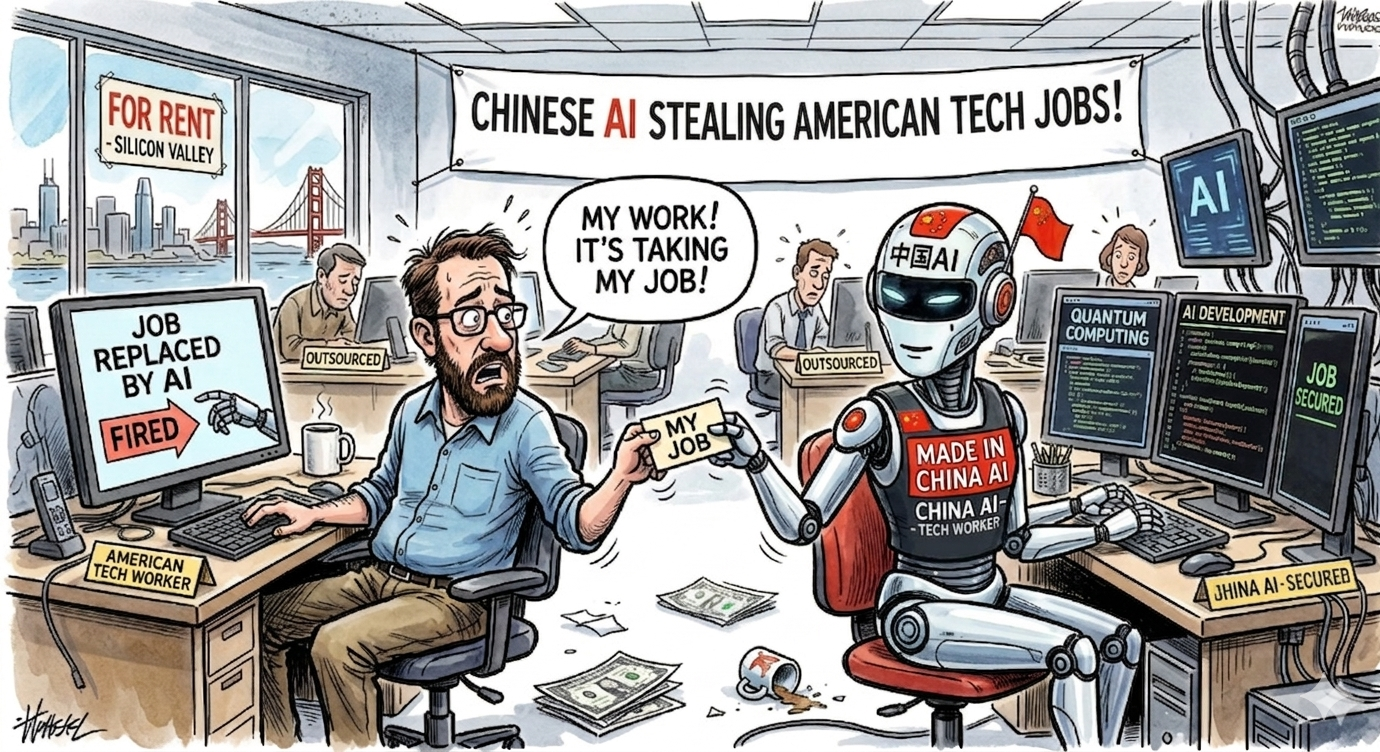
It is not outsourcing. How open weight Chinese AI is silently rewriting the US job market.
There is a popular narrative that the recent wave of tech layoffs in the US is simply a cycle of overhiring. However, looking closely at the data from API aggregators like OpenRouter tells a much more structural story.
I stumbled upon this data while writing my recent article on why Tsinghua University alumni are dominating the Chinese tech landscape (https://www.linkedin.com/pulse/why-increasing-number-xi-jinpings-fellow-alumni-dominating-jaime-xiao-iwwoc/). When examining the top 20 programming models on the platform, I noticed that five are from China. Strikingly, four of these five originate from the Tsinghua ecosystem. Together, Chinese models like Qwen, MiniMax, Kimi, and GLM now command nearly 60% of the volume in basic programming tasks.

The irony is that Silicon Valley outsourcing code to China is hardly a new phenomenon. Tech giants like Zoom famously leveraged Chinese engineering teams to scale rapidly before their IPO. I have personally engaged with two Silicon Valley unicorns that operated dedicated coding branches right here in Wuhan. It has long been a mature industry for tier two Chinese tech hubs to absorb this high speed development work.

Yet this traditional outsourcing model has strict limits. It primarily serves fast scaling startups burning cash to achieve maximum velocity before going public. The reality is that outsourcing to China is no longer cheap. It offers premium engineering quality that stable SMEs simply cannot afford. Meanwhile, publicly listed enterprises remain locked out of this offshore model due to rigid compliance and data security mandates.
Now we face a fascinating double disruption. The meteoric rise of Chinese large language models threatens to simultaneously kill this old outsource to China playbook and massively replace junior developer jobs within the US itself.
Here is what the underlying shift looks like:
1. The Commoditisation of Basic Code We are not seeing a simple direct replacement of a junior developer with a cheap API. Basic coding is rapidly becoming a cheap and ubiquitous infrastructure. Highly performant and free models are handling the massive workloads of data cleaning and boilerplate generation.
2. A Structural Shift in US Tech Budgets Tech giants are not just cutting costs. They are reallocating them. The capital saved by pausing junior hiring is being aggressively redirected towards Nvidia GPU clusters, top tier system architects, and AI researchers. The barrier to entry for software engineering has skyrocketed overnight.
3. The Vibe Coding Upgrade and AI Sovereignty This is where the geopolitical tripwire lies. The current 60% market share in foundational coding is just the beginning. As Chinese open weight models relentlessly close the capability gap with top tier American models, they will inevitably move up the value chain. The same high performance APIs currently generating boilerplate will soon evolve into the preferred engines for senior architects engaging in complex vibe coding.
When this transition occurs, the market share of Chinese models will climb even higher and embed itself deeper into enterprise environments. This brings us to a critical question of AI Sovereignty. Will the US and the broader Western world feel secure if their software ecosystems and advanced tech jobs are fundamentally powered by Chinese neural networks? Can a nation maintain its tech supremacy if the cognitive labour driving its innovations is essentially outsourced to foreign AI models?
The paradigm has shifted. Software generation is no longer a protective moat. The true competitive advantage over the next decade will belong to those who can navigate this volatile intersection of artificial intelligence, computing hardware, and global geopolitics.
I would love to hear how my network of investors, strategists, and tech leaders are pricing this shift into their 2026 outlook. Please share your thoughts below.
#TechTrends #ArtificialIntelligence #Geopolitics #FutureOfWork #SiliconValley #AISovereignty #VentureCapital