The Engine Room of a New Empire: How Hong Kong Financed China’s Motoring Revolution
Three years ago, during the Chinese New Year, I stood in a remarkably quiet Hong Kong. The city was only just emerging from the long shadow of pandemic isolation. The streets were subdued, the entrepreneurial hum was muted, and the eerie stillness seemed a grim and delayed vindication of Louis Kraar’s infamous 1995 Fortune dispatch titled The Death of Hong Kong.
Yet returning for a four-day visit this past Chinese New Year, I found a territory fundamentally transformed. The city was not dead but had simply been re-architected. The catalyst for this realisation did not hit me in a boardroom but on the pavement, where the presence of advanced Chinese technology—of which the electric vehicle is merely the most visible vanguard—signaled a city fundamentally re-wired for a new industrial age. The cityscape was suddenly and overwhelmingly awash with Chinese motoring marques, sparking a profound reassessment of Kraar’s thirty-year-old prophecy.
A retrospective glance at Kraar’s dispatch offers a striking barometer of how violently the global industrial axis has tilted. Kraar inadvertently captured the twilight of an ecosystem defined by artificial scarcity and the economics of the colonial middleman. Consider the motoring paradigm of 1995. The article highlighted two encapsulating data points. Chinese authorities were intercepting smuggled cars to bypass punitive import tariffs, and executives were citing softening motor sales as a bellwether for waning business confidence.
Thirty years ago, Hong Kong’s automotive identity was strictly inbound. It served as the premier entrepôt for Western and Japanese luxury vehicles entering a structurally deficient Chinese market. Conglomerates built empires acting as regional distributors and capitalised on the fact that the mainland lacked advanced manufacturing capabilities. The flow of high-value goods was resolutely West-to-East. Hong Kong clipped the ticket as the privileged port.
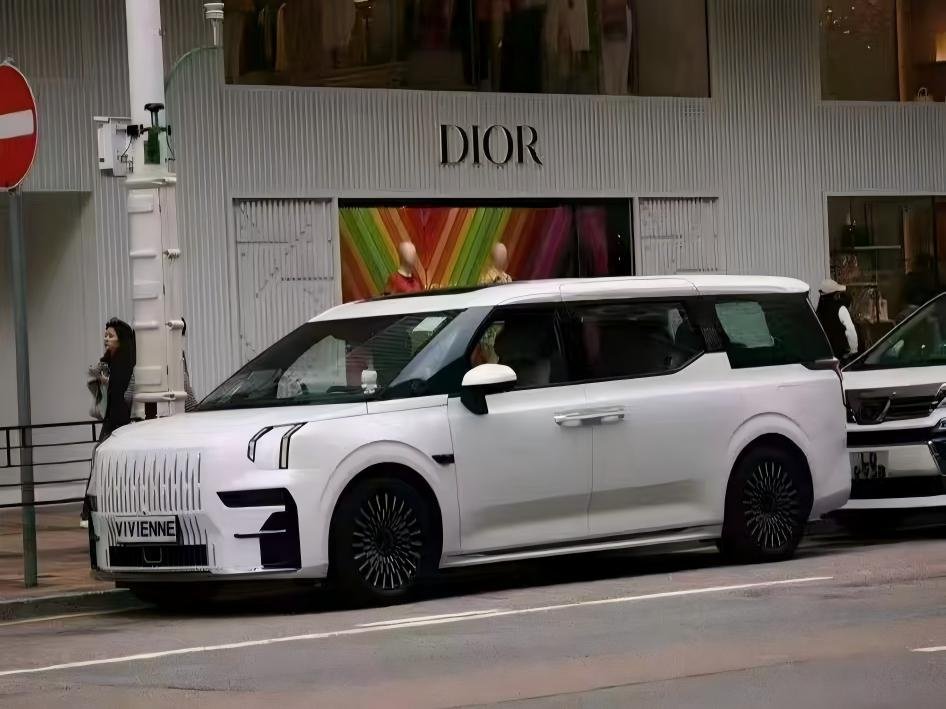
During my recent visit, the sheer scale of the inversion was impossible to ignore. Strolling through the streets, I was struck by how entirely the landscape had been rewritten in a mere thirty-six months. Crucially, what I observed was not a phenomenon confined to geographic or cultural loyalty. Watching the traffic, it became readily apparent that these vehicles are being adopted by a highly diverse demographic. Seeing so many of the city’s South Asian and Caucasian expatriate residents at the wheel signals a market capture driven by pure technological and pricing supremacy.
Recent market data robustly corroborates this ground-level reality. By the close of 2025, electric vehicles had fundamentally consumed the territory’s private car market and accounted for over 71 per cent of all new vehicle registrations. In a watershed moment, BYD officially dethroned Tesla to become the absolute best-selling EV marque in Hong Kong. Propelled by models such as the Atto series alongside rapid localised growth from Geely’s Zeekr and GAC Aion, Chinese manufacturers have comprehensively rewritten the consumer hierarchy. Even the iconic Hong Kong taxi fleet has reached a structural inflection point. Watching quiet and highly efficient electric models glide past where old and rattling Crown Comforts used to dominate felt like watching history turn a page.
Where the 1995 dispatch equated a drop in imported car sales with the demise of the city, Kraar fundamentally failed to anticipate Hong Kong’s true long-term utility. Its value lies not as a consumer terminus for imported luxury saloons but as the launchpad for the conglomerates building the future of mobility. Hong Kong no longer needs to physically warehouse European or Japanese vehicles to remain an automotive hub. Instead, it furnishes the international capital structures and the frictionless corporate governance required for mainland EV manufacturers to execute their global market capture. These manufacturers represent the core output of the vast “Robot Belt” industrial corridor stretching across the mainland coast.
To comprehend how Hong Kong functions as the financial engine room for this automotive offensive, one must look beyond the physical movement of metal. The export of electric vehicles is merely the highly visible end product. The invisible machinery catalysing this truly global offensive operates entirely through Hong Kong’s corporate and legal architecture. While legacy analysts fretted that Hong Kong would become a financial backwater, it has instead evolved into an essential offshore command centre.
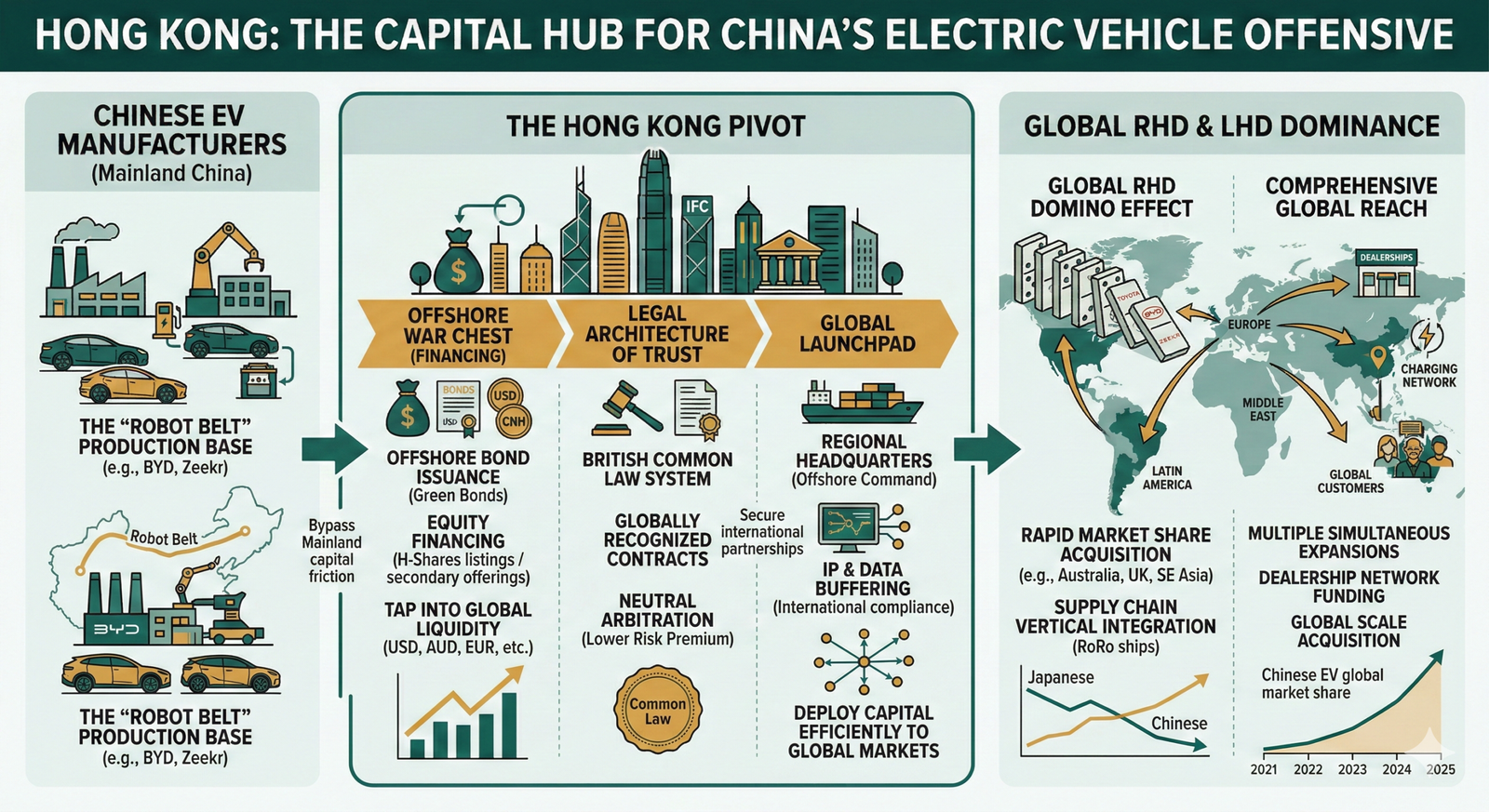
To aggressively expand across continents simultaneously, Chinese automakers require colossal reserves of foreign currency. They need this capital to establish local dealership networks, secure port infrastructure, and underwrite national marketing drives from Sydney to São Paulo. Relying strictly on mainland capital is inefficient and hamstrung by cross-border exchange friction.
Hong Kong provides the solvent. By establishing regional headquarters in the city, EV manufacturers tap directly into global liquidity. They issue offshore green bonds denominated in US dollars or offshore renminbi to international institutional investors. Dual listings and secondary offerings on the Hong Kong Stock Exchange provide rapid and massive capital injections. This offshore war chest directly subsidises the aggressive price-undercutting strategies currently dismantling legacy strongholds around the world.
Furthermore, selling advanced and connected hardware across diverse international jurisdictions demands an ironclad legal foundation. Local dealership groups and logistics partners in the European Union or South America require absolute contractual certainty. Here, the legacy of British common law has been effectively weaponised for global trade. When a mainland EV brand signs a multi-million-dollar distribution agreement overseas, the corporate entity executing that contract is almost invariably domiciled in Hong Kong. The jurisdiction provides a globally recognised and neutral venue for arbitration that dramatically lowers the risk premium for foreign partners.
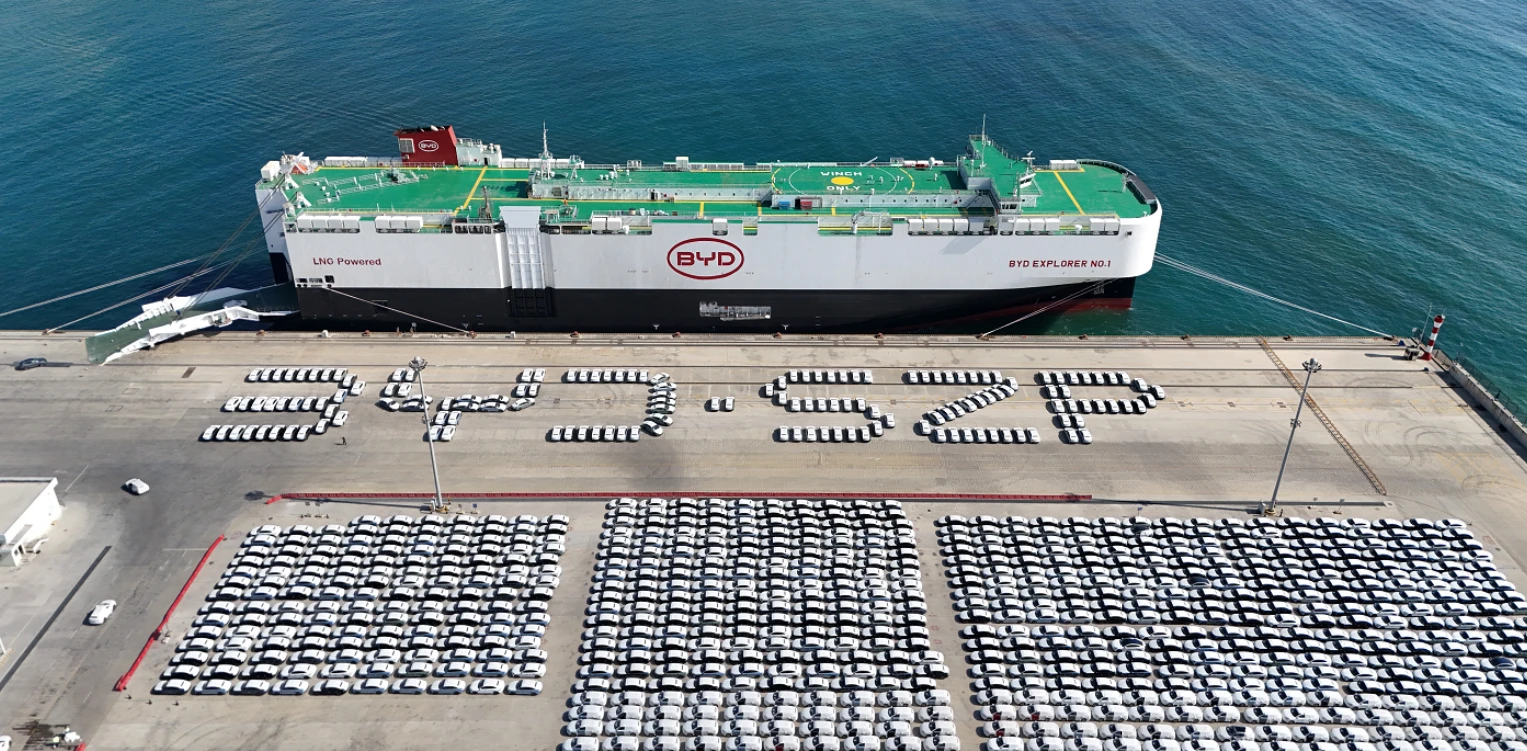
Armed with this Hong Kong-structured capital, automakers are executing a textbook global disruption. The funds allow brands to vertically integrate their logistics and charter their own Roll-on/Roll-off shipping fleets to bypass global bottlenecks. They can flood international markets with inventory and operate on razor-thin margins globally, prioritising the rapid acquisition of market share over immediate profit. This sustained financial pressure catalyses a worldwide domino effect that flips brand loyalty across entire continents in a matter of months rather than decades.
Thirty years ago, Hong Kong’s elite amassed fortunes importing a few thousand luxury vehicles into China. Today, watching the silent electric traffic flow through Central, the reality is undeniable. The territory’s capital markets are now underwriting the export of millions of vehicles out of China and fundamentally rewriting the global industrial hierarchy.