Hong Kong, the unexpected winner of the Iran War
As missiles rain on the Gulf, something else entirely is skyrocketing in a familiar safe harbour.
As Iranian and Israeli missiles illuminate the night skies over the Middle East, the ensuing panic in global energy markets has triggered a ferocious, structurally permanent pivot towards electric vehicles. Desperate to insulate themselves from the geopolitical premium on petrol and fractured supply chains, consumers and sovereign wealth funds alike are accelerating their EV procurement at an unprecedented rate. Yet the immediate financial windfall of this tragedy is washing up not in Silicon Valley, but on the trading desks of Victoria Harbour, sending the share prices of Chinese automakers into the stratosphere. As we observed in The Engine Room of a New Empire: How Hong Kong Financed China’s Motoring Revolution, the city had already laid the financial groundwork for the green transition. Now, the war has confirmed its absolute supremacy. Hong Kong is today the most important listing destination for global EV enterprises, bar none. EV manufacturers quoted on the local bourse now deliver a staggering 8m vehicles annually—more than three times the combined volume of all EV makers listed on the Nasdaq—and with every geopolitical tremor, that chasm only widens.
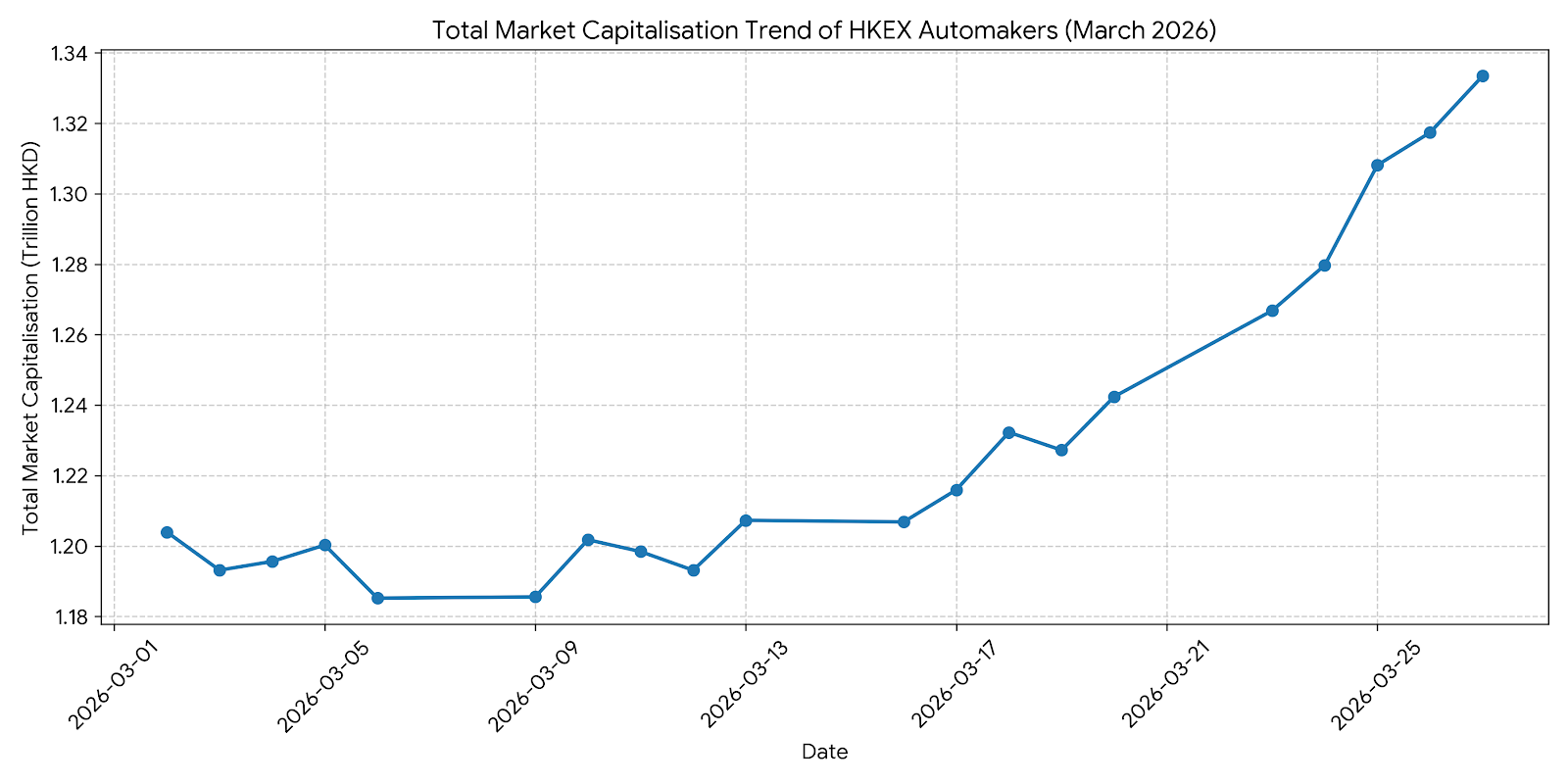
The sheer scale of this sudden global demand is staggering, driven by a visceral fear of physical fuel insecurity. In Britain, where petrol prices have breached a punitive £1.50 a litre, the Financial Times reported that inquiries for electric vehicles had doubled in a mere fortnight. Down Under, the tyranny of distance has collided head-on with Middle Eastern volatility. Pickles, a major Australian automotive marketplace, recorded a 111% surge in EV searches in the first three weeks of March—a phenomenon its executives marvelled at as an unanticipated hockey-stick acceleration. NRMA, one of the country’s largest insurers, noted a 15% jump in EV coverage requests in just two weeks. Range anxiety, it seems, has been entirely eclipsed by fuel-pump terror. Governments, too, are scrambling. Thailand’s cabinet recently fast-tracked its EV 3.5 subsidy programme in a desperate bid to hedge its manufacturing-heavy economy against the oil shock. Every panicking British commuter, Australian driver, and Southeast Asian policymaker is inadvertently funnelling wealth back to the manufacturers listed in Hong Kong.
Yet this automotive windfall is merely the visible crest of a much larger tidal wave of capital. The exact same geopolitical friction that is driving the global EV boom is violently rewiring broader trade routes and legal frameworks. As Western channels become increasingly unpredictable and the physical infrastructure of the Middle East comes under direct fire, global money is being forced to find new, neutral clearing houses. This structural shift is igniting spectacular—and perhaps less obvious—growth across a raft of Hong Kong’s other foundational sectors.
Foremost among these beneficiaries is the territory’s wealth management and family office ecosystem. As capital flees the volatility of the burning Gulf, it urgently requires a sanctuary. This reality was the prevailing undercurrent at the Milken Institute’s 2026 Global Investors Symposium, recently convened in Hong Kong. Amid the panel discussions, industry titans noted a frantic, global dash for asset reallocation; the imperative to diversify away from acutely concentrated geopolitical risk has never been more pronounced. Consequently, Hong Kong is being aggressively pitched—and enthusiastically embraced—as the ultimate financial fortress. According to late-March dispatches from finews.asia and The Straits Times, both officialdom and financial heavyweights now tout the city as the safest, most stable ideal asset management platform currently available. Backing this rhetoric with concrete ambition, the government has confidently reiterated its target to lure no fewer than 220 new family offices to its shores by the end of 2028. For the world’s jittery plutocrats, the calculus is ruthlessly simple: when the missiles fly, park your wealth where the foundations remain unshaken.
This massive capital migration has not gone unnoticed by the territory’s leadership, who are now openly leaning into the geopolitical tailwinds. Far from downplaying the global crisis, the upper echelons of the Hong Kong government have actively weaponised the city’s neutral status, cementing its branding as the ultimate ‘safe harbour’. Speaking on 26 March, Chief Executive John Lee was unambiguous in his assessment of the macroeconomic landscape. Addressing the escalating Middle Eastern conflict and the subsequent volatility, Lee declared Hong Kong to be a globally recognised safe harbour for capital stability. Armed with a robust financial architecture and a distinct lack of exposure to the kinetic conflict, the city is explicitly positioning itself to gather global capital and offer a secure operational base for international commerce when traditional avenues are burning.
“For the world’s jittery plutocrats, the calculus is ruthlessly simple: when the missiles fly, park your wealth where the foundations remain unshaken.”
But wealth requires plumbing, and the institutional architecture of global finance is visibly shifting eastward to accommodate this influx. As the geopolitical risk premium of operating across Eurasia reaches historic highs, major financial arteries are being rerouted to bypass the blast zones. Consider the recent manoeuvres of Türkiye İş Bankası. According to late-March reports from the South China Morning Post, Turkey’s largest private bank is currently accelerating plans to establish a dedicated corporate branch in Hong Kong. This is not a routine expansion; it is a calculated structural play. Amid the Middle Eastern tensions, the bank aims to establish a secure, insulated financial platform capable of bridging Chinese manufacturing power with broader global trade—a vital conduit that can no longer rely on the increasingly perilous hubs closer to home.

This flight to safety extends far beyond fiat currency and equities; it is fundamentally altering the trade of the very materials fuelling the global economy. In the brutal calculus of a war economy, the physical security of hard assets suddenly supersedes mere cost efficiency. The visceral panic over energy shortages and supply chain severances has created an unexpected opening for Hong Kong to assert itself as a premier global commodities trading centre. Christopher Hui, the Secretary for Financial Services and the Treasury, has bluntly acknowledged this paradigm shift, driving rapid infrastructure expansion to meet the moment. To accommodate the influx of tangible wealth seeking absolute physical refuge, the city is aggressively scaling its precious metals depository to hoard over 2,000 tonnes of gold—a staggering leap from its baseline 150-tonne capacity. Simultaneously, a new government-backed central clearing system for gold is commencing trial operations in 2026 to ensure transaction sovereignty. This infrastructural fortification extends to industrial resources as well; the London Metal Exchange (LME) recently accelerated the approval of new secure warehouses in Yuen Long, bringing the territory’s total to 11 in order to stockpile critical base metals. In an extreme wartime environment, the traditional metrics of commodity warehousing and exchange have been violently upended. For global traders moving critical resources, the absolute safety of the jurisdiction hosting their clearing houses and vaults has become paramount—a reality that is driving yet another lucrative vertical directly into Victoria Harbour.
Ultimately, the geopolitical inferno in the Middle East has catalysed a profound metamorphosis for Hong Kong. While the world grapples with fractured supply chains and kinetic warfare, the city has shrewdly consolidated its position not merely as a regional financial hub, but as an indispensable global sanctuary. By capturing the exponential surge in the electric vehicle transition, absorbing frightened flight capital, and anchoring rerouted commodities trade, Victoria Harbour is doing more than weathering the storm. It is capitalising on a fractured world order, proving that in an era of global unravelling, stability is the ultimate premium.