Every AI content boom arrives with a set of screenshots. The screenshots show plays. They do not show the invoice, and the invoice is where the business model is actually decided.
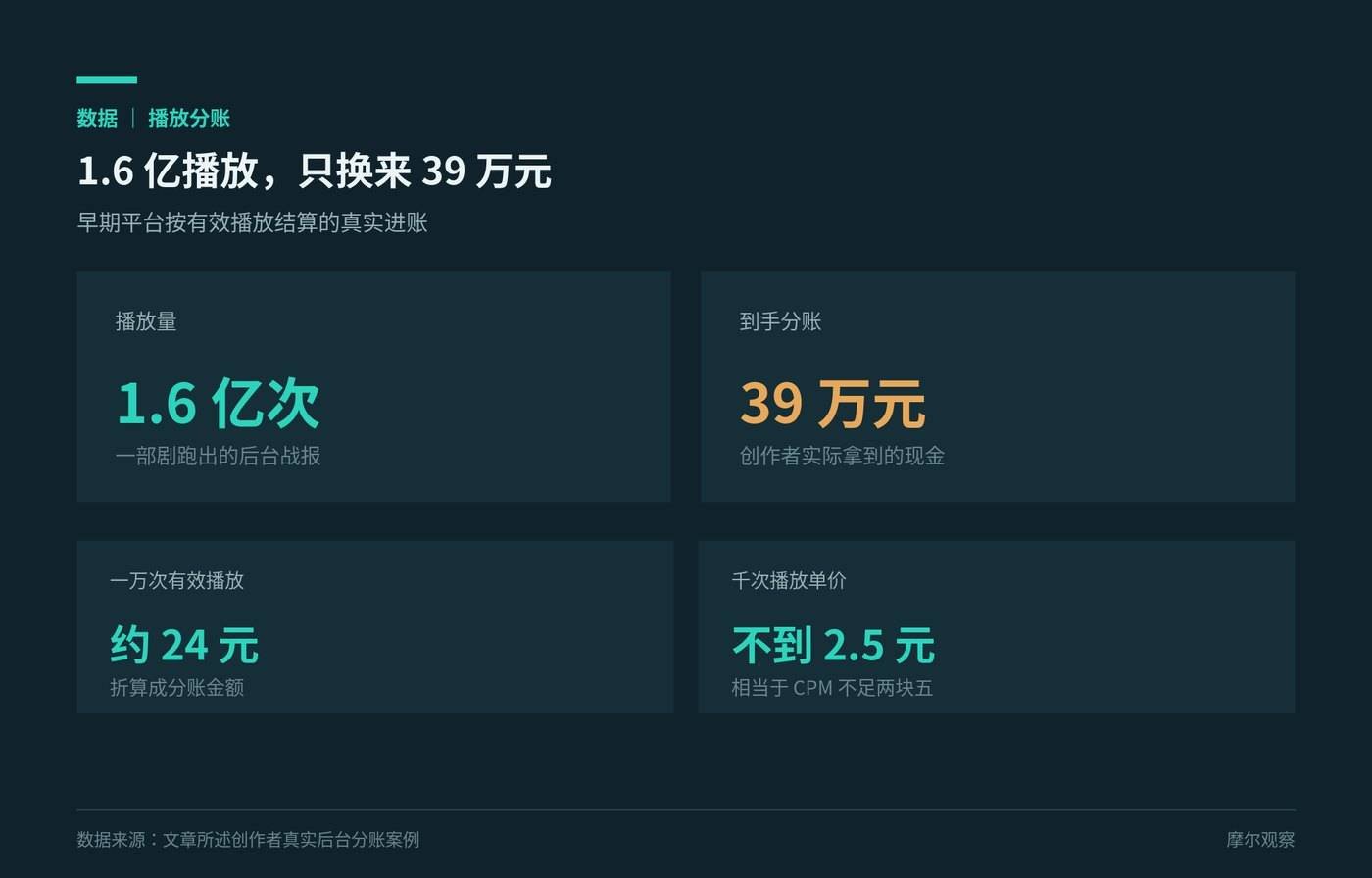
The screenshots circulating in China’s short drama market follow a pattern. One creator published their own backend: a single series reached 160 million plays and settled at RMB 390,000. Other cases claim all-part-time teams, ten seasons and a thousand episodes, billions of plays and tens of millions of renminbi in revenue share.
Those numbers are real as screenshots. They are misleading as economics.
What 160 million plays is worth
Break the RMB 390,000 down and the settlement rate is roughly RMB 24 per ten thousand valid plays, which is under RMB 2.5 per thousand. That is an early platform model that pays on valid playback rather than on impressions, and it is the rate creators are actually being paid.
Against that sits a cost structure priced per second and independent of whether the output is usable.
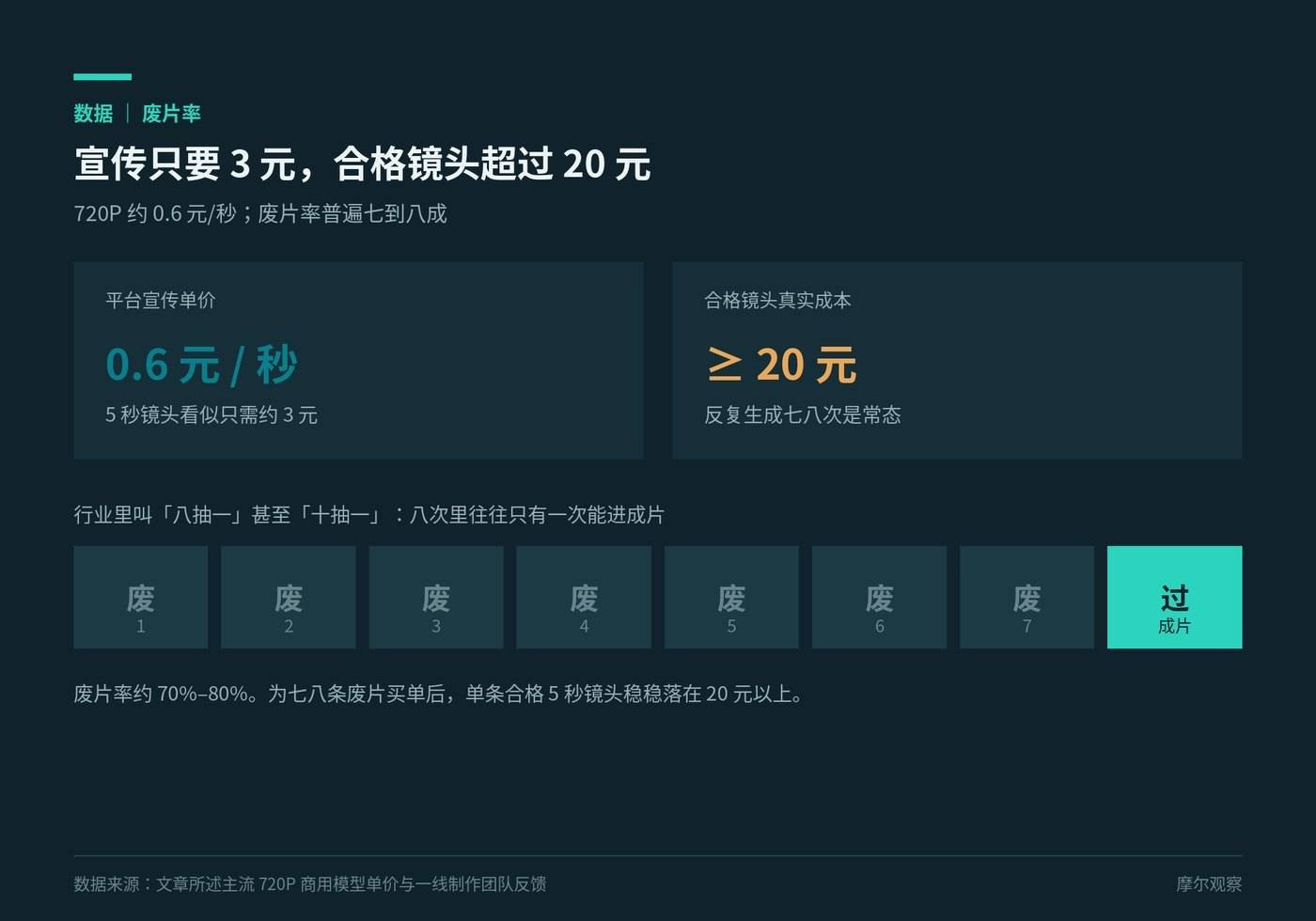
Commercial platforms advertise around RMB 0.6 per second for 720P generation. A five-second shot therefore appears to cost three renminbi. The arithmetic omits the variable that destroys the model: the discard rate.
Eight attempts for one usable shot
Diffusion models remain weak on spatial logic. Figures twitch and distort during motion, hands pass through objects, and camera moves break limb geometry. Production teams consistently report a discard rate of 70 to 80 per cent, which the industry calls one-in-eight or one-in-ten.
Buying those seven or eight failures means the true cost of one acceptable five-second shot sits firmly above RMB 20. A hundred-episode serial, at a dozen or more shots per episode, is a thousand-plus shots and a compute bill in the tens of thousands to hundreds of thousands of renminbi before a single frame is edited.
Two invoices, both larger than the contract
A producer in Zhengzhou, Shi Yiyuan, took an order for a 180-minute animated drama at RMB 400 per minute. After six episodes, re-rolling to fix continuity errors had consumed RMB 10,000 of compute, an effective RMB 800 per minute, close to twice the contracted rate. Completing the full film passed RMB 60,000 in compute with dubbing still unpaid.
A second case reported by Cover News: a full-time father, Jiang Lan, produced a series called Guixu that passed 100 million plays. Twelve episodes cost close to RMB 200,000 in compute, roughly RMB 2,000 per finished minute, for a product one person made at home.
Who this business actually belongs to
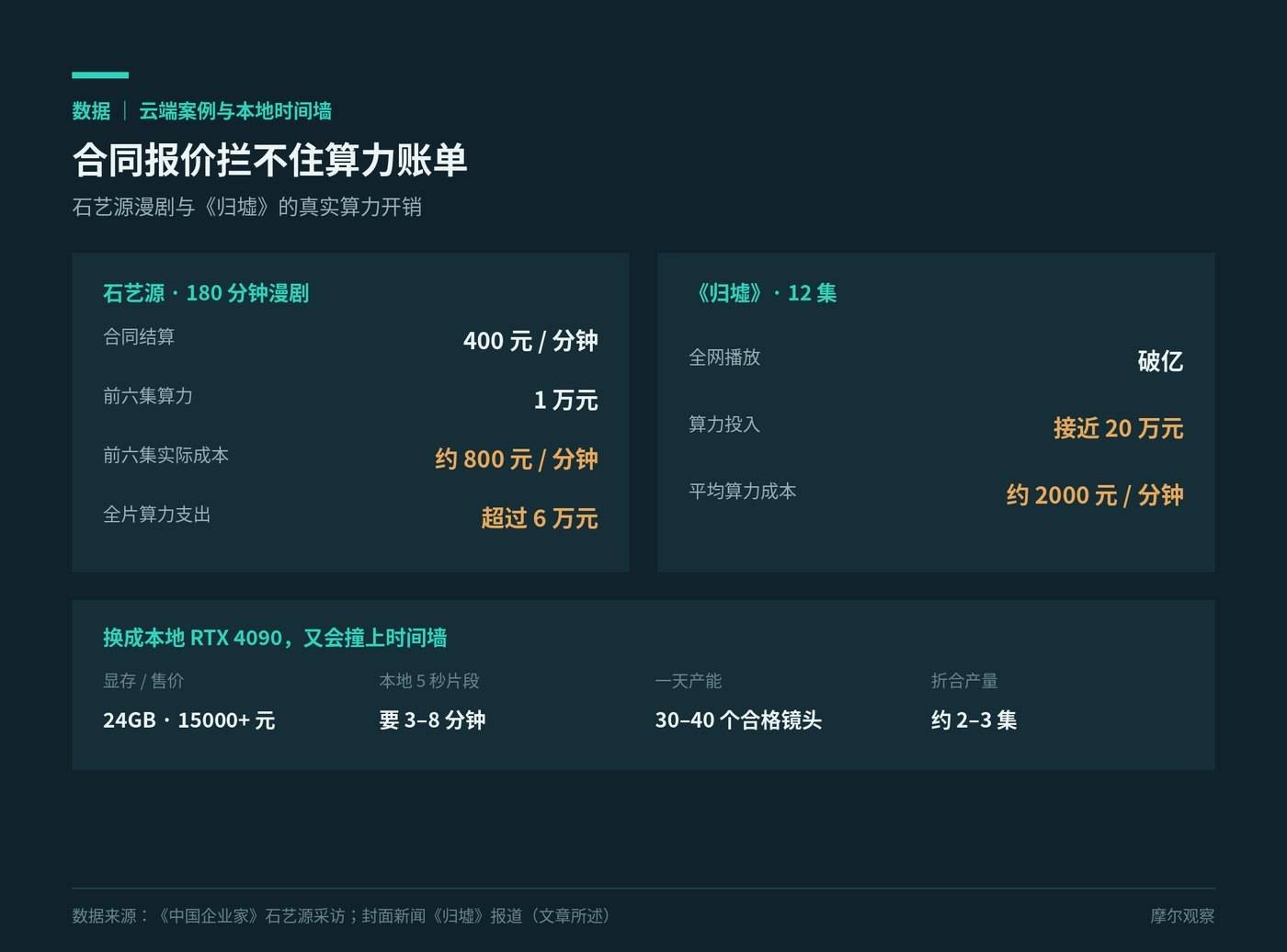
The gap between RMB 24 per ten thousand plays and RMB 2,000 per finished minute of generation is the entire story. Cloud compute is billed whether or not the shot works. Platform revenue is paid only when the shot works and someone watches it.
That asymmetry means the reliable profit in AI video sits with the compute seller, not the content seller. The creator absorbs the discard risk, the platform absorbs none of it, and the model provider is paid on attempts rather than outputs.
There is a rational response, and it is the same one Chinese studios are converging on: move inference on-premise, build a local workflow that can iterate without a per-second meter, and treat cloud generation as a finishing tool rather than a production line. That requires capital and engineering that most individual creators do not have, which quietly converts a low-barrier business back into a capital-intensive one.
The other response is to stop counting plays and start counting cost per finished minute. On that metric most of the published success stories are loss-making, and the ones that are not have already built their own infrastructure.
Editor’s note: This is an adapted translation of the original Sohu Tech report. It has been trimmed and restructured for readability for an international business audience. The full original (in Chinese) is at https://www.sohu.com/a/1100469452_116132.