Huang Xuejie, a leading Chinese lithium-battery scientist at the Chinese Academy of Sciences, has a timing argument the industry should hear: 2026 is the mass-production year for hybrid solid-liquid batteries, and full solid-state will not “flip the table” until after 2035. Between now and then, the hybrid is where the money and the deployment are.
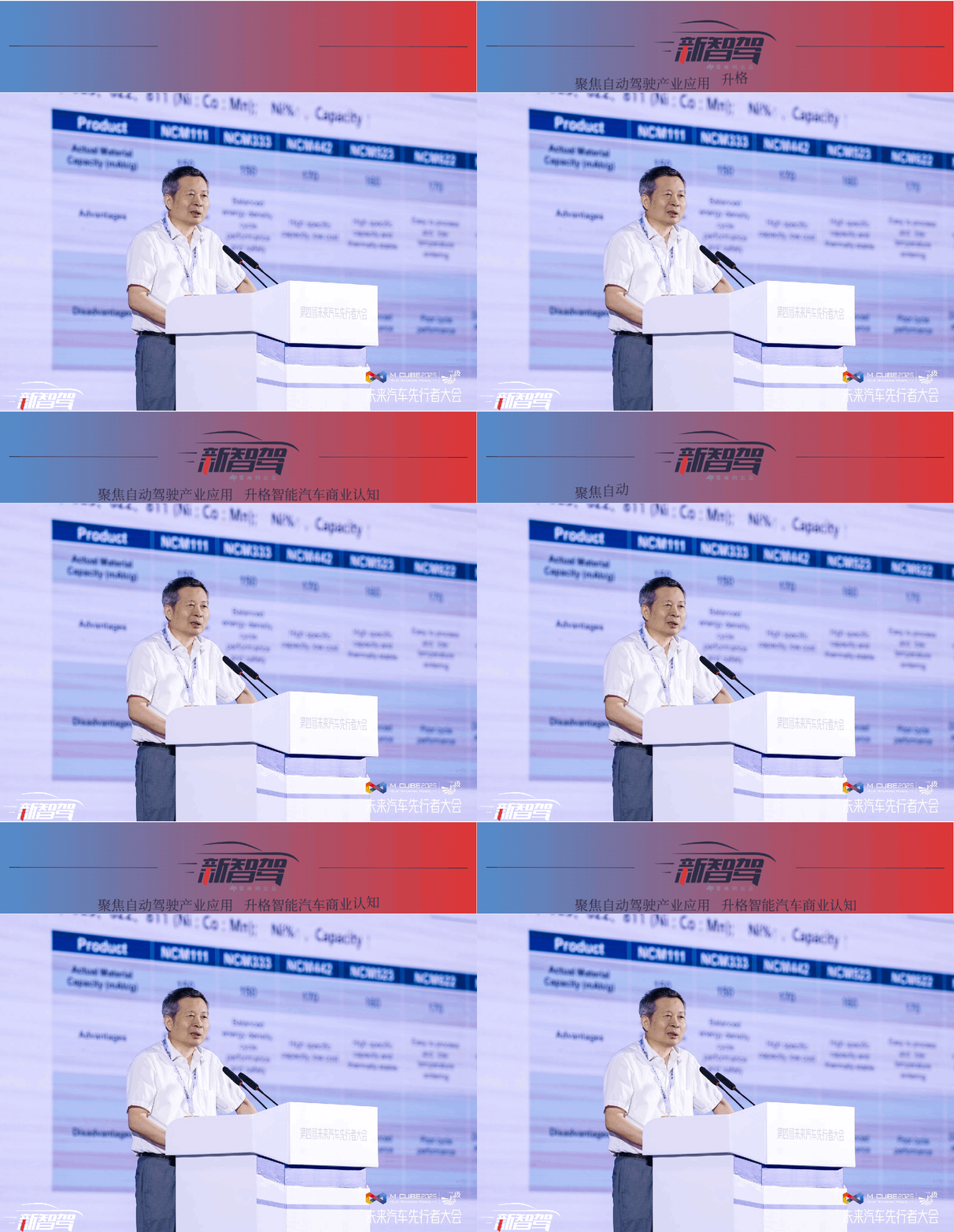
Speaking at a semi-solid battery forum in Shenzhen, Huang laid out the official roadmap: hybrid mass production in 2026, small-batch solid-state around 2030, and affordable next-generation solid-state in some cars by 2035. A new national standard taking effect in July even codifies the split, liquid, hybrid (also called semi-solid), and solid (full solid-state).
Why hybrid, why now
The hybrid’s appeal is pragmatic. Today’s liquid lines need almost no change, over 90 per cent compatibility, while the added solid electrolyte lifts energy density and cuts thermal-runaway risk. Huang’s team spent eight years on a high-density cathode with just 1 per cent cobalt and over 95 per cent nickel, tripling pressure tolerance so electrodes pack denser, hitting 220 mAh/g at 1C. On the anode, silicon-tin alloy raises ion speed over 100x, with battery life near 1,500 cycles.
For LFP, the hybrid answer is gel. Stationary storage cells can sit a decade or two; plain electrolyte stratifies under gravity like a jar of pickled eggs, dead at the bottom, weak at the top. Huang’s team builds a thick colloidal layer on the electrode surface, keeping liquid flowing inside, so the cell survives 20 years. For fast charging, they embed lithium-rich solid electrolyte to push ion supply at 60 to 70 degrees, targeting six-minute charges.
The strategic patience
The message for Western watchers: China is not waiting for the solid-state “breakthrough” to arrive fully formed. It is industrialising the bridge technology now, on existing lines, at existing scale, while the all-solid bet matures. That keeps Chinese cell makers shipping higher-density, safer packs this decade instead of betting the roadmap on a 2035 deadline.
Read the original report (LeiPhone)
Translated and adapted from LeiPhone (leiphone.com).