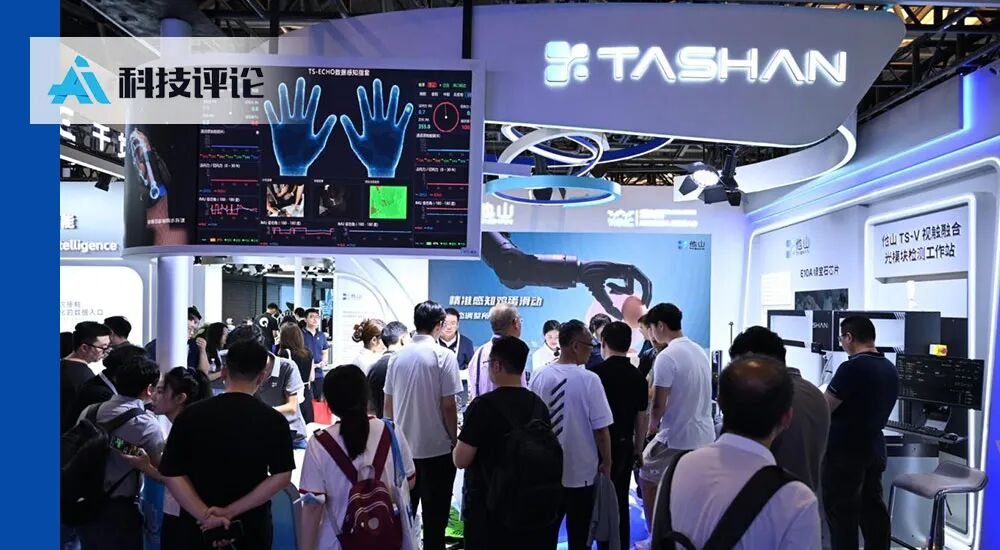
This year at WAIC, the embodied-AI booths shared one unexpected keyword: touch. Two years ago tactile sensing barely registered; now, from sensor vendors to whole-robot companies, “touch” is on every placard, with some declaring it more important than vision. The race is not just over sensors but over the models, data and even the chips underneath them.
Why naive fusion backfires
The case for touch is obvious once robots leave demos: cameras have blind spots and cannot feel the subtle contact between finger and object, like doing needlework with gloves on. So the industry spent a year bolting touch into VLA models. A paper called T-Rex, with authors including Fei-Fei Li, NVIDIA’s Jim Fan and UC Berkeley’s Pieter Abbeel, delivered a counterintuitive result: adding tactile condition to the classic pi0.5 model dropped task success from 17 per cent to 6 per cent.
The reason is frequency mismatch. Vision is low-frequency and global, five hertz suffices; touch is high-frequency and local, needing 20 Hz-plus to catch slip and deformation. Forcing two different signals through one path is like making GPS and steering fight for the same chip. T-Rex’s lesson: touch needs its own temporal encoding, its own pathway, its own training regime.
Building the chip anyway
That is why tactile leaders like Tashan are building native tactile models and, more controversially, their own chips. The critique is fair, the sensor roadmap has not converged and volumes are low, so a startup betting years on silicon looks like a gamble. But off-the-shelf chips cannot meet the need: a fingertip needs dense contacts and tiny size, demanding one highly integrated chip over several discrete parts. Tashan’s 2021 “Ruby” was the first AI touch chip; its new “Emerald” E10A converts touch signals to spikes in hardware, lifting measurement frequency two to three times normally and roughly 100x in spike mode.
Data collection is now consensus, but even the gear is being rebuilt. Flexible glove sensors drift and produce mostly invalid readings; exoskeletons are bulky. Tashan’s fingertip-sleeve design captures the highest-priority contact point while leaving joints visible to cameras, keeping consistency high, multiple-measurement std under 0.03, R-squared above 99.9 per cent.
The deeper point, echoed by Turing laureate Richard Sutton at WAIC, is that real-world reinforcement learning, robots learning by trial like humans, may be impossible without touch. The race to build robot feel is not hype. It may be the door to the next stage of physical AI.
Read the original report (LeiPhone)
Translated and adapted from LeiPhone (leiphone.com).