A humanoid robot has been working the production line inside CATL’s battery factories for more than three months. No remote operator. No safety handler. Just the machine, the line, and the clock.
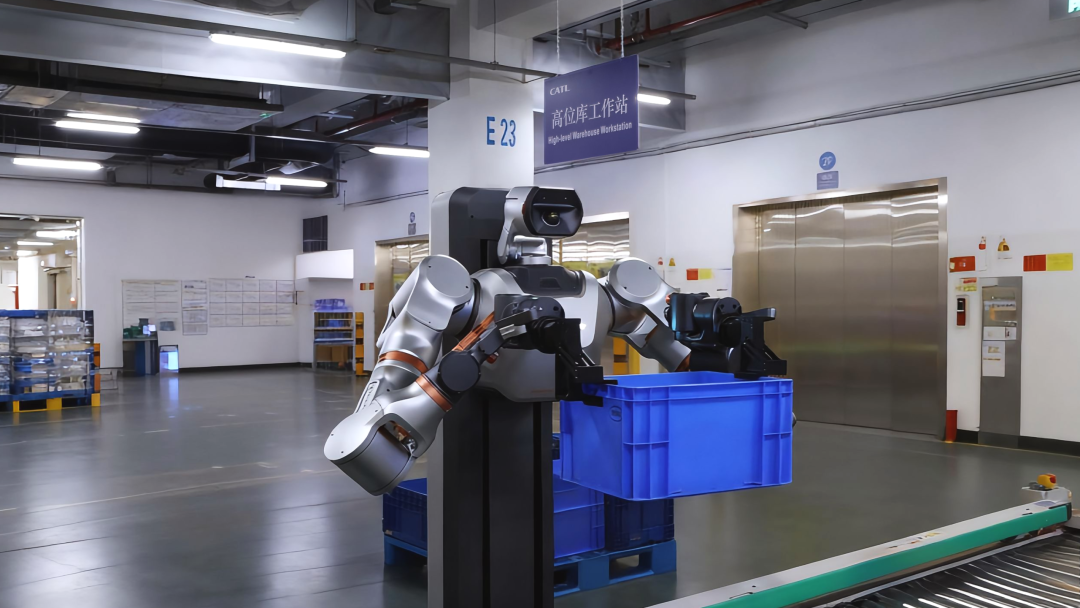
The robot is Galbot S1, built by Beijing-based embodied-AI company Galaxy General. According to the company and Beijing Daily, it has been running 7×24 in CATL’s module and battery-pack lines, moving materials autonomously, for over 90 days of continuous, fully self-directed operation. Galaxy General calls it the world’s first ‘normalised autonomous work’ by a humanoid on a new-energy manufacturing line.
It is the moment the industry keeps promising and rarely delivers: a general-purpose robot doing real, unglamorous shifts in a harsh industrial setting, not a choreographed demo on a trade-show stage.
The harder problem Galaxy General says it has been chipping away at is deployment itself. Robots that ace the lab tend to fall apart in the real world, where every site has different fixtures, lighting and tolerances. Normally that means re-collecting data and re-training a model on site, a slow, expensive loop.
Its answer is WAM-TTT, short for World Action Model Test-Time Training, which the company describes as the first test-time training framework built for embodied-AI world models. In plain terms: once a robot is deployed, it keeps learning and adapting. It can pick up a new task from a handful of smartphone videos of a human doing it, with no robot-body data and no motion labels. A worker films a demo; the robot adapts.
Galaxy General is also pushing the same brain into retail. At a FamilyMart store in Beijing’s Haidian district, a Galbot G1 named ‘Xiaogai’ greets shoppers, makes small talk and fetches items from shelves and the oven, a deliberately messy urban scenario that stresses stability and flexibility.
On the factory floor, the S1’s heavy-duty arms pick up a 50-kilogram tote, lock into its grooves with a faint click, and set it down in under 30 seconds, then reset and repeat. Galaxy General says it has deep partnerships with Bosch, SAIC, BAIC, Hyundai, Great Wall and Zeekr, with robots taking on inspection, loading, transport and sorting in real production lines.
The commercial test is no longer whether the robot can move. It is whether one model, deployed across thousands of units with real manufacturing tolerances and wear, can be made to perform consistently. For Galaxy General, every live shift is the exam.
Original report: Beijing Daily via QQ News.