World models take the stage at WAIC
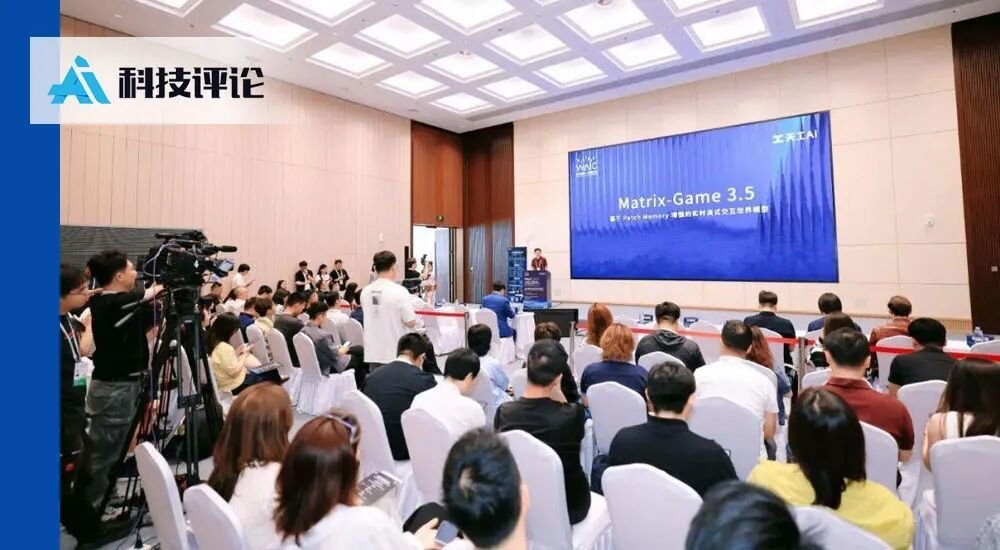
World-model fever reached WAIC 2026, where forums, booths and launches treated it as the soul of the event, because the year of embodied deployment demands a model that understands the physical world. On 19 July, Kunlun Wanwei’s forum answered the plain technical question: how does a world model truly grasp physics and reach the real world? Chairman Fang Han declared 2026 “year one of the world model”, and Matrix-Game 3.5 is its ace.
The object-permanence problem
The stumble starts with a benchmark. MemoBench, from Harvard, MIT, IBM and Google, tests object permanence: does a thing stay the same after it leaves and returns? A three-year-old scores full marks; ten leading world models all failed, the best at 0.58 out of 1. Most models only render, skipping the two earlier layers of understanding and predicting. MemoBench’s verdict: even with visually coherent frames, models cannot recover a hidden object’s state.
The problem splits into three: cannot remember (no steady identity), cannot recognise (fails to re-identify), cannot infer (wrong state change). Matrix-Game 3.5 answers each.
Remembering in 3D space
“Cannot remember” comes from a Transformer flaw: bigger attention windows dilute early information. Google’s Genie 3 keeps consistency for about a minute before scenes collapse. Matrix-Game 3.5 makes the industry’s first geometrically aligned patch-level long-term memory, switching from time indexing (“frame 5, top left”) to spatial indexing (“an object at coordinates x,y,z”), so the map persists no matter how long or from where you return.

“Cannot recognise” has two causes. Viewpoint change breaks pixel match, so Matrix-Game 3.5 adds PRoPE, encoding the camera projection matrix into spacetime position, plus Warped RoPE to relocate patches in the current view. Background clutter is solved by decoupling motion and stillness: patch memory holds stable structure while a subject token keeps the moving object’s identity, avoiding “many people” from “one moving person”.
“Cannot infer” is solved by writing causal reasoning into the training goal. Instead of separate state-then-action, Matrix-Game 3.5 jointly generates state and action under one loss, so it learns “if I do this, how does the world change”. Causal reasoning is grown into the model, not surfaced from data.
Three gates to the real world
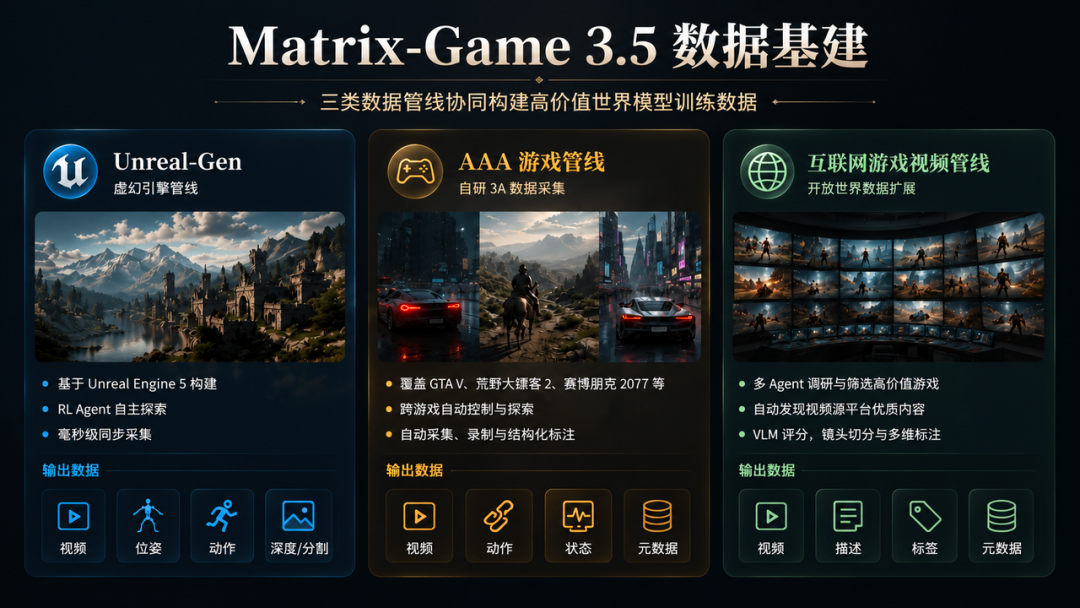
From game sandbox to physical world sits three gates. Data: internet video lacks depth and motion labels, so Kunlun auto-rebuilds physical scale through three pipelines, yielding over 5 million quality clips and 10,000-plus training hours across 1,200-plus scenes. Interaction: latency is a safety line in robot control, so 3-step sampling distillation, DiT INT8 quantisation and 75 percent pruning of the video encoder let a 5B model run 720p at about 20FPS on one GPU. Compute: rather than stacking parameters, Matrix-Game 3.5 adds interaction, long memory and camera control with almost no new parameters, keeping the base model’s open content quality.
Why Kunlun leads
Kunlun moved first and clearest: “All in AGI and AIGC” in 2022, Matrix-Zero in 2024, Matrix-Game 1.0 and 2.0 in 2025, 3.0 and 3.5 in 2026, with a clear definition framework and a reproducible path. It open-sources relentlessly: Matrix-Game was the first 10B-plus spatial-intelligence model open-sourced (May 2025); 2.0 brought the first open real-time long-sequence interaction. NYU’s Saining Xie, who with LeCun raised the JEPA flag, built the multi-agent world model Solaris on 2.0; NVIDIA and Zhejiang University built Light Interaction on 3.0. First to open sets the standard; later comers must comply.
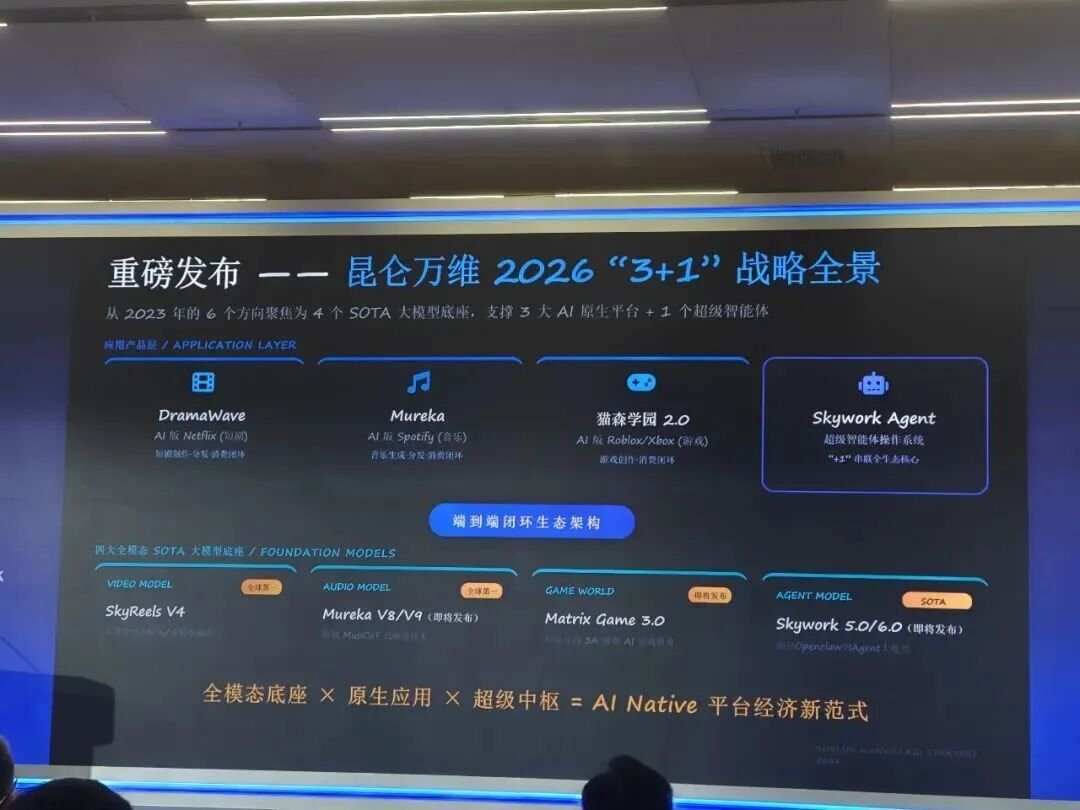
Its “4+3” AGI strategy links four model bases (video, audio, world, text) with three platform economies (short drama, music, games) in a model-platform-data loop. Technically, against Google’s Genie 3, whose causal grasp is statistical and memory-window-bound, Matrix-Game 3.5 outputs executable control commands, answering “what action gets the result” with physical correctness as the test.
A pivot point, not an end
Matrix-Game 3.5 is a lever. Robot training needs no million real-world retries; in the world engine, a robot can break ten thousand bowls at the cost of token electricity. Autonomous-driving sims need no closed test tracks; rain, night and sudden crossings generate with one click. Traditional game engines’ hard logic dies; with geometric understanding, spatial memory and causal reasoning, the world comes alive in the model. On 19 July 2026, the world model stepped toward the real physical world, and Kunlun, first to play, is defining the table’s rules. A Chinese world model has, for the first time, run out ahead as a global technology leader.
Editor’s note: This article is based on reporting by LeiPhone (Lei Feng Wang). Read the original in Chinese here: https://www.leiphone.com/category/industrynews/bugwcjvZxhFyiRY1.html.