100,000 units, or a fivefold leap
Halfway through 2026, the humanoid industry turned in a glossy scorecard. At July’s WAIC press conference, MIIT vice-minister Gan Xiaobin said full-year output could exceed 100,000 units. From about 20,000 in 2025 to 100,000 is a fivefold jump any sector would envy. Fellow vice-minister Ke Jixin called it a clear signal that humanoids are accelerating from exploration to scaled, standardised development.
Behind the number, the picture is messier. At WAIC 2026, across nearly 100,000 square metres, over 200 whole-robot firms competed, from biped to wheeled, industrial to consumer, million-yuan to ten-thousand-yuan. The race is young; the winner is far from set.

Duopoly leads, but output is not deployment
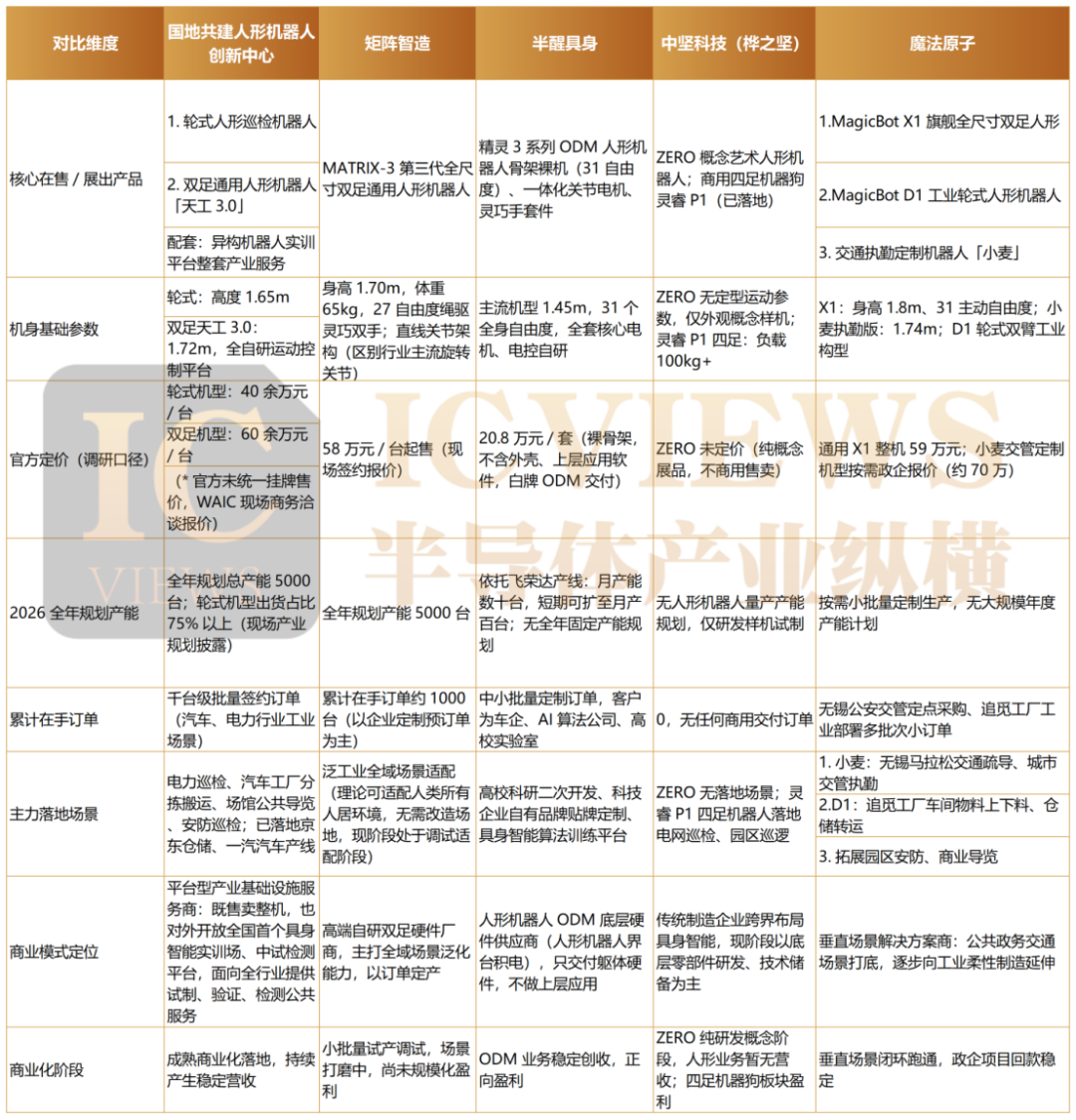
MIR DATABANK shows AgiBot and Unitree as a duopoly. AgiBot crossed 15,000 units in early June; Unitree hit about 11,000 in March. AgiBot’s path is textbook: 6 prototypes in 2023, scaled production from August 2024, 1,000 by January 2025, 5,000 by year-end, 10,000 by March 2026, 15,000 by June. Partner Yao Maoqing calls mass production the root that takes embodied AI from lab to industry. Unitree’s AP director Owen Chen says 2026 shipments should at least double 2025’s 6,500-plus, perhaps nearly triple, with capacity planned at 30,000.
Yet through Q3 2025, over 70 percent of Unitree’s humanoid revenue came from research and education, with industrial use just 9 percent. The robots are not “going to work”; they sit in labs and classrooms. That gap between output and true industrial depth is the industry’s core tension.
MIR also flags UBTECH: high output but a shipment rank that slipped to fourth, often meaning inventory or slow delivery. UBTECH’s U1, the first mass-producible full-size bionic humanoid, took 13,361 orders at 169,800 yuan, but as a consumer product those orders are not counted in industry output. Consumer heat versus industrial chill is stark.
Five firms, five survival modes
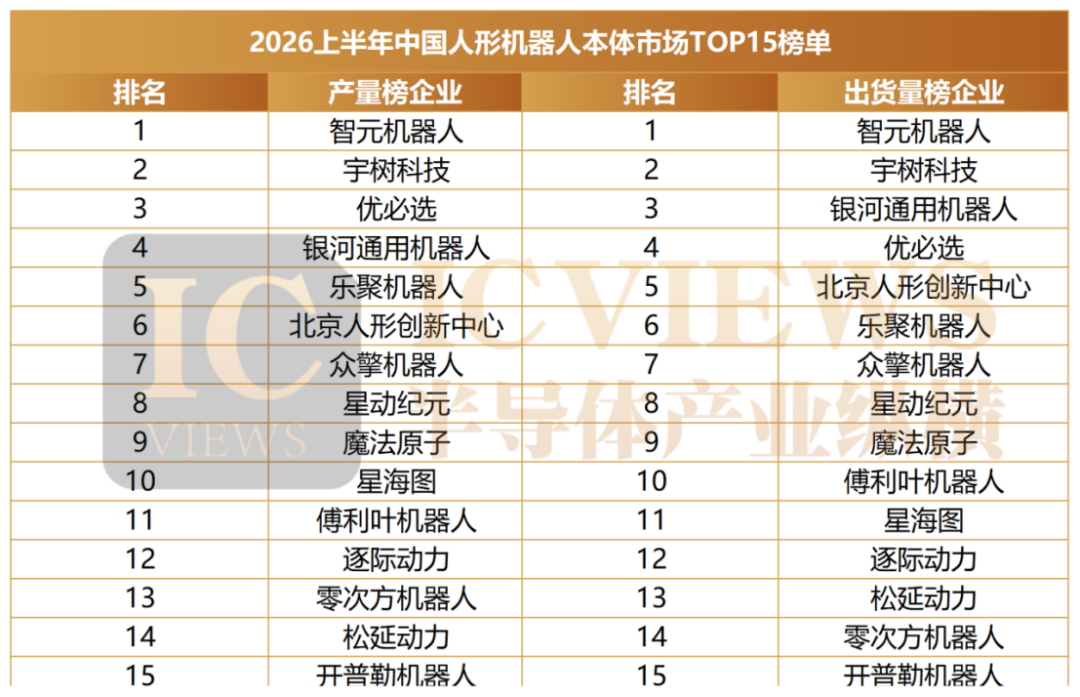
At WAIC, five firms sketch the ecosystem. The national-local innovation centre is pragmatic, with stable deployment in guiding, inspection and sorting, wheeled units at 400,000 yuan and biped at 600,000, and it openly prefers wheeled for cost and uptime. Matrix Manufacturing walks a high-end biped route, the MATRIX-3 at 1.70m, 65kg, 27-DOF hands, 580,000 yuan, about 1,000 orders, still in tuning. Banxing offers ODM skeleton delivery at 208,000 yuan, monthly output dozens, honest that buyers must finish the last mile. Zhongjian is still conceptual, its ZERO prototype with R&D up 291.23 percent. Magic Atom picked a vertical lane, the traffic-warden robot “Xiaomai” already on duty in Wuxi.
Biped, wheeled or dog
Is “humanoid” even necessary? Biped believers cite environment fit: human spaces are built to human scale, so two legs slot in without retrofits. Pragmatists counter that robot dogs are far more stable, lower-centre, less fall-prone; the national centre’s data shows wheeled outships biped in industry. A blunter view: humanoids earn their keep through emotional value, guiding and performing, while AGV-plus-arm already does industrial jobs well. In 2025, over 44,000 quadrupeds shipped, and the first to “go to work” at scale were quadrupeds and wheeled dual-arm units.
The two logics differ in time horizon. Biped is the long bet, needing mature control, cheap hardware and dense batteries. Wheeled and quadruped work today. The question is who survives to the long term; if cash runs out in two or three years, the perfect vision is moot. Boston Dynamics’ Atlas impressed after going electric but its cost stays opaque; Tesla’s Optimus keeps slipping, showing biped engineering is harder than expected. Domestically, Unitree and AgiBot run volume in consumer and research but thin industrial penetration. One veteran says bipeds need two wins, endurance and reliability, neither solved.
Capital shifted, but to the brain
In the first half of 2026, embodied-AI funding hit 104.1 billion yuan, nearly double all of 2025. Unitree’s STAR Market registration cleared; Zhuoli Dynamics raised nearly 200 million US dollars pre-IPO; Leju and Deep Robotics filed. But the flow changed: over half went to “brain” firms, under 20 percent to body makers. VLA models took 42 percent, world models 27 percent, data infrastructure 20 percent. The bottleneck is not hardware but the intelligence to understand and decide. VLA is the standard brain part, yet general autonomy needs tens of millions of hours of real interaction data; by early 2026 the world had only 500,000 compliant hours, a gap above 99 percent. Most humanoids still rely on remote control or presets, bodies without brains. Battery is the other hard limit: a 70kg robot standing burns 200 to 300 watts just fighting gravity, real runtime one to three hours.
The shakeout has begun
In February, China published its first full humanoid and embodied-AI standard system (2026 edition); in June, MIIT and SASAC launched a real-world training drive. But the market is colder. Over 680 whole-robot firms exist; MIR’s list means over 99 percent are spectators. Xie Shaofeng warns many still sit at prototype and demo stage with unclear paths. Most practitioners agree a fierce shakeout comes within three years. Tsinghua’s Zhao Mingguo predicted 2026 may be the year applications get screened. Output of 100,000 is not 100,000 robots on real jobs. As one veteran said, a robot that just dances proves nothing; the real skill shows in the field, and today most are still showing moves. Those that cannot work will be cleared by the market.
Editor’s note: This article is based on reporting by OFweek Robot. Read the original in Chinese here: https://robot.ofweek.com/2026-08/ART-898890-8420-30696724.html.