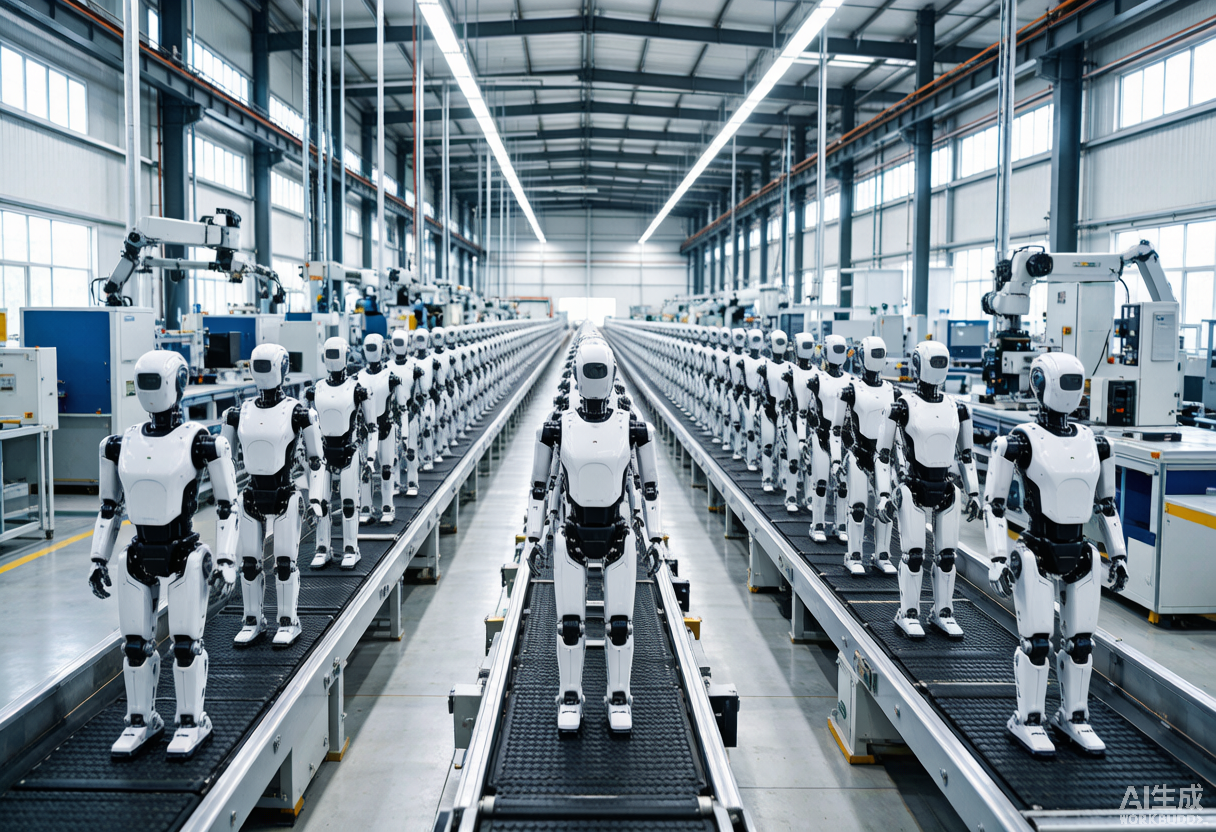
The embodied AI industry has spent two years caught between hype and delivery lag. In 2026, the competition is shifting from demo videos to production capacity.
Magic Atom has broken ground on its headquarters factory in Wuxi’s Liangxi Science City. The site will house four joint module production lines and two final assembly lines. At full capacity, it targets 10,000 robots per year: 9,000 small quadrupeds and 1,000 large quadrupeds.
A 10,000-unit threshold
For a company founded in early 2024, aiming straight for 10,000 units is unusual. Most second-tier players are still planning at the 1,000-unit level. Yield volatility, supply chain gaps, and stubborn costs remain industry-wide problems. That is exactly why the 10,000-unit milestone matters.
Magic Atom’s industrial wheeled humanoid robot has entered top-tier manufacturing factories, handling material transport and line loading. Its traffic management robot has been tested at large public events for crowd control. The company has secured cumulative orders exceeding 100 million yuan, including a 150 million yuan healthcare robotics order that set a record for the segment.
Three routes emerge
The industry is splitting into three camps. First, general humanoid stars betting on full-size universal robots with maximum long-term upside but cautious production timelines. Second, traditional industrial robot makers like Stander and KuaiCang, leveraging mature chassis tech and supply chains, already at 10,000-unit mobile robot capacity. Third, large model and tech service providers like iFlytek and StepFun, staying asset-light and partnering with hardware makers.
Magic Atom takes a fourth path: physical-AI-native, integrating software and hardware from day one. Its self-developed Magic-VLA K02 model achieved over 90 per cent success on long-horizon industrial tasks like box folding and sealant application.
Global footprint
Magic Atom signed an exclusive strategic partnership with AliExpress for overseas channels. Its products now cover nearly 30 countries, with overseas revenue exceeding 30 per cent of total. A 500 million yuan funding round in March fuelled the capacity build-out.
Editor’s note: This is an adapted translation of the original Gasgoo report. It has been trimmed and restructured for readability for an international business audience.