A robot that plays real tennis
On 22 August at the National Speed Skating Hall, the Ice Ribbon, in Beijing, the second World Humanoid Robot Games opened, and China Central Television cut to a real tennis court. A humanoid stood inside as incoming balls passed 50 km/h; within milliseconds it judged the landing, moved its feet, twisted its body and swung, the ball skimming the net and landing in. Serve, forehand, backhand, baseline rallies, net volleys, all the way through with no breakdown. In a doubles warm-up it covered for a human partner and switched tactics. In one high-speed exchange it made an extreme save, then fell hard and pushed itself up off the floor to keep playing. The first humanoid to complete a fully autonomous tennis rally came from Galbot, and the company named the moment AstraTennis.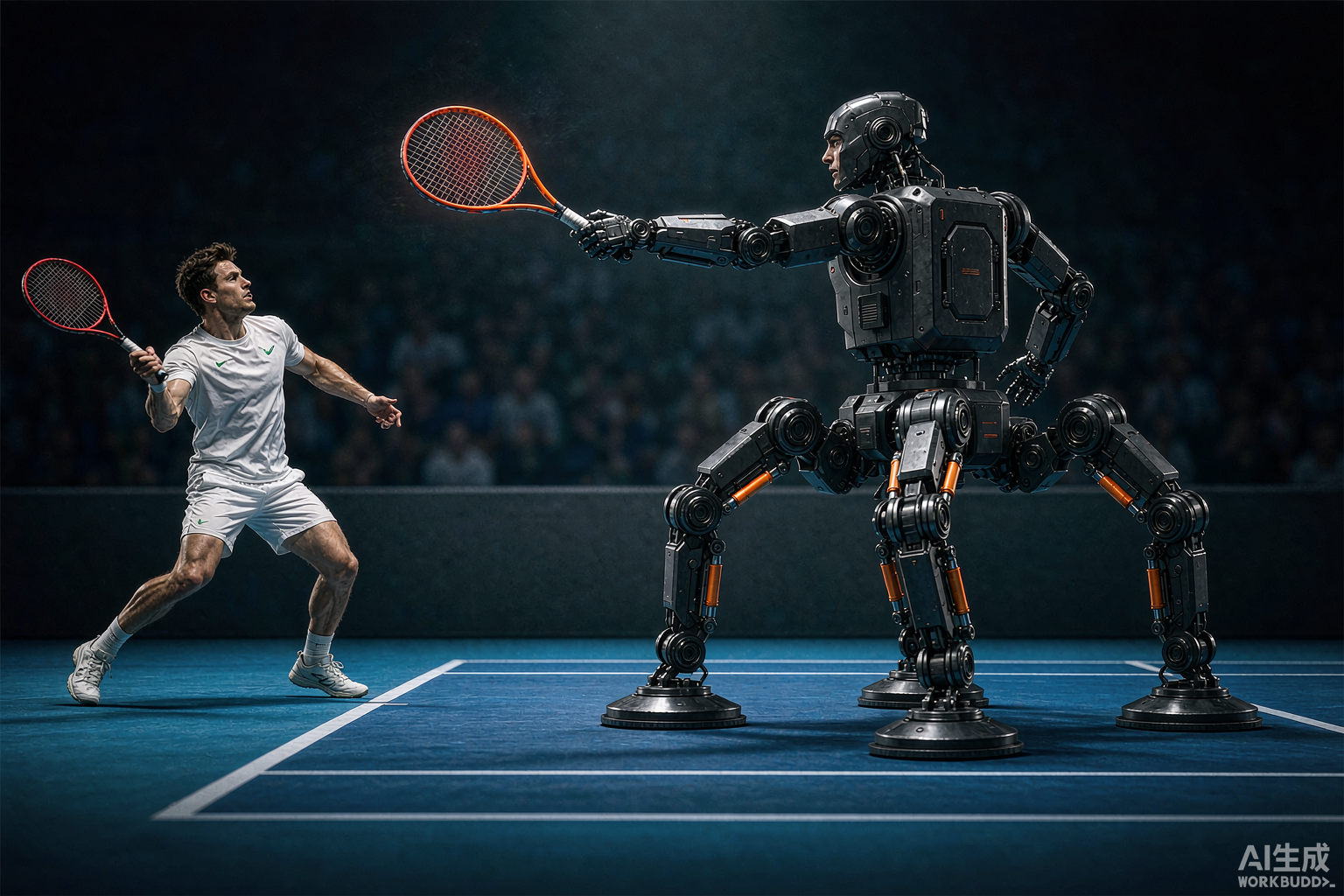
Ten years ago AlphaGo proved AI can think. What Galbot wants to prove now is that AI can do. From thinking to doing took humanity a full decade, and this is why the coverage treats it as a landmark: it refreshes a single metric and, more importantly, puts a humanoid on a real court where thinking and acting are online at once.
Brain, cerebellum and a bridge
Galbot’s answer is an embodied large model called AstraBrain. Its defining trait is that it welds into one model the things a humanoid needs: the brain understands and decides, judging where the ball lands, how to play, how to organise tactics and how to coordinate with a doubles partner; the cerebellum handles motion control, whole-body balance at high speed, explosive swings and human-like movement; and a brain-bridge translates the brain’s decisions into the cerebellum’s action commands. Previously these three were separate modules with weak interfaces; Galbot made them one, which is the claim behind the world’s first whole-body, whole-hand end-to-end large model integrating brain, cerebellum and neural control. On court the value shows: a ball arrives, the brain judges in milliseconds whether it is deep or shallow, whether to attack or defend, while the cerebellum already executes slide left, crouch, draw; at the instant of contact the brain updates, the last shot was not sharp enough, press the line next time. Only an integrated architecture can hold that think-while-playing real-time loop.
At CVPR 2026 in June, Galbot published AstraBrain-WBC 0.5, showing the cerebellum reaching 92.58 per cent zero-shot generalisation and sub-1.5-millisecond inference latency in the lab. AstraTennis is that same system’s first appearance in real competition.
Learning from imperfect human data
Galbot founder and CTO Wang He calls tennis the humanoid’s ultimate exam: whoever answers on the tennis court proves they have solved both the cerebellum and the brain. On court, learning movement the old way fails. In high-speed rallies a human cannot react fast enough for teleoperation data to be useful, and motion-capture of a full match is prohibitively expensive. Galbot took the opposite route with AstraBrain Latent, the world’s first whole-body real-time planning algorithm for tennis rallies, whose name, latent, means it digs the latent rules of how to play out of seemingly imperfect, incomplete human action data.
The counter-intuitive move: instead of waiting for perfect teleoperation data, Galbot collected ordinary people’s scattered basic-action fragments, forehands, backhands, side steps, cross steps, then let the algorithm combine, correct and generalise them into a complete tennis skill. Perfect data is too expensive and rare; the imperfect data already hides the core priors of human movement, weight transfer, arm swing, foot push. What remains, the algorithm handles. The value reaches beyond tennis: the threshold for robots to learn motor skills drops sharply, no need for top athletes or costly capture gear.
To keep movements from distorting at speed, the team added a hidden-space action barrier, a boundary in latent space that keeps the robot’s actions within a human-like style while adjusting stance and swing to the incoming ball, and trained in random perturbations so the robot slowly learns self-correction. By then it plays a live ball and adapts on the spot.
A virtual world to practise in
Galbot also built its own virtual tennis world on top of Galaxy Star Foundry, its 10-billion-scale embodied dataset. Training runs in two steps: massive rehearsal in the virtual environment where the robot plays continuous games against virtual opponents of different levels, reflecting and improving, then a few calibrations on the real machine. The key step is multi-agent play: instead of imitating a human move by move, Galbot lets robots play themselves, two or more agents sparring in simulation, you hit me, I work out the return, and untaught abilities emerge. That is the most prized thing in the large-model era, skill emergence: feed enough data and quantity becomes quality, the robot learns to generalise. The skills trained in the virtual world transfer to the real court, which is why AstraTennis appeared in a global live broadcast rather than staying a lab video.
The fall that mattered most
The most striking frame of the match was the fall. In a high-speed exchange the Galbot humanoid missed an extreme ball and hit the floor hard, then with no staff rushing in and no stop called, it stood up quickly and prepared for the next ball. That detail is more shocking than any spec: this is not a lab performance. The motion control is strong enough to self-recover from real-world accidents.
Zoom out and Galbot’s route, brain decision, cerebellum execution, data emergence, integrated as one, gives the whole embodied sector a reusable paradigm. Previously a humanoid learned each new action by recollecting data and retraining; a general motion base means dance, inspection, rescue and housework can share one body operating system, with marginal cost falling as scale rises. That capability is already running elsewhere: in smart pharmacies the robot picks a target from tens of thousands of items for the rider; on industrial lines Galbot’s S1 dual arms lift 50 kg of material. Tennis is just the newest tile it lit.
From the digital world to the physical, from placing a stone to swinging a racket, AI walked a full decade to stand up from the screen and truly step onto the floor of human life.
Editor’s note: This is an adapted translation of the original LeiPhone report. It has been trimmed and restructured for readability for an international business audience. The full original (in Chinese) is at https://www.leiphone.com/category/ai/DtuJryomWlykalLZ.html.