Two dollars an hour. That is where Roland Berger thinks the running cost of an advanced humanoid robot lands, and it is the number that rewrites where things get made.
The consultancy’s new report, Humanoid Robots 2026: The Convergence Moment of a New Market, marks a shift in the question the industry is asking. It is no longer whether humanoids are a bubble. It is who takes position if the industry is real.
Why now
Three variables arrived at the same time.
AI capability crossed a threshold. Vision-language models, generative AI, edge computing and modern control algorithms are moving robots from executing a script to reading an environment and deciding what to do.
Hardware is close to usable. Compute, perception, actuators, power and structural components have entered pilot validation, though not yet mass commercial deployment. Battery life sits mostly at two to eight hours against a target of 16, and key subsystems still need cost reductions of 50 to 90 per cent.
The labour gap turned structural. Roland Berger projects that by 2050 the working-age population will fall 24 per cent in China against 2025, 18 per cent in the European Union and 25 per cent in Japan. That is not a cycle.
The market numbers, and the one that matters more
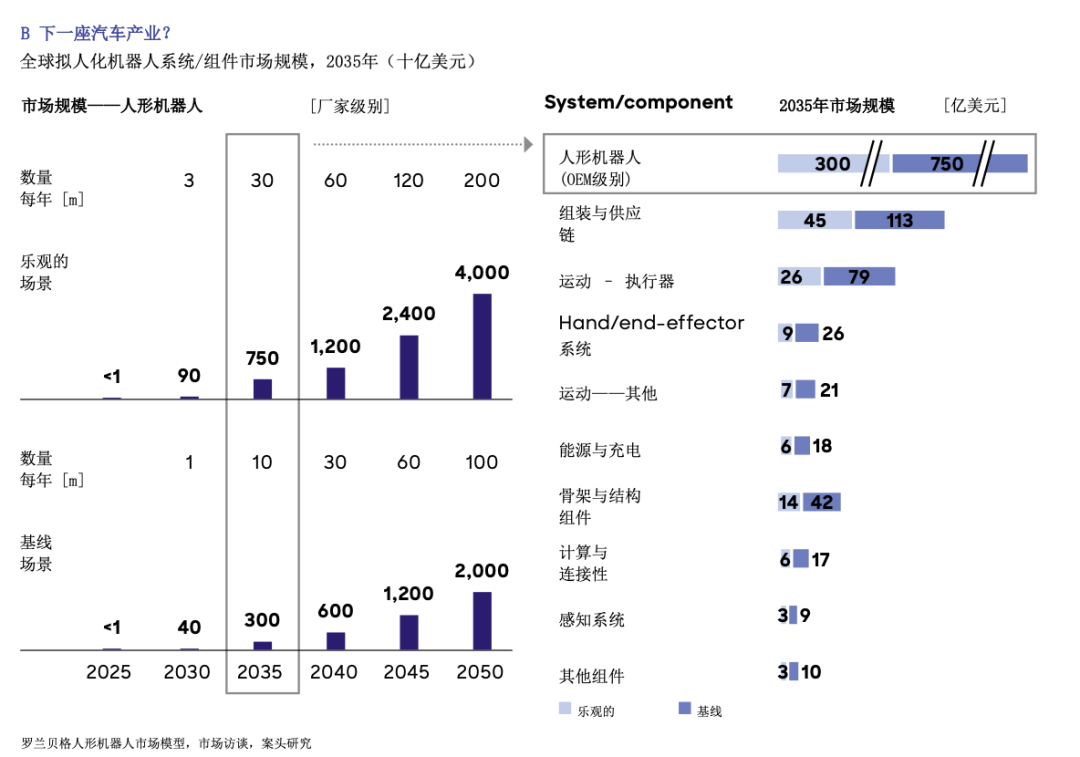
Roland Berger models the humanoid OEM market at roughly 300 billion dollars by 2035 in its base case and up to 750 billion dollars in the optimistic case. By 2050 the optimistic path reaches 4 trillion dollars.
Large numbers, but the operating figure is the one with teeth. If an advanced humanoid can run at about two dollars an hour, the logic behind global manufacturing footprints changes.
The bottleneck moved from mechanics to data
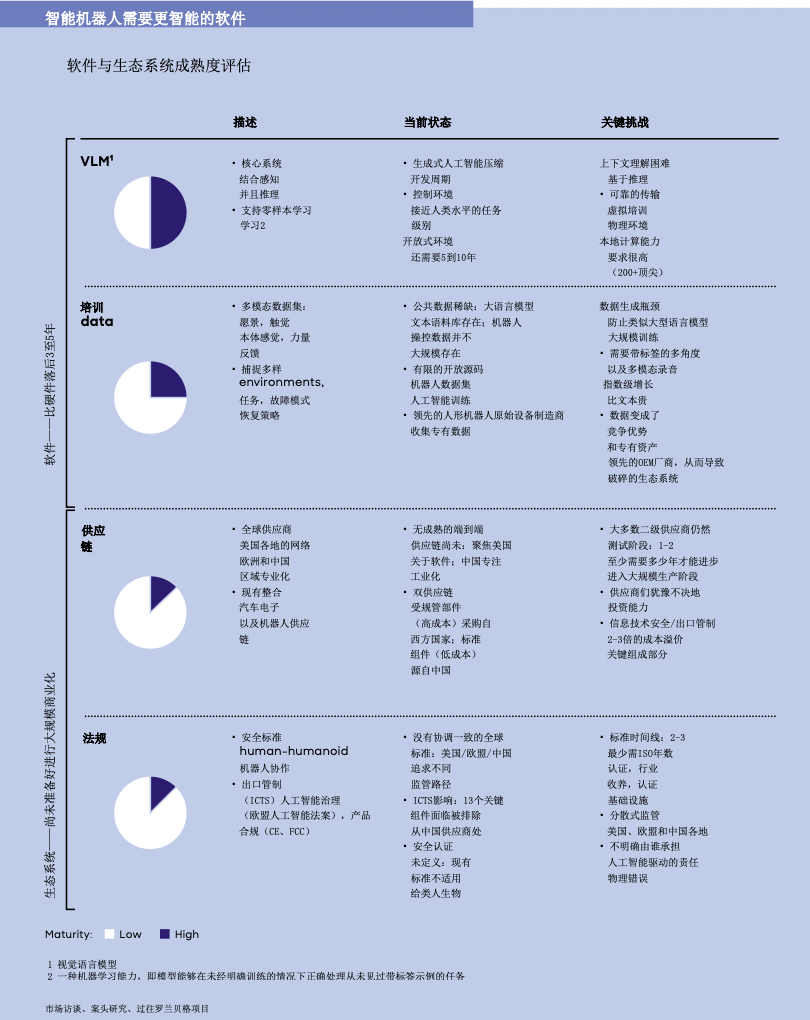
The most important line in the report for anyone building in this space: the primary bottleneck has shifted from mechanical engineering to AI architecture and data strategy.
Humanoids cannot feed on internet text the way a language model can. They need multimodal data from the physical world, vision, touch, proprioception, force feedback, failure modes and recovery strategies. That data is expensive, hard to collect and tightly bound to context.
Which means whoever puts robots into factories, warehouses and campuses earliest gets the operating data earliest. More data, better models. Better models, more deployments. More deployments, more data. That is the flywheel.
Two routes, and a 30 times production gap
Roland Berger splits the global field cleanly. The West is AI-first. China is deployment-first. North America is betting on foundation models and general intelligence. China is prioritising volume production and getting machines running in controlled settings.
The report puts 2025 Chinese humanoid output above 15,000 units, at least 30 times North America and more than 150 times Europe, the Middle East and Africa combined.
China may not hold the strongest model at the start. It is likely to reach manufacturing scale, cost decline and real-world data accumulation faster.
The first wave is industrial, not domestic
Mention humanoids and most people picture a household helper. The report is colder than that. What lands first is work with a defined goal, a controlled environment and high task repetition: shelf picking, carton handling, machine loading and unloading, internal logistics, simple parts sorting, assembly prep.
Unglamorous, and real. The value of early deployment is not immediate labour savings. It is capability, experience and training data. Roland Berger suggests OEMs target pilots of 10 to 50 units and optimise early for data diversity rather than raw productivity.
The implications split by role. OEMs need to get a data flywheel and a manufacturable platform running. Component suppliers need to lock positions in actuators, sensors, controllers, reducers and power management. Manufacturers and logistics operators should not wait for a finished product, they should turn their own plants into training grounds and trade access for priority and co-development rights.
Humanoids are early. The window is not. When the products mature, the standards settle and the field stabilises, position will not be this cheap.
More from the original report
Editor’s note: This is an adapted translation of the original OFweek report. It has been trimmed and restructured for readability for an international business audience.