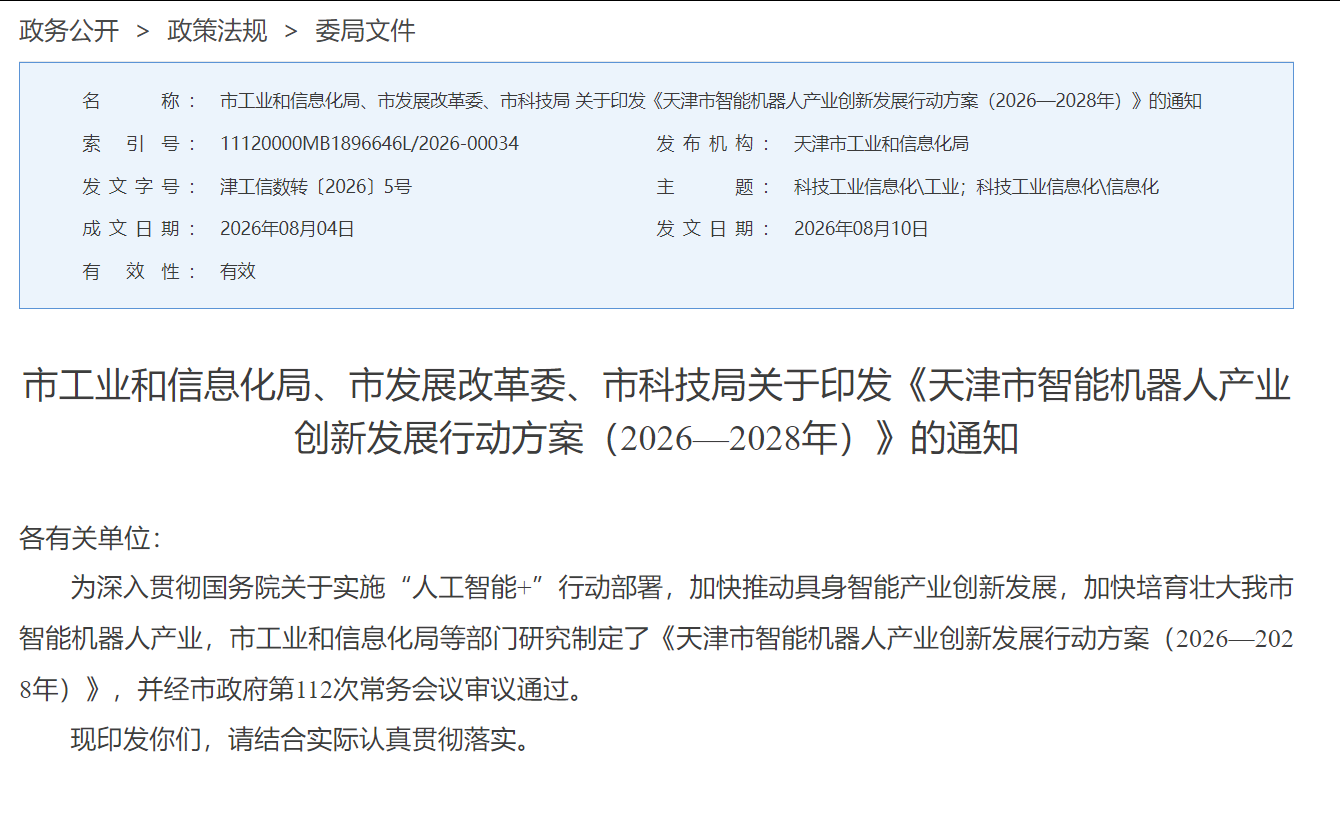
On 12 August, Tianjin’s industry, development and science bureaus issued the Tianjin Smart Robot Industry Innovation and Development Action Plan for 2026 to 2028. By the end of 2028 the city targets core output above 20 billion yuan, average annual growth beyond 15 per cent and a Beijing-Tianjin-Hebei regional supply rate above 60 per cent.
Tianjin is not merely importing robot projects. The plan aims to complete the chain from research and manufacturing to application and service: one smart-robot innovation consortium, a bid for one or two national innovation platforms, and 20 key technology products around main-control chips, operating systems, reducers and servo motors. It also targets three or more firms with output above 1 billion yuan and 20 national specialised little-giant firms.
The policy weight sits on core parts, algorithms and data rather than headline output. Tianjin will tackle end-cloud chips and operating systems, lift the performance of integrated controllers, bionic bodies and high-integration joints, and develop more than 200 industrial specialised models and over 100 high-quality datasets. The move extends a 2025 AI action plan that leaned on the local Xinchuang supply chain and real scenarios, pushing AI further into physical manufacturing.
The plan also concedes the real bottleneck is not strategy but replicable commercial orders. Tianjin will build more than 20 real-world training spaces and over 100 demonstration scenarios across industry, special operations and public services, hoping open scenarios pull technology iteration and company growth. Whether it can string chips, reducers, servo systems, models and whole machines into one supply chain, and turn demos into sustained procurement, decides if dense industrial layout becomes a true robot cluster or stays at pilot scale.
Editor’s note: This is an adapted translation of the original Gasgoo report. It has been trimmed and restructured for readability for an international business audience.