On 12 August, Manus published an open letter to users announcing it would soon resume operating as an independent company and keep serving its millions of users worldwide. As part of resuming independence and complying with regulatory requirements in certain jurisdictions, data some users generated on or after Meta’s acquisition day of 29 December 2025 will be deleted in late August.
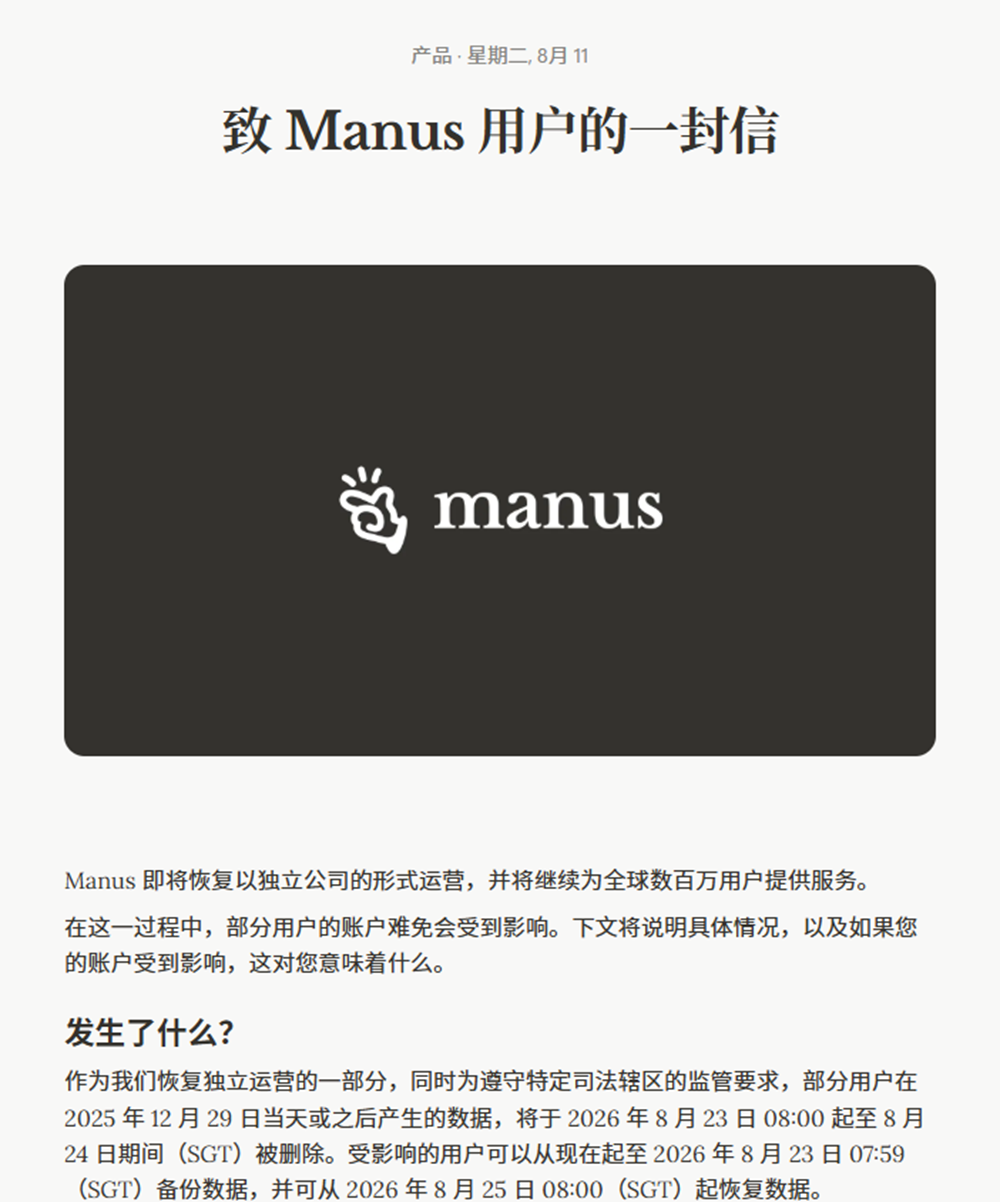
The letter confirms the Manus-Meta split. The deal, which stunned the global AI circle at several billion US dollars, ends seven and a half months after it was announced.
The key arrangement: affected users’ data created on or after Meta’s acquisition day, 29 December 2025, will be deleted on 23 to 24 August, Singapore time. Manus has launched a dedicated backup and recovery tool; the backup window is open now and closes on 23 August. Affected users can back up first, recover data from 25 August, and expect about two days of account inaccessibility. Unaffected users continue as normal.
As compensation, Manus will not charge affected users during the backup period and will issue a “return reward” after recovery. On why only post-acquisition data is affected, Manus said this is part of the Meta split and compliance with certain jurisdictions, not a leak or security incident. As an independent company, user data will be stored in the United States and Singapore.
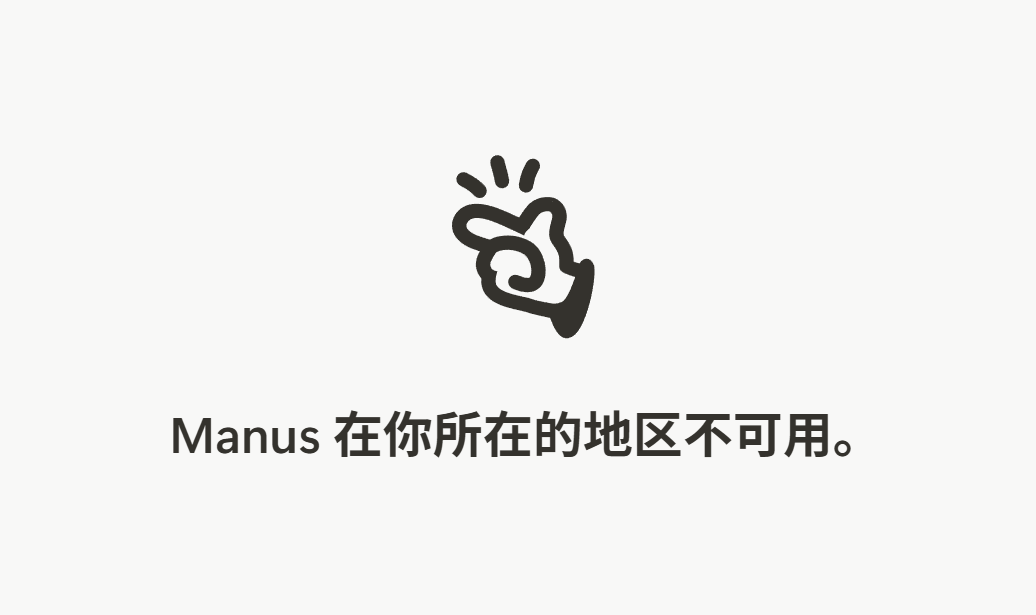
Manus remains unavailable in mainland China, so this data handling mainly affects overseas users.
Manus’s seven and a half months were turbulent. On 30 December 2025, Meta announced it would acquire Butterfly Effect, Manus’s parent, in a deal reportedly worth several billion US dollars. ZhenFund, a long-term investor, called it Meta’s third-largest acquisition after WhatsApp and Scale AI.
Under the original plan, Manus would fold into Meta’s consumer and enterprise ecosystems, founder Xiao Hong would join Meta as a vice president, and 100 team members would join Meta’s Superintelligence Lab organisation in Singapore. Before the deal, Manus was at its peak. In March 2025 it launched as the “world’s first general AI agent”, with invite codes in scarce demand. Its agents processed over 147 trillion tokens, spun up more than 80 million virtual machines, and grew annual recurring revenue from 0 to 100 million US dollars in eight months, while seeking a new round at a 2 billion US dollar valuation.
The turn
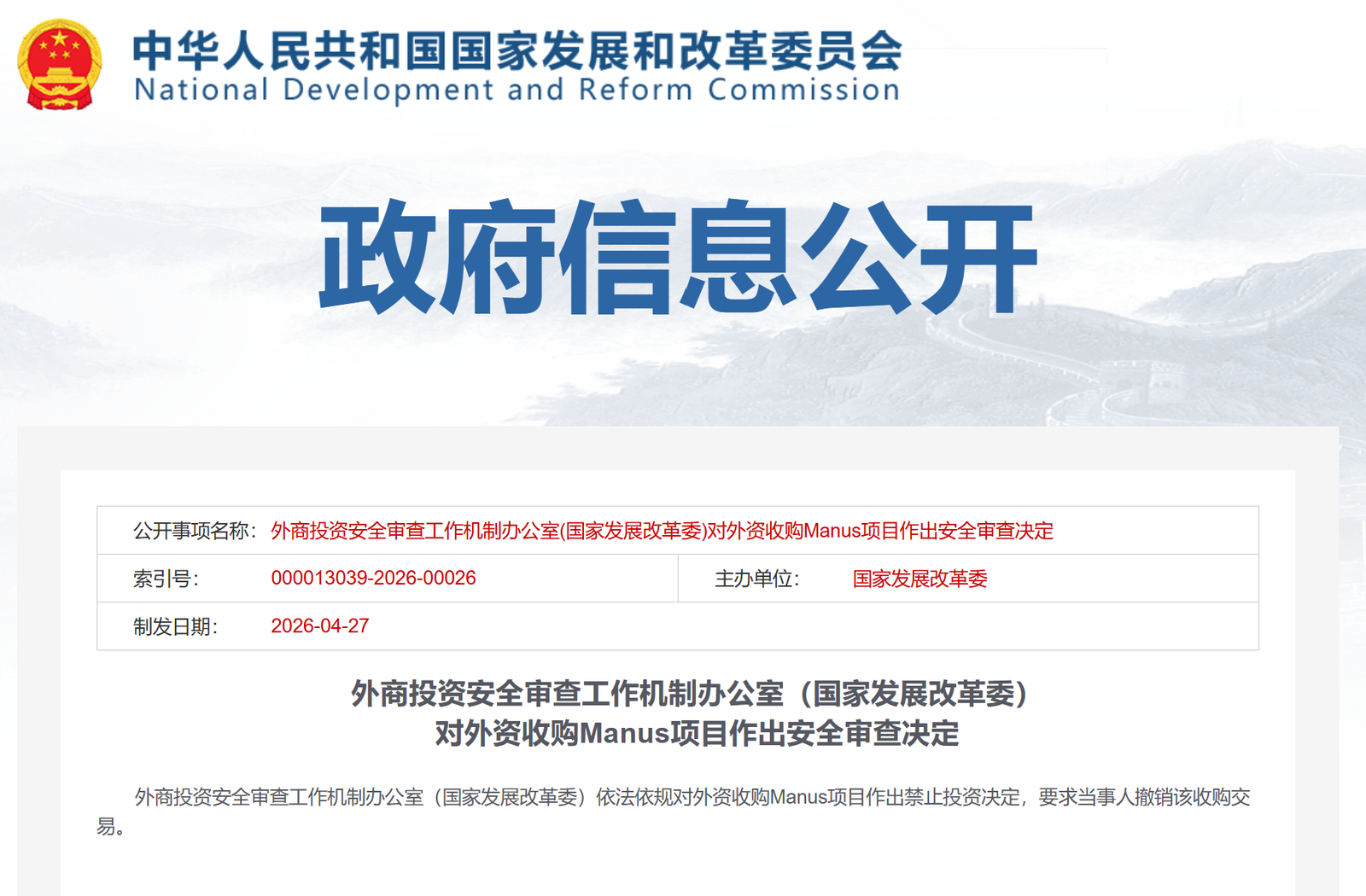
The deal reversed sharply this year. On 8 January, the Commerce Ministry said it would assess the case with related departments. On 27 April, the foreign-investment security review office under the National Development and Reform Commission formally barred the foreign acquisition of the Manus project and ordered the parties to unwind it. Under the foreign investment security review rules, completed deals must dispose of equity or assets within a limit to restore the pre-investment state. The user-letter arrangements are the regulatory fallout; resuming independence is essentially fulfilling the “restore the original state” requirement.
During the Meta months, Manus changed most visibly in performance. A person familiar with the matter told the Financial Times that its annual recurring revenue climbed to 400 million to 500 million US dollars in July, from 100 million at acquisition. On capital, the Financial Times reported that Tencent, ZhenFund and Sequoia China are discussing a buyback of Butterfly Effect equity at the roughly 2 billion US dollar Meta valuation, with Tencent taking the largest stake but staying a minority; Benchmark, the US venture firm that led Butterfly Effect’s 75 million US dollar Series B, is not participating. After a buyback, Manus would keep operating independently from Singapore, with a future independent listing possible, though a Hong Kong listing would require the restructuring to complete first.
Xiao Hong and Tencent have history: he was among the first external testers of WeChat-ecosystem agent products, and his earlier official-account tool Yiban received Tencent investment. Before the acquisition, Butterfly Effect had completed four funding rounds, with post-money valuation rising from 14 million to nearly 500 million US dollars.
Where Manus goes after the split
From its March 2025 debut to the December Meta acquisition, the April regulatory block and now the return to independence with data deletion and repatriation, Manus has run a full cycle in under a year and a half that most startups never see. The general-agent track it sits in has grown far more crowded in those eight months. Meta’s willingness to spend several billion dollars shows the space is now contested by giants and founders alike. Today the model vendors are building agent ability directly into their own products, squeezing startups with the “model is the product” squeeze.
Without Meta’s traffic and ecosystem, and after nearly eight months of capital turbulence, whether Manus sustains its growth depends on whether the “series of new features” promised in its letter actually wins users back.
More from the original report
Editor’s note: This is an adapted translation of the original Zhidx report. It has been trimmed and restructured for readability for an international business audience.