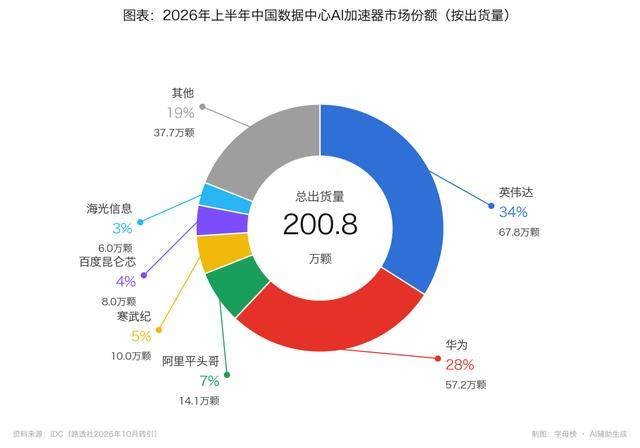
Two shifts are accelerating in China’s AI chip market. Nvidia’s share is being eaten by domestic makers, and non-GPU accelerators are rising. IDC data for the first half of 2026 shows China’s data-centre AI accelerator shipments reached 2.008 million units, with non-GPU at 1.016 million, surpassing GPU for the first time. Nvidia still leads at 34 per cent, but Huawei is at 28 per cent, a gap of only six points.
The full-stack play
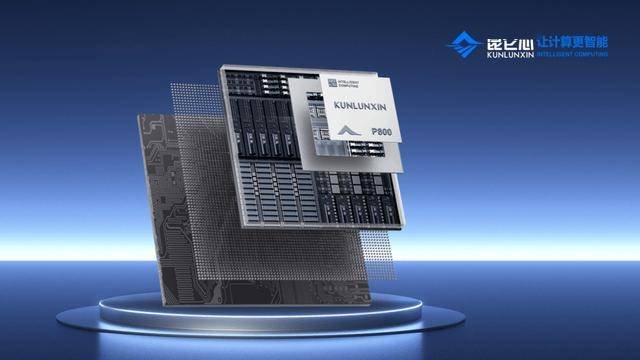
Alibaba CEO Wu Yongming said in March that Pingtouge’s chip revenue had reached the RMB 10 billion level annually, and at the Cloud Summit the firm launched Zhenwu V900, due for mass production in the first quarter of 2027. Baidu is spinning off Kunlun; its P800 cluster of 30,000 cards is lit, and it seeks about a US$50 billion listing. Tencent shipped Zixiao 2.0 in July for internal use with a 100,000-card target by year end. ByteDance’s chip team reportedly exceeds 1,000 people. Even model maker DeepSeek is rumoured to be building its own inference silicon.
Why chips, not models
Model companies are still hunting for profit while training and inference bills become chip makers’ margins. Deloitte expects inference to be about two-thirds of AI compute in 2026. On matched inference tasks, custom chips can hit 1.5 to 3 times the energy efficiency of general GPUs and cut unit cost by over 35 per cent. Amazon set the template: its Trainium and Graviton chip business now runs above a US$25 billion annual rate, and Anthropic and OpenAI committed to Trainium.
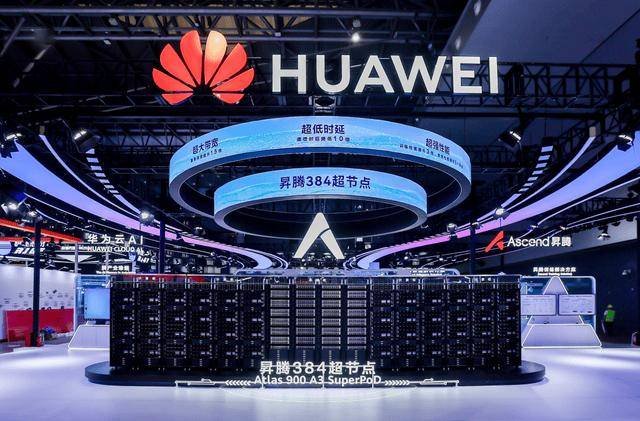
Chinese giants go further with two monetisation paths: hardware, by selling supernodes, and capital markets, by spinning chips into separately valued assets. But today’s buyer is tomorrow’s competitor. Tencent backed Enflame through 11 rounds and holds 20.26 per cent, yet Enflame drew 83.79 per cent of 2025 revenue from Tencent. Capacity is the bind: 2026 domestic AI chip demand is about 4.2 million units against roughly 2.6 million of supply, a gap near 40 per cent.
Editor’s note: This is an adapted translation of the original Sohu report. It has been trimmed and restructured for readability for an international business audience. The full original (in Chinese) is at https://www.sohu.com/a/1087733440_121948416.