Shenzhen is sending a clear signal to the global robotics community. On the eve of the 2026 World Robot Conference, the Shenzhen Institute of Artificial Intelligence and Robotics (AIRS) announced that AIRSEAI, its open-source embodied-intelligence project, has formally joined the LF AI & Data Foundation under the Linux Foundation. It is the first technical project under LF AI & Data to focus on embodied intelligence.
The Linux Foundation is one of the world’s largest open-source collaboration ecosystems. It backs more than 1,300 open-source projects and brings together about 855,000 code contributors and over 21,000 participating organisations. LF AI & Data is its umbrella foundation for open-source artificial intelligence and data innovation, offering neutral governance, community building, compliance, security and outreach support.
For AIRSEAI, joining LF AI & Data means a research platform born inside a single institute will move to a neutral, globally co-built model. It offers research bodies, robot makers and developers a shared public infrastructure for embodied intelligence.
Why “open” matters here Most players in the field simply bolt a large model onto a robot body and hope general intelligence follows. Liu Shaoshan, director of AIRS’s Embodied Intelligence Centre and the project’s initiator, argues that durable capability cannot be stacked together from hardware or models alone. “The truly sustainable path is to let the system keep exposing problems in real tasks, accumulating data, expanding ability, and preserving effective modules through open collaboration,” he said. Joining the Linux Foundation turns that evolution from one team’s engineering process into an open mechanism the global community can join.
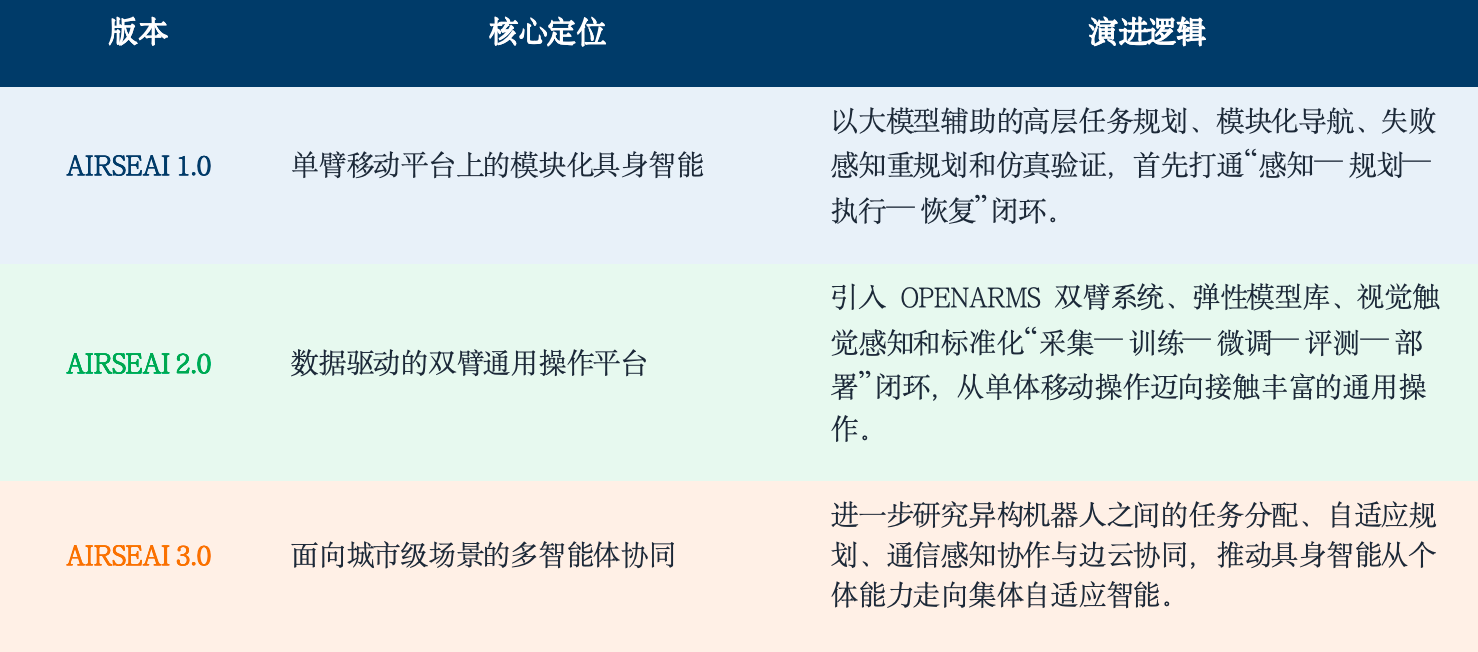
AIRSEAI is not built around a single robot product. It follows a principle of solving the key bottleneck exposed in the previous stage each generation to build a long-term open infrastructure. It evolves from modular single-robot planning, to data-driven dual-arm general manipulation, to collective adaptive intelligence across heterogeneous robots. The first generation secures stable, reliable single-robot operation. The second gives robots more complex physical manipulation through data. The third lets different robots coordinate in open, dynamic environments.
The embodied-intelligence stack spans robot bodies, sensors, chips, foundation models, control, data, simulation, evaluation and application scenarios. No single firm or lab can build the whole base alone. The Linux Foundation supplies neutral governance, open contribution flows, intellectual-property and compliance support, community operations and global ecosystem links, so different companies and research bodies can innovate around shared interfaces without lock-in to one vendor or one robot form.
After joining LF AI & Data, AIRSEAI will evolve through a Technical Steering Committee, public technical discussions, a transparent roadmap and open contribution mechanisms. Near-term research focuses on completing AIRSEAI 2.0’s multimodal data and deployment loop, strengthening dual-arm manipulation and tactile sensing, building stricter capability boundaries and simulation-to-reality evaluation, and broadening compatibility with third-party robots and compute platforms.
Launching at the World Robot Conference also sends a signal about Shenzhen’s industry. The city has a complete robot-hardware manufacturing chain and deep experience in humanoid robots and smart-equipment production. AIRSEAI fills the open-source gap on the basic-software side. “China can not only make a rich variety of robot bodies, but is also willing to contribute open basic software, data flows and system methods, and build the public technology base of the embodied-intelligence era with international developers,” Liu said.
AIRS has invited robot manufacturers, chip and compute-platform firms, model developers, universities, research institutes and users to join. Source code, technical documentation, governance information, community meetings and contribution channels will open progressively through the AIRSEAI website, its GitHub organisation and LF AI & Data community platforms.
Images
Editor’s note: This is an adapted translation of the original Shenzhen News report. It has been trimmed and restructured for readability for an international business audience.