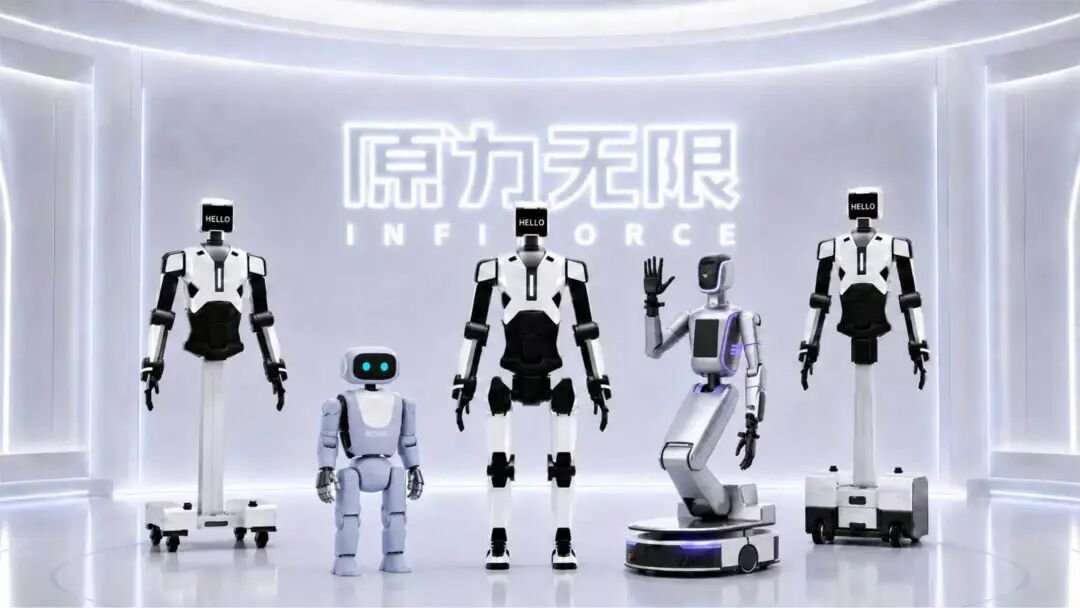
Yuanli Wuxian, an embodied-brain company, completed Series A and A+ funding of nearly RMB 1 billion on 14 August. The round was led by Dunhong Asset and a leading state-owned platform, with Zhejiang University’s sci-tech group, Yandu state control and Lishui state capital among the industrial and institutional backers, and earlier investor CCV adding more.
The cash goes to three places: the AtomBrain causal world model, the full-stack AI infrastructure DataGrid, and scaled delivery and validation of multi-form robots in real scenes. Yuanli Wuxian also said it will soon release an embodied model built on high-quality Ego data, which it calls the first of its kind. The more interesting question is whether that model proves Ego data can turn steadily into robot-capable skill.
Ego data: not just shooting video
The embodied-intelligence field is short on usable experience, not short on video. Since 2025, Yuanli Wuxian has backed Ego data, recorded from the operator’s own viewpoint and closer to how a deployed robot observes. Paired with motion trails, contact state, environment feedback and task results, a clip becomes training experience. Ego data arises from people’s normal work, so it is richer and easier to scale than teleoperation, though it cannot replace real-robot data.
To make this work, Yuanli Wuxian built DataGrid, tying capture hardware, processing, auto-labelling, training interfaces and real-robot validation into one system. In 2026 its East-China data centre with Yandu state control opened, nearly 2,000 square metres, its second embodied-brain training centre after Hangzhou, with scenarios like convenience-store fulfilment, personal-care cleaning and pet-toy handling.
A causal world model that judges consequence
Continual-learning VLA answers “what do I see, what do I hear, what next.” A causal world model asks “if I do this, what happens.” Will the cup slip, will the soft pack deform, will one wrong step break the whole task. Yuanli Wuxian’s AtomBrain puts both in one embodied brain. its AtomVLA, accepted at IROS 2026, uses a language model to break long tasks, then a predictive latent world model to rehearse candidate actions and give the VLA a reward signal, cutting costly real-robot trial and error. On published benchmarks, AtomVLA reached 97 per cent success on LIBERO and 93.1 per cent on RoboTwin 2.0.
Why the commercial scene matters
Many embodied firms stall between lab demos and real sites. Yuanli Wuxian chose “one brain, many bodies, many scenes,” moving one AtomBrain across humanoid, general, biped and specialist robots, so new scenes need not start from zero and on-site success or failure flows back through DataGrid. The company says its technology is in validation or commercial use across more than 30 cities and 100-plus real scenes in commercial service, warehouse logistics and industrial manufacturing. In July it signed a strategic tie-up with CREC Industry, covering infrastructure joint research, robot application and standards.
After nearly RMB 1 billion, Yuanli Wuxian still has to prove three things: that Ego data scales, that the causal world model lifts success rates, and that on-site feedback makes the next robot better. The industry used to compare parameters. Now it compares learning speed.
Editor’s note: This is an adapted translation of the original OFweek report. It has been trimmed and restructured for readability for an international business audience.