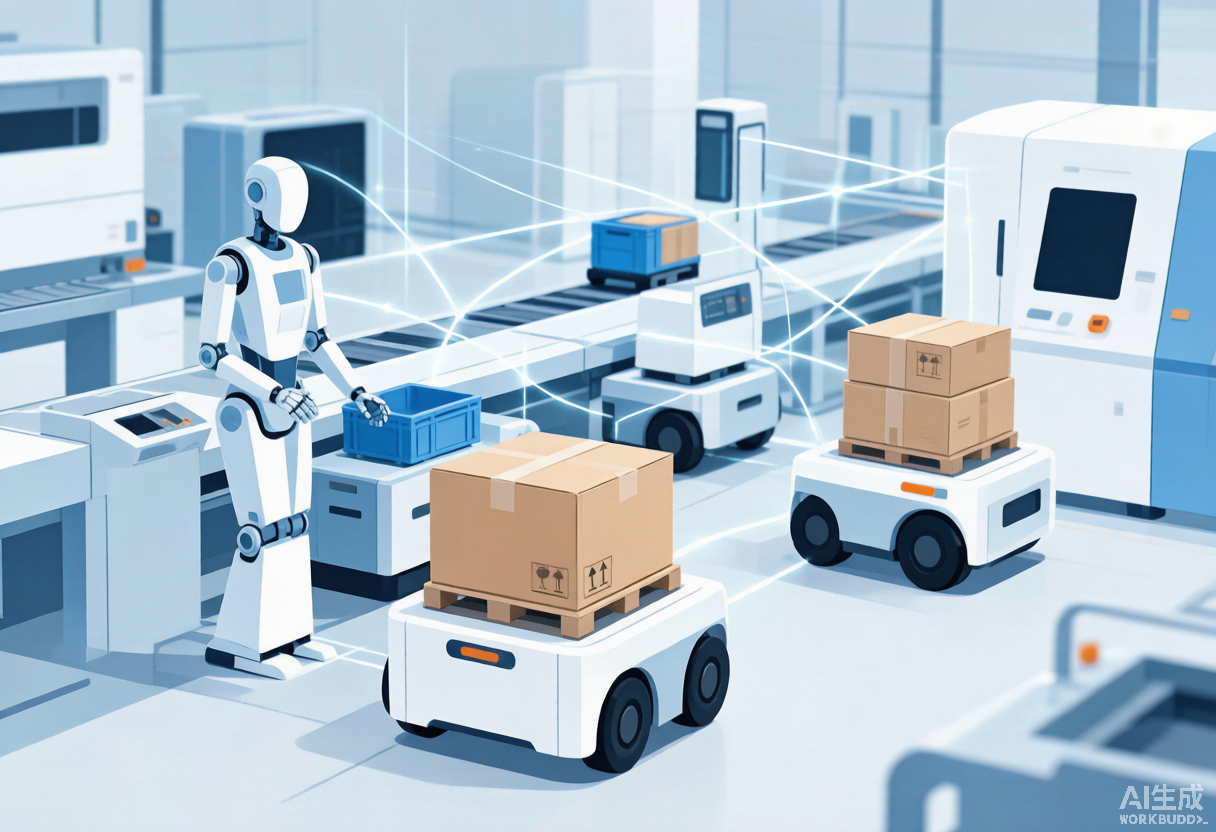
Bangqi, a Shenzhen firm, has staked its strategy on building a factory-wide intelligent system rather than selling single devices. Using its own industrial vertical AI model, it pairs an LDS production-coordination system and an ADS multi-brand scheduling system with self-built AGV, AMR and embodied-robot hardware, pushing plants from local automation toward global autonomous decisions.
From made-in-China to designed-in-China
For more than ten years, single-point hardware automation has spread, but system-wide coordination and data flow remain a gap most factories have not crossed. Bangqi aims to close it with an AI industrial operating system, LDS, delivering an “AI plus industrial agent plus robot” package that gives a factory a nervous system able to think, decide and coordinate.
A three-stage path
Bangqi’s clients include CATL, EVE Energy, Gotion, Sunwoda, Guangzhou Pharmaceutical, SF Express and DHL, nearly 100 leading firms, with more than 2,000 delivered projects across China, North America, Europe and Southeast Asia. In a deep interview, chairwoman Wu Xiaoqian described two phases: 2013 to 2019, building industrial software and data algorithms while peers raced hardware specs. and after 2019, moving to full-chain coordination as demand shifted from “machines replacing people” to “end-to-end autonomy.”
Wu frames the three technology fronts as one body with two wings. The “body” is the industrial AI agent, the factory’s digital brain for global perception, autonomous decisions and continuous improvement. One “wing” is embodied intelligence, linking brain and world so a robot becomes a smart limb, not a tool. The other “wing” is AGV and AMR, the legwork that solves mixed-brand scheduling and full-flow logistics while feeding data back to embodied research.
One hub for mixed-brand robots
On a leading battery line, a dozen brands and hundreds of AGVs run their own schedulers under laser SLAM, magnetic or QR navigation, often in incompatible map coordinates, so the customer needs physical isolation just to avoid collisions. Bangqi’s ADS is a universal execution hub that abstracts dozens of private protocols into one command model and solves trajectories, tasks and battery in real time on one dynamic map, with millisecond-level deterministic response. That cuts lock-in and builds the industrial data pool for the agent layer.
Embodied robots that close the loop
In September 2025 Bangqi unveiled its embodied robot at an industry expo: mobile, perceptive, grasping and decision-making in one unit, with dual seven-degree-of-freedom arms and dexterous hands accurate to the millimetre, moving at 1.5 metres per second with over 100 kilometres of range and at least eight hours of operating battery. A modular design lets it dock onto different carts and switch between warehouse, line and dock. It is already used on an auto-parts line.
Results on the floor
In a lithium-battery gigafactory, Bangqi lifted plant-wide automation by 50 points, from 30 per cent to over 90 per cent, raised output 10 per cent, cut hardware cost 30 per cent and labour cost 50 per cent. For a major new-energy vehicle maker, its full-link plan took raw material in to finished product out with no human in the loop and met the industry’s strict traceability rules, lifting efficiency and material turnover by over 20 per cent. Wu’s four trends for the next decade: pervasive industrial AI agents, scaled embodied robots, standardised open digital bases, and green, RaaS-style services that lower the bar for smaller firms.
Editor’s note: This is an adapted translation of the original OFweek report. It has been trimmed and restructured for readability for an international business audience.