After drones, robots are becoming Shenzhen’s next industry with a real cluster effect, and the trade data now backs it up. In the first seven months of 2026 the city’s total imports and exports reached 3.42 trillion yuan, up 32.8 per cent, with exports of 1.77 trillion and imports of 1.65 trillion, the latter up 61.9 per cent as Shenzhen absorbs global AI supply-chain demand.
Inside that, a single line stands out. Shenzhen’s separately listed robot exports reached 8.58 billion yuan, up 10.5 times from a year earlier. The jump follows a customs change: from 1 January 2026 China gave smart bionic robots their own tariff code, 8479.8970, and cleaning robots 8508.1110 and 8508.1910, ending the vague classifications that lumped new machines under old heads. Shenzhen’s robot exports are about a quarter of China’s national total, sold to more than 100 countries and regions.
A structural rise
The 2025 Shenzhen robot industry white paper put output at 242.6 billion yuan, up 20.56 per cent, with the figure climbing from 158.2 billion in the previous five-year plan to 242.6 billion, a compound rate above 11 per cent. The drivers are scaled industrial-robot deployment, deeper service-robot penetration, and new consumer categories. Along Liuxian Avenue, one local said, tactile sensors, lidar, servo electronics, power modules, arms and dexterous hands are all sourced nearby, delivered to the doorstep. That supply density is the city’s repeatable advantage, the same pattern that built its EV and drone industries.
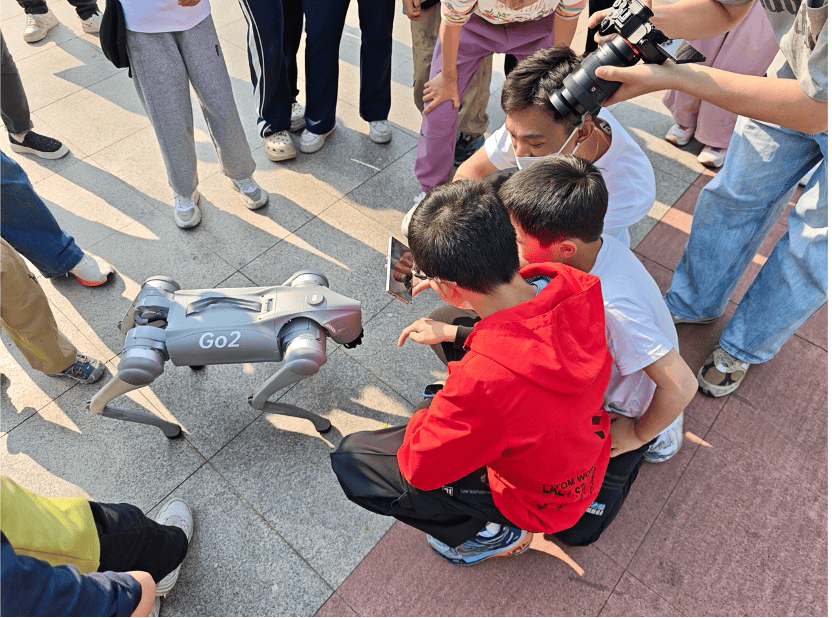
Shenzhen splits its robots into industrial and consumer classes. Humanoids are still mining overseas growth through scenario invention, while cleaning robots, with a dedicated tariff code, are already the export workhorse: Shenzhen cleaning-robot exports hit 6.025 billion yuan in the first half. Nationwide, cleaning robots plus bionic fish and birds reached 18.09 billion yuan in the half.
Approaching the tipping point
In the first quarter of 2026 Shenzhen’s industrial-robot output rose 74.2 per cent. China’s industrial-robot output grew 28.5 per cent in the first seven months, and the country’s quadruped robots took close to 70 per cent of global unit share while humanoid models passed 400 variants, over half the world’s. At the 2026 World Robot Conference, vice-minister Xin Guobin said the robot industry’s large-firm revenue passed 300 billion yuan in 2025 and 165.5 billion in the first half of 2026, up 24.5 per cent, and the humanoid shipment report put the first-half figure above 40,000 units, 97 per cent of the global total.
Embodied-AI funding in China reached 93.5 billion yuan in the first half, five times a year earlier, with Shenzhen second among cities at 23.817 billion across 61 deals. For European supply-chain watchers the lesson is that Shenzhen is not exporting gadgets but a full stack: parts, assembly, delivery and a cost curve proven by volume, now with a tariff code that makes the trade visible.
Editor’s note: This is an adapted translation of the original Sohu report. It has been trimmed and restructured for readability for an international business audience.