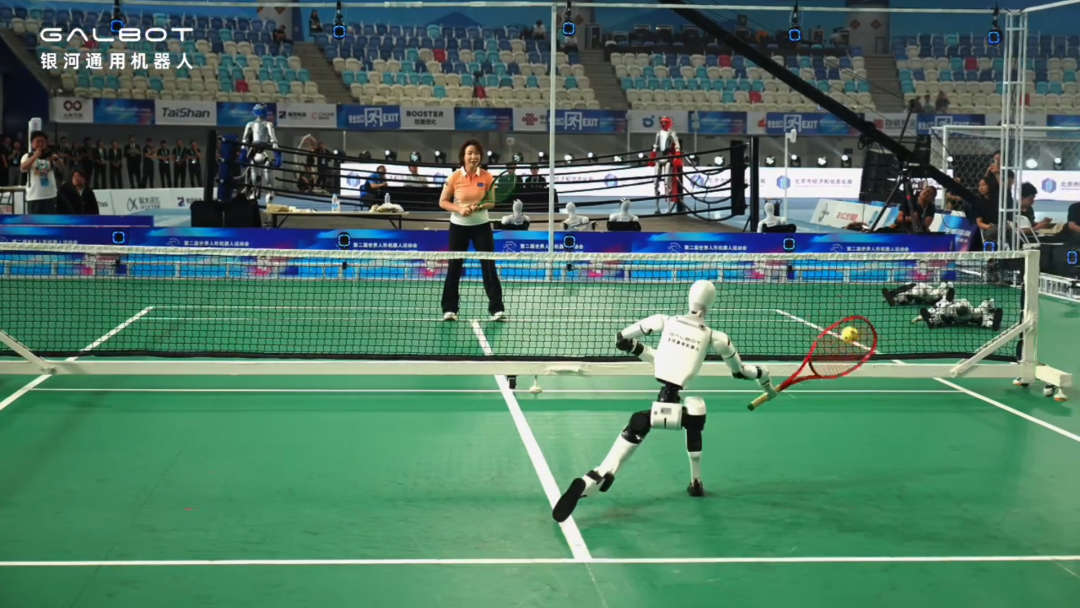
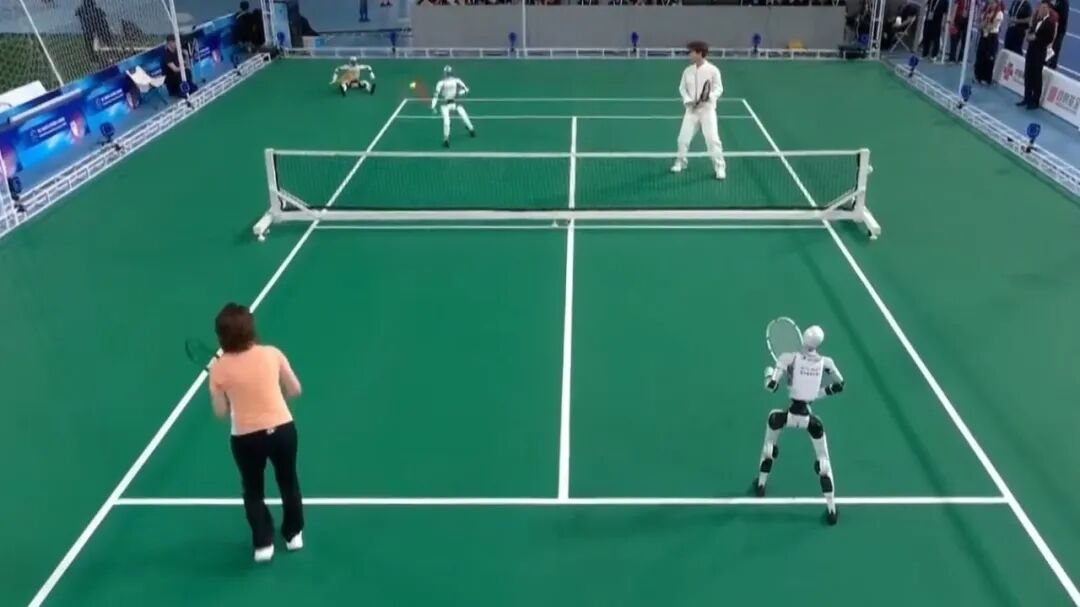
On 22 August, at the National Speed Skating Oval in Beijing, the opening of the second World Humanoid Robot Games put a live tennis court on air. A humanoid robot faced incoming balls travelling above 50 km/h, judged the bounce in milliseconds, moved its feet, twisted its body and swung, landing the ball inside the lines. Serve, forehand, backhand, baseline rallies, net volleys: it did not fall apart.
In a warm-up doubles segment it covered for its partner and switched tactics, and during a high-speed rally it made an extreme save, crashed hard to the floor, then pushed itself up and kept playing. The robot that completed the world’s first fully autonomous tennis rally comes from Galbot, a Beijing embodied-AI company. A decade after AlphaGo proved AI could think, Galbot wants to prove AI can act. Galbot named the moment the AstraTennis moment.
A brain that decides, a cerebellum that swings
Galbot’s answer is AstraBrain, an embodied large model that welds three jobs into one network. The brain handles understanding and decisions: reading the bounce, choosing how to play, organising tactics, judging doubles coverage. The cerebellum handles motion: full-body balance at speed, explosive swings, human-like movement. A “brain bridge” translates the brain’s decisions into the cerebellum’s motion commands. Galbot calls it the world’s first end-to-end whole-body model that integrates brain, cerebellum and neural control.
On court the payoff is a real-time loop: as a ball arrives, the brain classifies it as deep or short and decides attack or defend, while the cerebellum is already sliding left, dropping and loading the racket. The engineering lineage traces to AstraBrain-WBC 0.5, shown at CVPR 2026, which pushed zero-shot generalisation to 92.58 per cent and cut inference latency below 1.5 milliseconds. AstraTennis is that system’s first appearance in real adversarial play.
Learning from imperfect human data
Galbot founder and CTO Wang He calls tennis the “final exam” for humanoids, because it forces both brain and cerebellum to work at once. Teleoperation cannot capture a rally no human can react to, and motion-capture of a real match is prohibitively costly. So Galbot built AstraBrain Latent, described as the first whole-body real-time planning algorithm for tennis rallies, which mines the latent rules of how to play from scattered, imperfect human clips.
Instead of waiting for perfect demonstrator data, the team collected fragmentary basics, forehands, backhands, side slides, and let the algorithm compose, correct and generalise them. A “latent action barrier” keeps movements within a human-like envelope while adjusting to the incoming ball, and randomised perturbations teach self-correction. The result is a robot that plays a live ball and adapts on the spot.
Sparring against a thousand versions of itself
The third pillar is Galaxy Workshop, Galbot’s self-built virtual tennis world running on a tens-of-billions-scale embodied dataset. Training runs in two steps: massive rehearsal against virtual opponents of varying skill inside simulation, then light calibration on the real machine. The key step is multi-agent play, where the robot plays itself, and capabilities no one explicitly taught emerge on their own, the skill emergence the model era prizes.
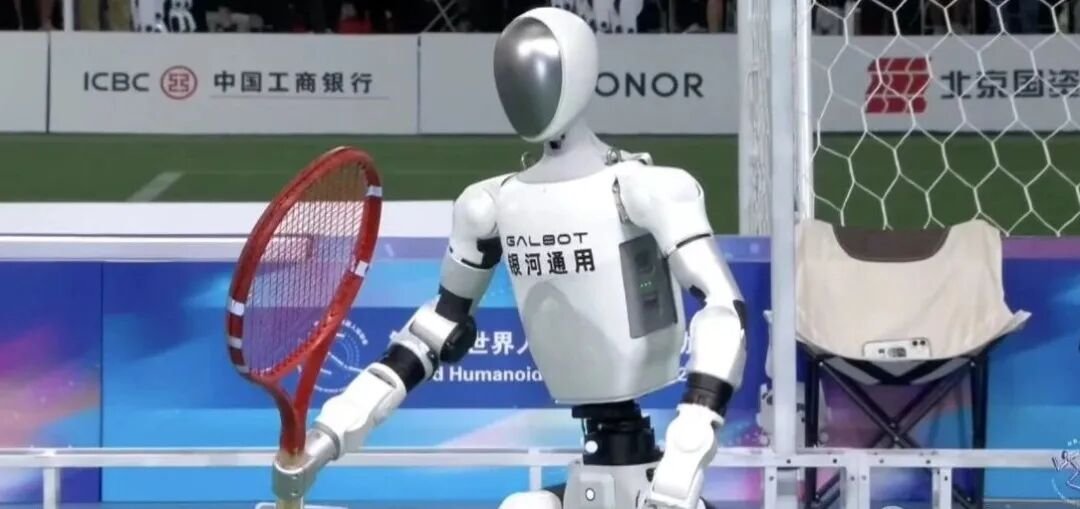
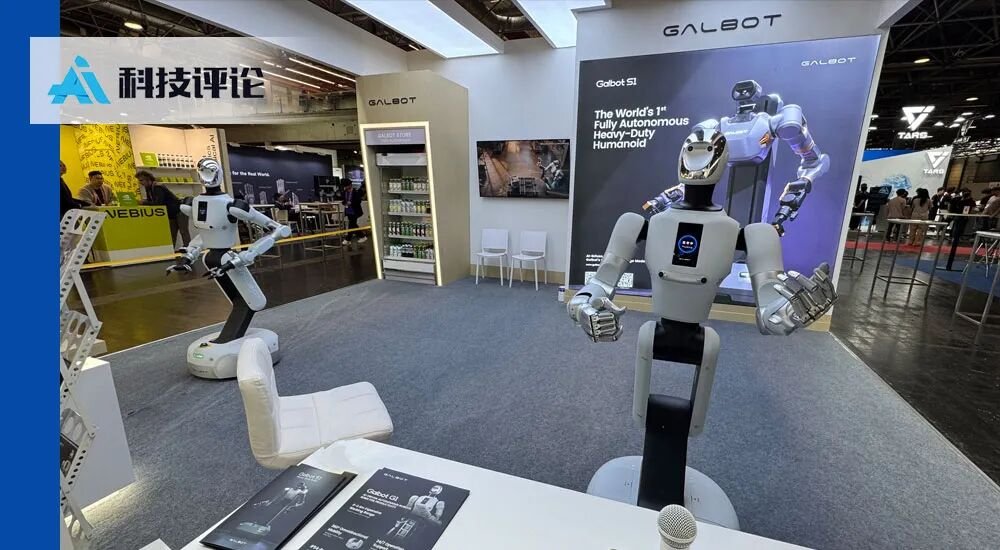
The full chain is now clear: AstraBrain thinks and moves, AstraBrain Latent extracts skill from broken data, Galaxy Workshop supplies the arena and opponents. Galbot says the paradigm, brain decision, cerebellum execution, emergent data, as one reusable system, is what the whole embodied-AI industry can copy. Its Galbot S1 arms already lift 50 kg of material on factory lines, and robots in smart pharmacies pick target items from tens of thousands of products. Tennis is just the newest tile it has lit up.
Editor’s note: This is an adapted translation of the original LeiFeng Net report. It has been trimmed and restructured for readability for an international business audience.