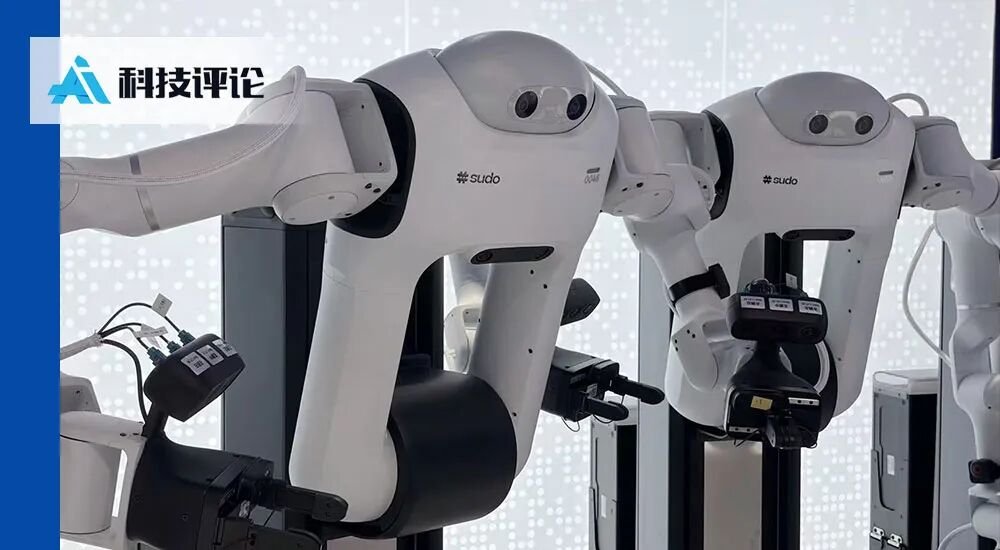
At WAIC 2026 the embodied-intelligence zone was again among the most crowded. Robots made coffee, took photos and danced. The SuDu Technology booth drew a crowd too, but the mood was different. A few robots stood quietly at workstations doing unglamorous things: picking items, wrapping an object with a cloth using both hands, inserting a part into its slot. The motions did not show off, but stability, success rate and generalisation were excellent.
This is not SuDu’s first headline. In April 2026 it first showed its full-stack self-developed embodied platform, #sudo R1. In a 60-minute demo the robot grabbed more than 100 previously unseen objects, including transparent glasses, reflective metal, soft cloth and irregular toys, at close to 100 per cent success. In June, at ICRA and CVPR, it showed the system globally for the first time, holding high grab success even with randomly placed items.
Founded only a year ago, SuDu already carries a RMB 20 billion valuation. The reason is not only market excitement about embodied intelligence but its team. Founder Su Hao is the most watched figure: a distinguished Haoqing professor at Fudan and founding dean of the Institute for General Physical Intelligence, he created ShapeNet and PointNet, foundational work in 3D vision, and pushed the SAPIEN and ManiSkill robot-simulation platforms. His Google Scholar citations exceed 150,000.
Three months from one skill to ten-plus
At WAIC, SuDu showed more than ten skills at once, from precise placement and soft-object manipulation to two-hand collaboration, mobile grasping and autonomous navigation, spanning home scenarios to industrial lines and single-arm to multi-robot coordination. The leap itself drew attention.
SuDu’s R&D vice president and hardware lead Chen Runze described the robot’s basic capability unit as an “atomic capability.” The idea is that future capability growth should not depend on engineers retraining for every task, but accumulate basic abilities like humans do. Su Hao, in his 17 July WAIC keynote, said physical intelligence lacks not more isolated task demos but “aggregating scattered knowledge” into systematic understanding of the physical world. The layer closest to manipulation is hardest to observe. Knowing what to do and the hand actually being able to do it are two different things.
SuDu wants a similar accumulation system: start from atomic capabilities, combine into complex skills, and finally support long-horizon tasks. A gift-box wrapping task looks like one flow but splits into recognition, grasping, pose adjustment, fine placement, two-hand coordination and contact control, capabilities that also transfer to assembly, tidying and handling.
Capabilities combine like building blocks, experience accumulates in simulation
The hardest problem is data. Language-model capability grew on the internet’s existing text. Robots face a continuously changing physical world where a simple grasp hides object mass, friction, contact state, trajectory and environment constraints.
SuDu chose an unusual route: let robots accumulate experience in simulation first. Sim-to-real has long been robotics’ core difficulty because real-world uncertainty is hard to model fully. Su Hao, with a Stanford CS PhD and a UCSD professorship, built ShapeNet, PointNet, SAPIEN and ManiSkill to make digital learning closer to real physics. SuDu rebuilt its own robot-learning data-production system that now generates million-scale data daily.
It uses a “simulation training plus real-world assist” hybrid: large-scale simulation builds base capability. fine real-world data lifts reliability and adaptation. Atomic skills practised and verified fast in simulation recombine like blocks into new tasks, the reason SuDu expanded skills so quickly.
Hardware as the algorithm’s extension
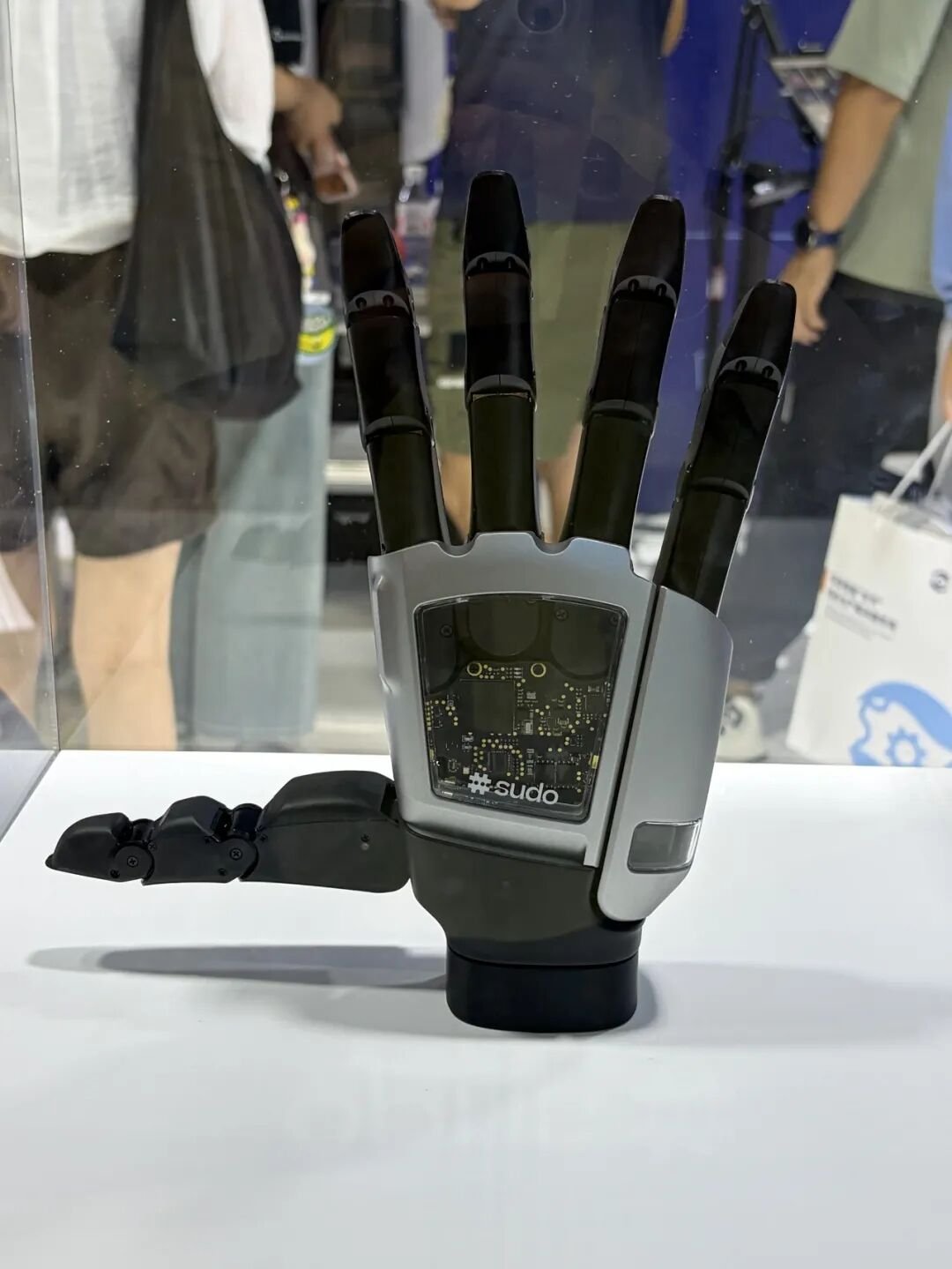
In a corner of the booth sat a self-developed dexterous hand: a 22-degree-of-freedom direct-drive hand, with thumb and pinky at five DOF each and the other three fingers at four. Against traditional grippers it aims closer to the human hand in complex tasks. SuDu added a nail-like structure at the fingertip so the robot can perform fine tasks like pinching a thin needle or popping a can tab, which soft fingertips struggle with. It chose direct drive, acting on the joint without a reducer, giving the control model a more direct, force-controllable response.
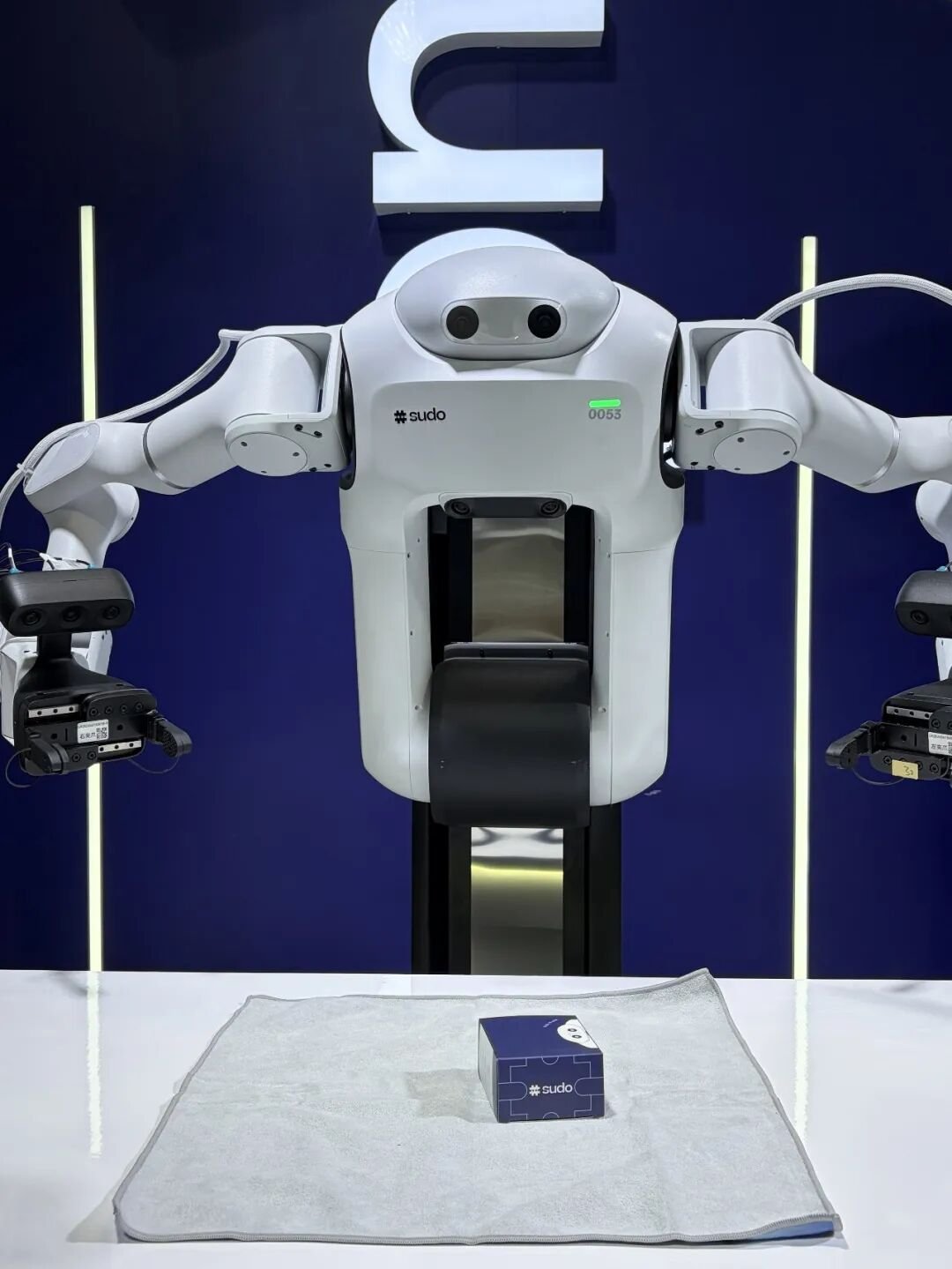
Hardware and software must iterate together. When a model fails a task it may need a control change, which may in turn change mechanical design. SuDu insists on “white-boxing” so every link is understandable and tunable, and keeps the body, data, model training and deployment under its own control.
Fast industrial landing behind 99 per cent-plus reliability
In the industrial zone, SuDu’s battery-assembly robot with CATL ran live: four robots across stations collaboratively assembling lithium battery modules, a validated scheme with grab success above 99.5 per cent. Retail and food-service pilots are also moving. Chen Runze said the gap from 90 per cent to 99 per cent reliability “is a whole universe,” because one failure on a line can mean stoppage and rework. SuDu treats real deployment as part of model training, feeding new failures back into the loop.
SuDu targets 100-unit delivery in 2027 and 1,000-unit scale in 2028. More than the numbers, its leaders care whether capability replicates with deployment: if every new customer needs fresh data, retraining and rebuilds, scale stays project-based. Only when one base capability migrates fast across scenes does the industry enter a truly replicable stage.
The competition is entering a capability-growth era
SuDu’s first domestic public exhibition reads like a statement: if a robot holds a set of transferable, combinable base capabilities, can it gain complex ability by stacking, and reach generalisation? Its route uses a virtual-real data system for generalisation, software-hardware coordination to shorten iteration, and real scenes to test boundaries. The consensus has not converged, but what may decide a robotics firm’s competitiveness is no longer how many demos it showed today, but whether it can still gain new capability at the same speed six months out, and whether those capabilities stably enter the real world a year out.
Editor’s note: This is an adapted translation of the original Leiphone report. It has been trimmed and restructured for readability for an international business audience. The full original (in Chinese) is at https://www.leiphone.com/category/ai/7NBqAPnPNa3p2OD4.html.
Translated and adapted from Leiphone (https://www.leiphone.com/category/ai/7NBqAPnPNa3p2OD4.html).