In the first half of 2026, China’s car market moved through pressure and change at once. Domestic passenger-car registrations fell about 20 per cent year on year, even as close to 500 new models launched. With supply and demand out of step, a new car’s hot-selling window shrank sharply, and the average industry profit margin was squeezed to 1.5 per cent. Selling one 200,000 yuan car left the maker only about 3,000 yuan, what Qin Lihong, NIO’s co-founder and president, called ‘a porter in the industrial world’.

The market structure is splitting. In May 2026, battery-electric vehicles became the largest powertrain form in China’s passenger market for the first time, above 40 per cent share. In the large five-seat SUV segment, the BEV to range-extender sales ratio reversed from 1 to 23 in the first quarter of 2025 to 8 to 1 in June 2026. The range-extender route, once sold as freedom from range anxiety, is in pain.
NIO is a useful case. In July the company, counting NIO, Onvo and Firefly, delivered nearly 36,000 vehicles, up 71 per cent year on year. Brand transaction prices held high: NIO at 443,000 yuan, Onvo at 245,000 yuan, Firefly at 120,000 yuan. In the first half NIO sold 10,232 vehicles in Beijing, close to BMW’s roughly 11,000, and Qin expects to pass one of the German premium trio there this year.
On the ‘sales-only’ obsession, Qin argued a car firm is a business and what matters is revenue and margin. The whole-industry average margin was 1.5 per cent in the first half. NIO held its prices and avoided the disorderly price war. Onvo’s average price of 245,000 yuan sits just 10,000 below Audi’s roughly 250,000, above Cadillac and Volvo.
Why pure electric is winning, especially in large SUVs: a 900V platform frees space for a front trunk that range-extenders, weighed down by engine, exhaust and fuel tank, cannot match. Public charging points in 2025 were more than five times the 2020 level, and NIO’s swap network changed the refill experience. Running cost runs as high as eight to one in favour of electricity over fuel. And most range-extender owners actually charge daily anyway.
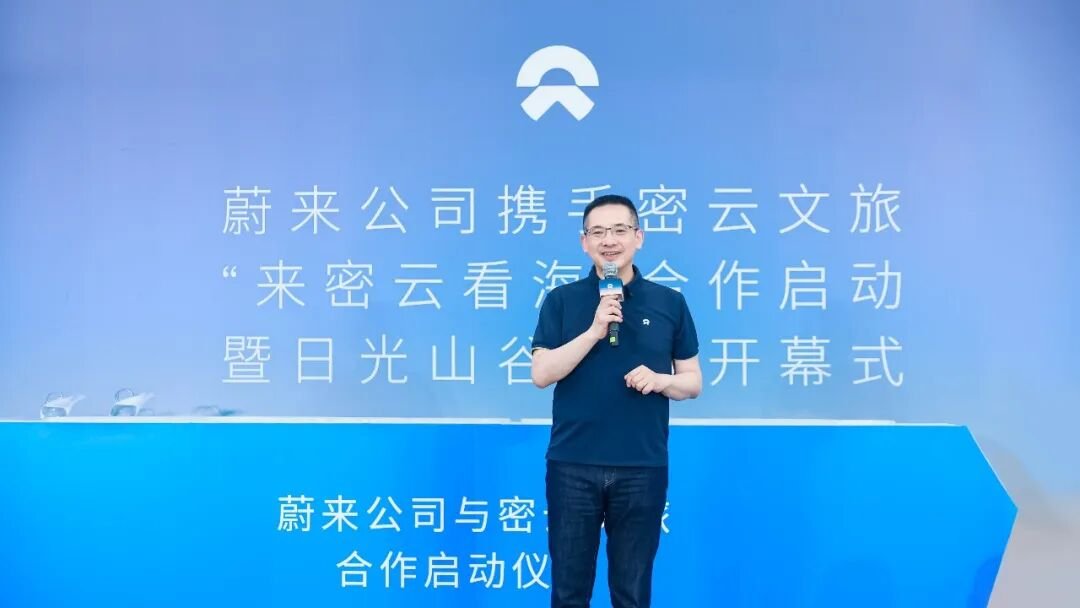
On the ‘Tesla, Li Auto, Xiaomi, Onvo’ label for the 200,000 to 300,000 yuan family market, Qin said the pure-electric shift there is already here. From May, BEV became the top powertrain in the whole market above 40 per cent, and he expects pure electric to pass 50 per cent of new-car sales in roughly a year. China’s vehicle exports rose more than 50 per cent in the first half, with one in three cars built shipped overseas.
NIO has beaten the German premium trio in 41 cities and regions, including Shanghai, Hefei and Haikou. Qin frames this as two trends: new energy replacing fuel, and Chinese-brand confidence rising across every price band. ES8 reached 130,000 deliveries 305 days after launch at a 400,000-plus yuan average price; ES9 passed 10,000 in its first 30 days.
On quality, Qin pointed to NIO’s 2019 battery recall of roughly 4,000 to 5,000 delivered cars at about 700 million yuan cost, cleared in under 20 days through the swap network, and a larger but minor ES6 recall in the first half of 2026. His line: recall is not shameful, it is responsibility. The real moat, he said, is system capability, from chips and operating systems to batteries, manufacturing, supply chain, service and the used-car business, with the swap network growing harder to copy as cars converge.
Image gallery

Editor’s note: This is an adapted translation of the original Leiphone (Lingxiang Wang) report. It has been trimmed and restructured for readability for an international business audience. The full original (in Chinese) is at https://www.leiphone.com/latest/index/id/4762.
Translated and adapted from Leiphone (Lingxiang Wang) (https://www.leiphone.com/latest/index/id/4762).