Hangzhou-based Xieyue Intelligent, or Leap Intelligence, has closed a nine-figure angel-plus round, with Linear Capital, Junshan Capital, Hongyi Capital and Hidden Hill Capital participating. The money will fund embodied foundation-model training, compute and data infrastructure, team expansion, and home-robot hardware development with scenario validation.
It is the company’s second round within seven months of founding. Its angel round was led by Vision Plus Capital with Li Auto participating, completed in April. Media reports describe it as Li Auto’s first direct investment in an embodied intelligence project.
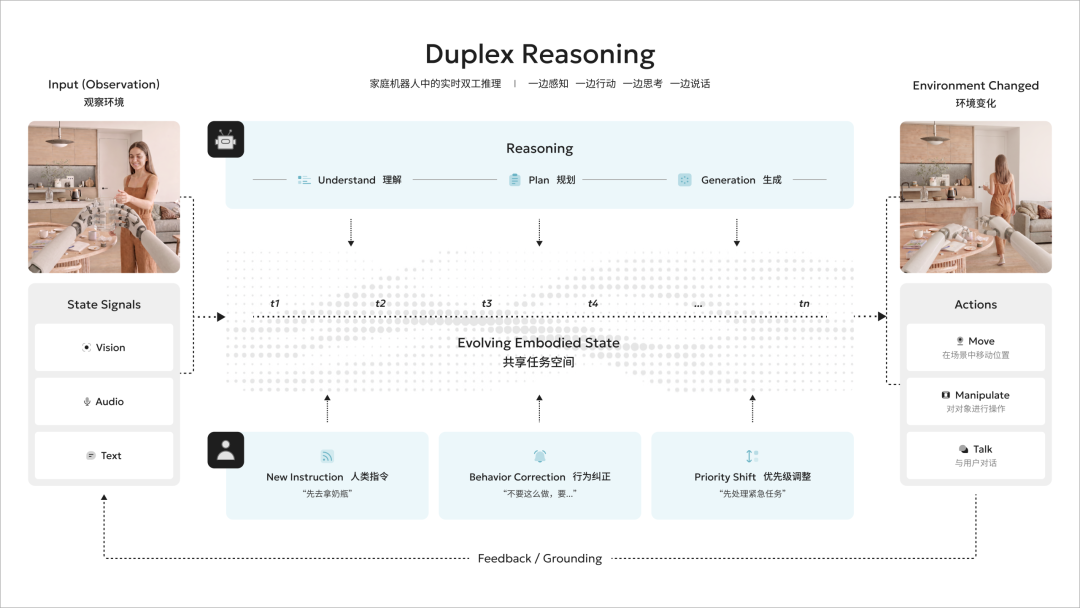
Leap Intelligence was founded in Hangzhou early this year by Chen Wei, formerly Li Auto’s chief AI scientist and head of its foundation-model division, and Zhang Xiao, formerly Li Auto’s product-line president. Chen is chairman and chief technology officer, Zhang is chief executive. The company takes the home as its first landing scenario and calls its model paradigm Duplex Reasoning, which requires the robot to keep a two-way channel with a person while perceiving, reasoning, planning and acting, so a conversation can be interrupted at any time and a goal can be adjusted mid-execution. That corresponds to three capabilities: interruptibility, correctability and takeover. The model uses a vision-language-action backbone with a world model layered on to predict the outcome of actions.
Chen says the company judges that embodied intelligence is won on data quality and systematic infrastructure, so it runs training infrastructure and data infrastructure in parallel, the first covering pre-training, post-training and reinforcement learning, the second covering signal sync, task design and labelling quality. Its first-person data capture hardware and data platform are in place, with a plan to run the full loop from capture to cleaning to labelling to training within the year.
On commercialisation the company’s cadence is validate first, then enter the home. It will test cross-space generalisation and task completion rates in semi-structured settings such as hotels and care homes before moving to households, prioritising high-frequency, long-horizon tasks such as laundry, tidying and cleaning. Its first product is expected in the first half of 2027. In household tasks, perception, understanding, planning, manipulation and interaction are tangled together, splitting the load between reasoning and physical work, which is why the home is being used to test general embodied intelligence. Whether validate-first then enter-the-home works will depend on how much cross-space generalisation holds up in real settings.
Editor’s note: This is an adapted translation of the original OFweek Robot report. It has been trimmed and restructured for readability for an international business audience.