At the 2026 China International Industry Fair, humanoids demoted pick-and-place on production lines while collaborative arms and dexterous hands handled fine grasping. Stable performance starts with joint selection, the first unavoidable step. Traditional selection stayed at “spec-matching”, aligning parameters against existing options. Nationz Technologies answered with “definition”, reshaping joint-control logic with a full chip family.
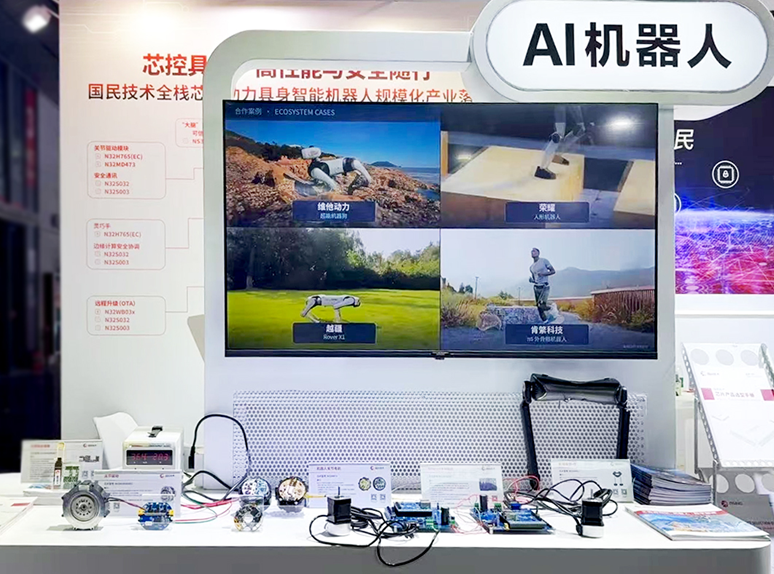
At the fair, Nationz’s stand centred on industrial energy and AI robots, showing joint solutions built on the N32H785EC, N32H765EC and a cost-effective N32H473 secondary servo joint, covering high, mid and low load scenarios, alongside battery-management, Bluetooth and security chips.
Joint selection runs on two dimensions: load grade and placement, and control layer. Main joints (shoulder, hip, knee, elbow) carry high load and demand compute and sync precision. Secondary servo joints (wrist, ankle, torso) are numerous and cost-sensitive. Dexterous-hand micro-joints are many, small and power-sensitive, needing distributed control.
The control layers are single-joint servo (field-oriented closed loop) and a multi-axis sync master, the “motion cerebellum”. Selection is essentially matching joint type, control layer and energy efficiency.
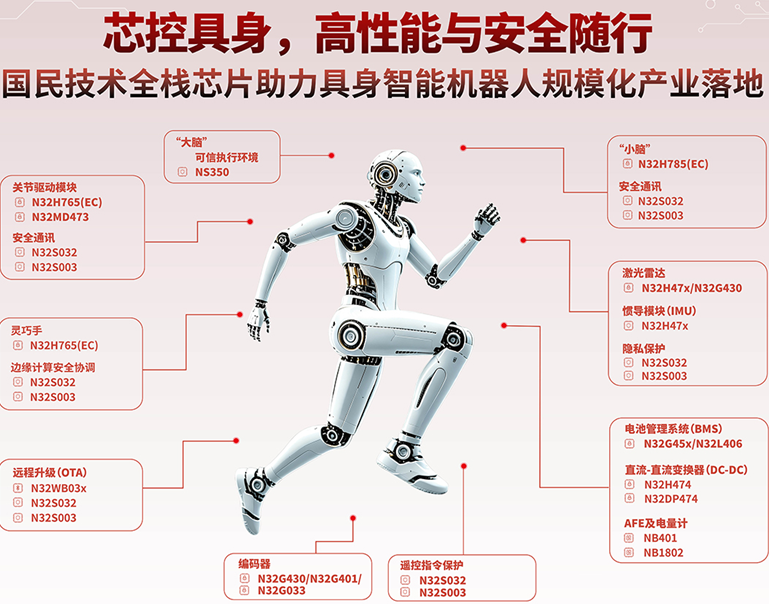
Nationz maps this across three tiers. The N32H785EC and N32H765EC serve main joints and the motion cerebellum, using a dual-core M7 at 600 MHz plus M4 at 300 MHz, dual-port EtherCAT and hardware CORDIC and FMAC accelerators for multi-axis sync. The N32H473 and N32MC471 serve cost-effective secondary servos with single-chip field-oriented control to cut bill-of-materials cost. Dexterous hands use a distributed multi-chip layout with 3 by 3 mm packages that shrink finger modules.
For European buyers the supporting ecosystem matters. Nationz builds its hardware trust root to meet EU Cyber Resilience Act component-security requirements, with chips certified to Common Criteria EAL4 plus and EAL5 plus and national cryptographic standards, covering secure boot, key isolation and safe over-the-air updates, aligned to both China’s GB/T 45502 and the EU CRA.
The throughline is that joint selection is shifting from copying specifications to defining architecture, and the chips doing it are now built to clear both Chinese and European security bars.
Editor’s note: This is an adapted translation of the original OFweek report. It has been trimmed and restructured for readability for an international business audience. The full original (in Chinese) is at https://robot.ofweek.com/2026-10/ART-8321202-8120-30707414.html.