UBTech has signed a strategic cooperation memorandum with the international relations office of the Ras Al Khaimah government in the United Arab Emirates. The framework covers humanoid research, real-world testing and system deployment, with an explicit focus on adapting the technology to Gulf conditions.
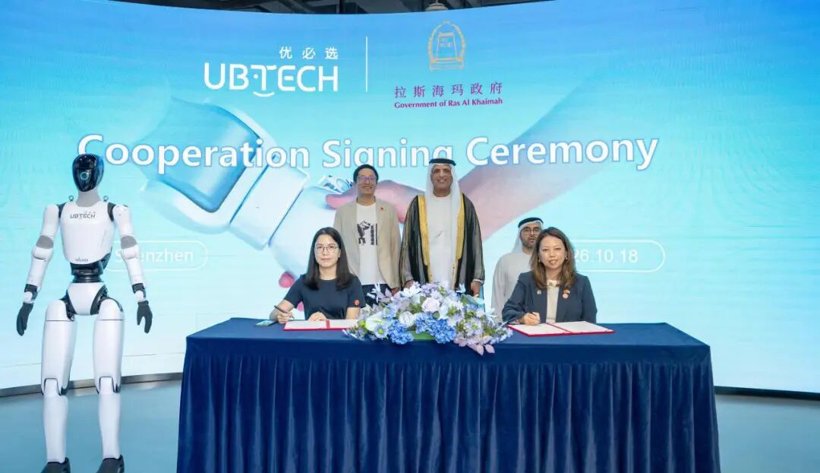
Under the plan UBTech will deploy humanoid products in the emirate and station engineering teams there to run live demonstration projects, stress-testing its automation stack in daily operations and in conditions that are unforgiving by design.
Four scenarios first
The first phase concentrates on industrial automated assembly, smart public services, AI-enabled elder care, and tourism and culture. Ras Al Khaimah will provide sandbox testing conditions and a forward-looking regulatory framework. UBTech supplies the platform, the technical infrastructure and the development capacity.
The emirate is also being positioned as a regional base for validating how humanoid systems perform across the UAE and the wider Gulf. Its climate does real work in that argument: sustained heat, hard sunlight and sand are the three conditions most likely to degrade sensors, seals and thermal margins over a long duty cycle.
The Gulf is already crowded
The Middle East has become one of the preferred destinations for Chinese embodied robotics exports. Unitree began working with the Saudi company QSS in 2023, and its industrial quadrupeds have been used for high-temperature inspection at Adnoc, the Abu Dhabi National Oil Company. AgiBot has built a Middle East team and is exploring work with government bodies and industrial partners in the UAE, Saudi Arabia, Qatar and Turkey.
UBTech’s own Gulf exposure predates this memorandum. In August 2025 it signed a USD 1 billion strategic cooperation agreement with Infini Capital, a long-horizon Middle East fund, with plans for a joint venture, a super factory and a research centre in the region.
Trade data supports the direction. Chinese customs figures show humanoid robot exports up 210 per cent year on year in the first quarter of 2026, with Europe, South East Asia and the Middle East as the main destinations.
What Shenzhen gets out of it
A memorandum with a government office is not revenue. What it buys UBTech is a regulatory sandbox and a set of environmental conditions that cannot be reproduced in a Shenzhen showroom or a Chinese factory floor. For a company whose home market is now full of subsidised demonstration projects, field data from a harsh climate is a scarcer asset than another domestic pilot.
The commercial logic runs the other way too. Gulf governments are buying industrial diversification and want the assembly, service and training work to happen locally. That means Chinese robot makers will increasingly be asked to trade technology transfer for access, which is a different negotiation from shipping boxes.
Editor’s note: This is an adapted translation of the original Gasgoo report. It has been trimmed and restructured for readability for an international business audience. The full original (in Chinese) is at https://www.gasgoo.com/apps/e060bad9eca91db7f01403fc7120041f/robot/news/70475409-%E8%90%BD%E5%AD%90%E9%98%BF%E8%81%94%E9%85%8B%E6%8B%89%E6%96%AF%E6%B5%B7%E7%8E%9B-%E4%BC%98%E5%BF%85%E9%80%89%E5%87%BA%E6%B5%B7%E5%86%8D%E4%B8%8B%E4%B8%80%E5%9F%8E/.