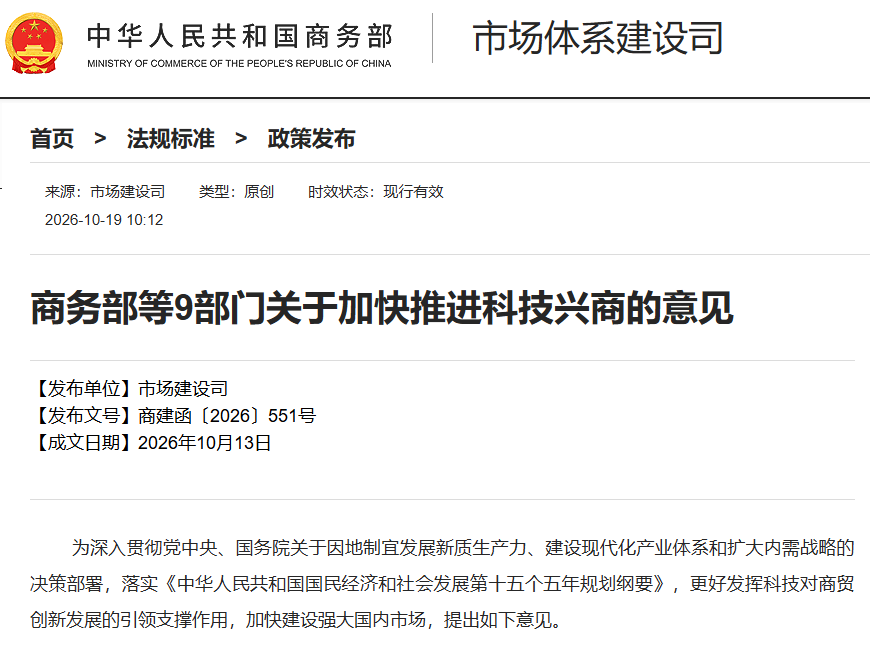
On 19 October the Ministry of Commerce published a joint opinion from nine ministries on accelerating technology-driven commerce. The document is dated 13 October, runs to eighteen measures, and carries the reference Shang Jian Han 2026 number 551.
This is not a single-ministry circular. Commerce, the Cyberspace Administration, the National Development and Reform Commission, the Ministry of Industry and Information Technology and the Ministry of Finance are among the nine signatories. The level of the document matters as much as its content.
One clause stops the reader. It calls for pushing embodied AI technology into commercial settings, extending into home services and trade logistics. The next calls for cultivating new intelligent service formats including robots and virtual digital-human companions. The next again calls for enriching the supply of smart goods spanning phones, computers, home devices, wearables and robots.
In a single document, robots moved onto the shelf as goods and services rather than onto the line as tooling and workstations.
Three ministries, three languages
Taken alone the document is not explosive. Stretched across the year, the shift is visible.
In June, the industry ministry and the state asset regulator launched a live-scenario training programme with a clear focus: robots into factories, into production lines, into high-risk sites. The problem being solved was substitution of labour.
In September, the NDRC said it would guard against blind herd behaviour in the robot industry and stressed real demand.
In October, nine ministries wrote embodied AI into the consumption framework: upgrading goods consumption, expanding services consumption, improving circulation efficiency, integrating scenarios.
This is not policy conflict. It is a change of narrative track, from industrial substitution to service consumption.
From saving money to selling things
Industrial policy anchors valuation to labour cost substitution. A robot enters a plant, saves a number of workers, pays back in a number of years. It is a clean business-to-business calculation with a clear ceiling: factory budgets are finite, procurement cycles are long, and the customer cares about return on investment rather than how impressive the technology looks.
Consumption policy anchors to consumer stock-keeping units. How many kinds of goods and services can a robot carry, how many new consumption scenarios can it create. Domestic help, elder care, education, culture and tourism, retail: each is an independent category with independent pricing power and its own repeat-purchase logic.
Western markets are already testing this path. 1X’s Neo was named to Time magazine’s best inventions of 2026 at $20,000 a unit, positioned as a household helper that fetches objects, clears surfaces, folds laundry and loads the dishwasher. Time’s framing was pointed: the first humanoid robot broadly sold for the home, a consumer product rather than an industrial system.
China is running the same direction. Westlake Robotics’ WR1 leads on autonomous full-body laundry folding, 36 seconds per item at a 100 per cent success rate, demonstrated in kitchens and bedrooms rather than on a factory floor. Folding clothes is not valuable in itself. A machine that folds clothes is.

Why the hardware bill is the hinge
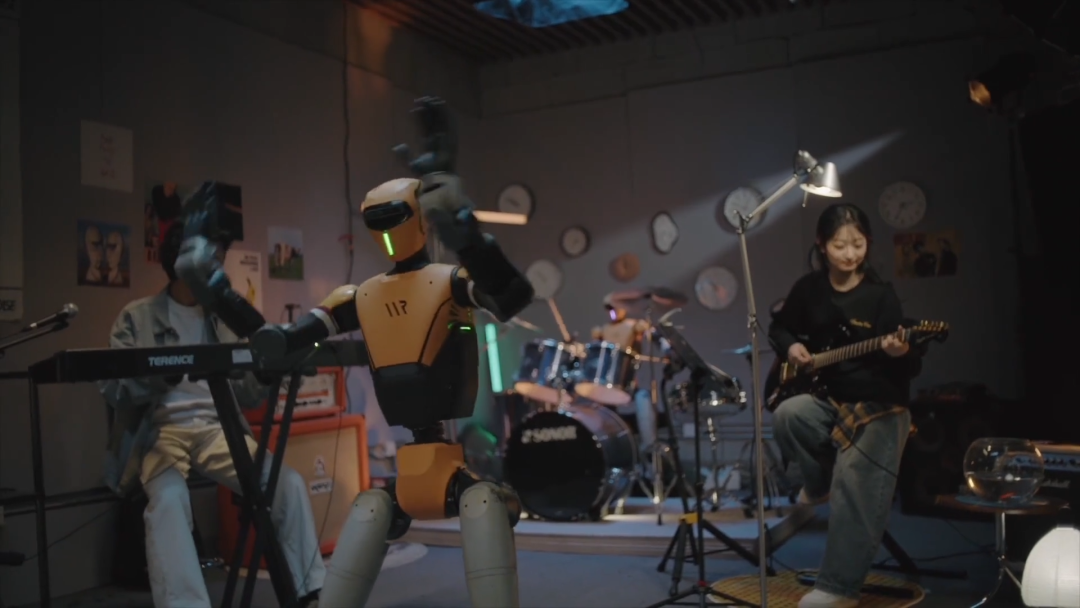
Both examples point to the same threshold. Once hardware cost falls to the ten-thousand-yuan class and generalisation in home scenarios starts to work, the commercial logic flips from how much labour cost is displaced to how many consumer categories are created. The first is a zero-sum game over existing spend. The second creates new spend.
Capital markets have begun pricing the switch. Over the past year first-order valuation anchors sat on unit shipments and industrial deployments. In recent months financing heat around home service robots has risen. Huatai Securities is direct: the AI companion robot industry is moving toward commercial validation, and shipments will be the near-term catalyst. Consumer robot pricing has already fallen to the RMB 2,000 to RMB 4,000 band, with ten-thousand-yuan class units being delivered.
The secondary market transmission is subtler. Industrial robot equities are priced on orders and capacity. Consumer robot equities are priced on user lifetime value and scenario penetration. Those two logics carry different multiples, price-to-earnings for the first and price-to-sales with user counts for the second.
The nine-ministry document is, in effect, national policy backing for the second valuation logic.
The industrial substitution story ran for three years and asked how much money a robot could save a factory. The consumption story has barely started and asks how many new kinds of consumption a robot can create for a household. Efficiency has a ceiling. Demand does not.
Editor’s note: This is an adapted translation of the original OFweek report. It has been trimmed and restructured for readability for an international business audience. The full original (in Chinese) is at https://robot.m.ofweek.com/2026-10/ART-8321206-8480-30707847.html.